Tests included 8 parameters listed
Explore the tests in Smokers Panel - Basic by category.
Cardiac Risk Markers 5 APO B / APO A1 RATIO (APO B/A1) APOLIPOPROTEIN - A1 (APO-A1) APOLIPOPROTEIN - B (APO-B) HIGH SENSITIVITY C-REACTIVE PROTEIN (HS-CRP) Lipoprotein (a) [Lp(a)]
Diabetes 2 AVERAGE BLOOD GLUCOSE (ABG) HbA1c
Drugs 1
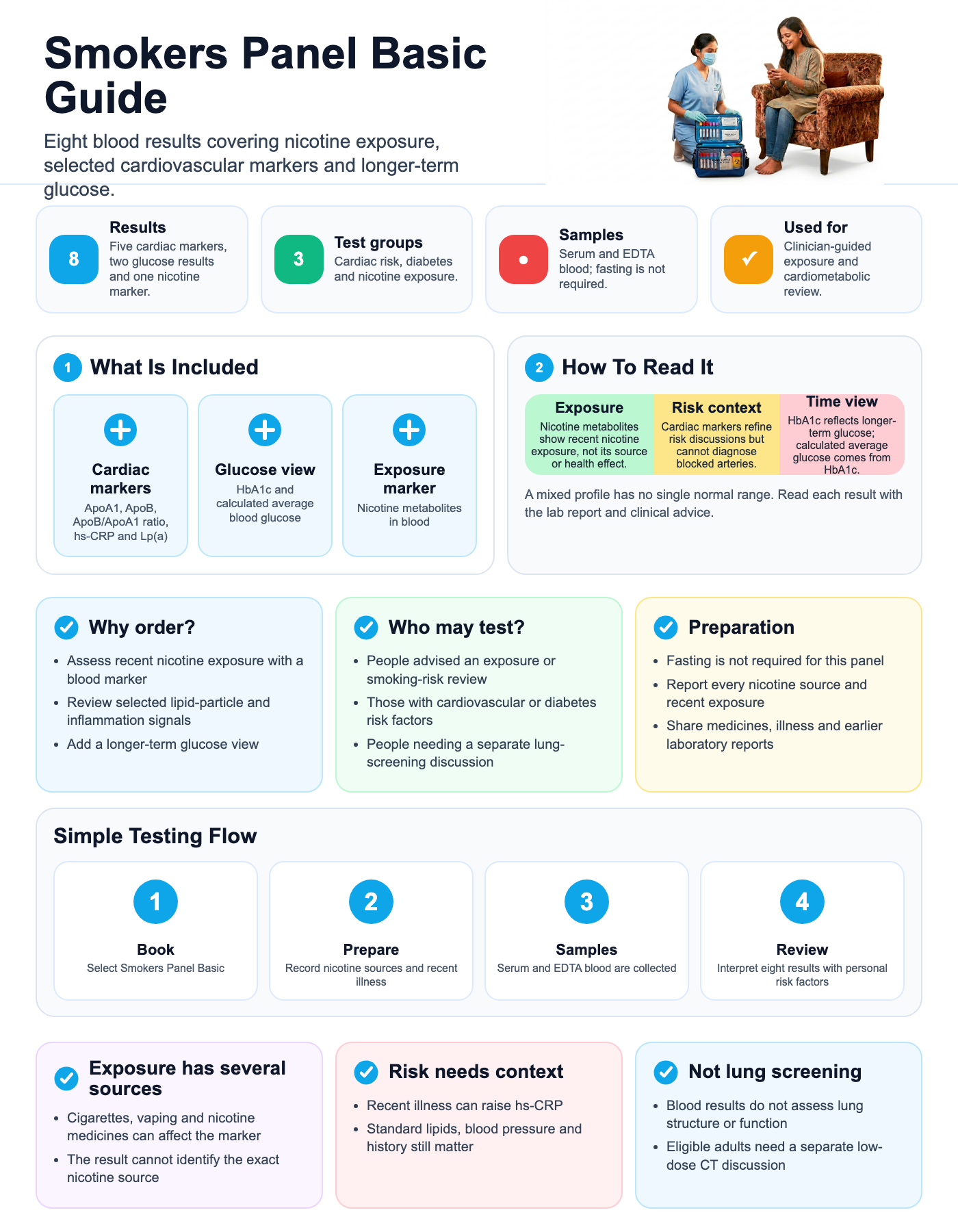
Profile visual guide View larger ↗
Tap the guide to enlarge it and read every detail.
Pinch with two fingers to zoom. Swipe to explore, or use + and −.
Smokers Panel Basic Reference Guide
This panel combines eight blood results from three distinct clinical areas. Nicotine metabolites indicate recent exposure but cannot show the source or health damage. Five cardiac markers add lipid-particle, inherited-risk and inflammation context. HbA1c and calculated average glucose describe the same longer-term glucose pattern. The panel does not examine lungs, diagnose cardiovascular disease or replace lung-cancer screening.
Why This Test Is Ordered
Understand the nicotine-metabolite result Cotinine is a major nicotine metabolite commonly used to assess recent exposure. Its longer persistence makes it more practical than nicotine for exposure assessment. Blood cotinine can reflect cigarettes, bidis, cigars, vaping or smokeless tobacco. Nicotine gum, patches, lozenges and other medicines can also affect the result. Secondhand smoke may produce detectable cotinine without active tobacco use. The value cannot reliably identify which nicotine source produced the exposure. Exposure timing, frequency and metabolism influence how the result should be read. A nicotine-metabolite result does not measure lung, heart or blood-vessel damage. Read ApoB as a particle-burden marker ApoB is carried by lipoprotein particles that can contribute to artery plaque. Each atherogenic particle generally carries one major ApoB protein molecule. ApoB therefore adds particle-number context beyond cholesterol concentration alone. It may be useful when triglycerides, diabetes or metabolic risk complicate lipid interpretation. ApoB should still be reviewed beside LDL cholesterol and the standard lipid profile. Blood pressure, smoking history, diabetes and age remain essential risk information. One ApoB result cannot confirm plaque, narrowing or a future heart attack. Treatment decisions require overall cardiovascular risk and a clinician-led plan. Place ApoA1 and the ratio in context ApoA1 is the main protein associated with high-density lipoprotein particles. The ApoB-to-ApoA1 ratio compares atherogenic particles with an HDL-associated protein. A higher ratio has been associated with greater coronary heart-disease risk. The ratio is calculated from ApoB and ApoA1 rather than measured independently. Always inspect both component values before interpreting a changed ratio. A normal ratio does not cancel the cardiovascular effects of smoking. The ratio does not replace standard cholesterol testing or clinical risk calculation. Compare repeat results only when units and laboratory methods remain compatible. Recognise the inherited Lp(a) signal Lipoprotein(a), called Lp(a), is a cholesterol-carrying particle in the blood. Its concentration is strongly influenced by inherited genetic variation. A high Lp(a) level can increase heart and blood-vessel disease risk. Raised Lp(a) may matter even when routine cholesterol values appear acceptable. Family history of premature cardiovascular disease strengthens the reason for review. Lp(a) units and assay methods can differ, so conversions are unreliable. Use the laboratory interval and units printed on the current report. An Lp(a) result cannot show whether an artery is already narrowed. Use hs-CRP as careful risk context High-sensitivity CRP measures very small amounts of C-reactive protein in blood. It can contribute inflammation context during selected cardiovascular risk assessments. Hs-CRP does not identify the location or cause of inflammation. Infection, injury and inflammatory illness can temporarily raise the result. Recent symptoms should be considered before using hs-CRP for stable risk review. A clinician may repeat an unexpected value after temporary inflammation resolves. Hs-CRP should be interpreted beside lipids, blood pressure and medical history. The result cannot diagnose a heart attack or blocked coronary artery. Interpret HbA1c and average glucose together HbA1c reflects average blood glucose across approximately the previous three months. It is less affected by a single meal than a direct glucose measurement. Calculated average blood glucose is derived mathematically from the HbA1c result. These two rows are related and should not be counted as independent evidence. Neither result shows today’s glucose or brief highs and lows. Unexpected diagnostic-range HbA1c usually needs confirmation unless clear symptoms are present. Anaemia, altered red-cell survival and some haemoglobin variants can affect HbA1c. Review the glucose pattern separately from nicotine and cardiac-marker results.
Symptoms And Who Should Test
People reviewing recent nicotine exposure A clinician may request testing when recent nicotine exposure needs objective context. The result can complement an honest history of tobacco and nicotine use. It cannot prove whether exposure was intentional, occupational or secondhand. Nicotine replacement must be disclosed before interpreting an exposure result. Occasional use may produce a different pattern from frequent daily exposure. Individual metabolism and collection timing can also influence the measured value. Testing should support a defined clinical or occupational question. It should not be used to shame, label or diagnose a person. People with cardiovascular risk factors Smoking substantially changes cardiovascular risk beyond any single laboratory marker. High blood pressure, diabetes and abnormal lipids add further risk information. Age, family history and previous cardiovascular disease also shape interpretation. The five cardiac markers may refine selected parts of that wider assessment. This panel does not include a complete standard lipid profile. It also does not measure blood pressure, heart rhythm or artery narrowing. Chest pressure, breathlessness or sudden neurological symptoms need urgent assessment. Routine panel testing should never delay emergency care for acute symptoms. People with diabetes or metabolic risk HbA1c can support screening or monitoring discussions about longer-term glucose. Smoking and diabetes together increase concern about cardiovascular complications. High triglycerides or metabolic syndrome may make ApoB particularly informative. Calculated average glucose simply translates HbA1c into familiar glucose units. A normal HbA1c does not remove future diabetes risk. A diagnostic-range result may require confirmation and clinical review. Pregnancy and selected blood conditions can change the appropriate diabetes test. Personal targets after diabetes diagnosis must come from the treating clinician. People with premature heart disease in the family Inherited Lp(a) can help explain risk not captured by routine cholesterol alone. A family history of early heart attack or stroke deserves careful documentation. Relatives may share an inherited tendency toward higher Lp(a). The report should retain its original Lp(a) units for comparison. ApoB and the ApoB-to-ApoA1 ratio add different particle-related information. Normal results cannot erase smoking exposure or a strong family history. Preventive decisions still consider age, blood pressure, diabetes and standard lipids. A clinician can decide whether relatives or additional markers need testing. People considering lung-cancer screening This blood panel is not a lung-cancer screening examination. It cannot find a lung nodule, tumour or early structural lung change. Evidence-based screening for eligible high-risk adults uses low-dose computed tomography. Eligibility depends on age, cumulative smoking exposure and time since quitting. Screening recommendations vary by country and individual health status. A clinician should confirm eligibility, benefits, limitations and possible follow-up. Persistent cough, coughing blood or unexplained weight loss needs clinical assessment. Symptoms require evaluation even when every blood result appears within range.
Preparation And Interpretation Notes
Follow the panel collection instructions Fasting is not required for the eight results listed in this panel. Follow stricter instructions when another booked test specifically requires fasting. The booking uses serum and EDTA blood samples for different test groups. A trained professional collects blood from a vein using labelled tubes. Normal hydration is reasonable unless a clinician gives different instructions. Do not prolong fasting or overdrink water to influence the results. Mention previous fainting, difficult draws or blood-thinning medicines. Minor tenderness or bruising can follow routine venous collection. List every nicotine and tobacco source Report cigarettes, bidis, cigars, hookah, vaping and smokeless tobacco. Include nicotine gum, patches, lozenges, sprays and prescribed nicotine products. Mention secondhand smoke exposure at home, work or social settings. Record the last use or exposure time as accurately as possible. Do not change usual nicotine use unless the requester gives specific instructions. Stopping briefly before collection may not remove a metabolite already present. The laboratory result cannot identify the exact product or exposure route. Share the testing purpose so the result answers the intended question. Report illness before hs-CRP interpretation Tell the reviewer about fever, infection, injury or inflammatory symptoms. Recent surgery or another acute illness can also influence inflammatory markers. An elevated hs-CRP cannot show where inflammation is occurring. Stable cardiovascular risk interpretation may require recovery before repeat testing. Do not assume a raised value means heart disease or smoking damage. Do not assume a low value makes continued smoking safe. Share anti-inflammatory medicines and other relevant treatment changes. Urgent symptoms need clinical assessment rather than waiting for a repeat marker. Flag factors that can affect HbA1c Report anaemia, recent bleeding, transfusion or treatment affecting red blood cells. Mention known haemoglobin variants, kidney failure or significant liver disease. Pregnancy changes how clinicians select and interpret diabetes tests. HbA1c does not capture rapid glucose changes over several hours. Calculated average glucose inherits the same limitations as the HbA1c result. Bring direct glucose readings when they do not match symptoms or HbA1c. Do not alter diabetes medicines solely from an unreviewed panel result. A clinician can select confirmation testing when results and history disagree. Review the whole cardiovascular picture Use the exact units and reference intervals printed by the laboratory. Compare ApoB and ApoA1 before relying on their calculated ratio. Keep Lp(a) values in their reported units when reviewing previous tests. Interpret hs-CRP only after considering recent inflammatory conditions. Add standard lipids, blood pressure and diabetes status when clinically indicated. Record smoking duration, daily amount and time since any quit attempt. Normal panel values do not exclude cardiovascular or smoking-related disease. The strongest preventive step for a person who smokes is supported cessation care.
Frequently Asked Questions
What does Smokers Panel Basic include?
It includes eight blood results covering nicotine exposure, selected cardiac markers and HbA1c-derived glucose.
Is fasting required for Smokers Panel Basic?
No; fasting is not required unless another booked test needs it.
Can nicotine replacement affect the result?
Yes; nicotine gum, patches, lozenges and similar products can affect nicotine metabolites.
Can secondhand smoke affect nicotine metabolites?
Yes; secondhand exposure can produce detectable cotinine in blood.
Does this panel test lung function?
No; it contains blood markers and does not measure breathing or lung structure.
Is this panel a lung-cancer screening test?
No; eligible high-risk adults should discuss low-dose CT screening with a clinician.
Can a normal panel make smoking safe?
No; normal blood results do not remove the established harms of smoking.
Why are HbA1c and average glucose both listed?
Average glucose is calculated from HbA1c, so both describe one longer-term glucose pattern.
Can recent infection affect hs-CRP?
Yes; infection or inflammation can raise hs-CRP and complicate cardiac-risk interpretation.
Can I book home collection?
Home collection is available where the entered address is serviceable.
Who should review this panel?
A clinician should review it with nicotine exposure, symptoms and cardiovascular risk factors.