Choose your City

View more

Food intolerance test in Mumbai, which includes 218 tests, designed to identify specific food allergies & immune system reactions that impact the functioning organs.

Food Intolerance Test price in Mumbai 2025

Food intolerance test in Mumbai, which includes 218 tests, designed to identify specific food allergies & immune system reactions that impact the functioning organs.

Food Intolerance Test Sample Report

Group Name
Fasting
Sample Type SERUM
Sample Collection Expert collect samples at Home
Reports Delivered Online within 24-48 Hrs*
Report type Email & Hardcopy ( On request )

Parameters Included in Food Intolerance Profile

What tests are included in the Food Intolerance Profile?


Cereals (18 Tests)

▾
  • Barley
  • Buckwheat
  • Corn (maize)
  • Couscous
  • Durum wheat
  • Flax seed
  • Gliadin
  • Malt
  • Millet
  • Oat
  • Polenta
  • Quinoa
  • Rice
  • Rye flour
  • Spelt
  • Transglutaminase
  • Wheat
  • Wheat bran

Dairy (9 Tests)

▾
  • Alpha-lactalbumin
  • Beta-lactoglobulin
  • Buffalo milk
  • Casein
  • Cows milk
  • Egg white
  • Egg yolk
  • Goat milk
  • Sheep milk

Fish (38 Tests)

▾
  • Alga espaguette
  • Alga spirulina
  • Alga wakame
  • Anchovy
  • Barnacle
  • Bass
  • Carp
  • Caviar
  • Clam
  • Cockle
  • Cod
  • Crab
  • Cuttlefish dorado
  • Eel
  • Haddock
  • Hake
  • Herring
  • Lobster
  • Mackerel
  • Monkfish
  • Mussel
  • Octopus
  • Oyster
  • Perch
  • Pike
  • Plaice
  • Razor clam
  • Salmon
  • Sardine
  • Scallop
  • Sea bream
  • Sole
  • Squid
  • Swordfish
  • Trout
  • Tuna
  • Turbot
  • Winkle

Food Intolerance (1 Test)

▾
  • Food intolerance profile

Fruits (38 Tests)

▾
  • Apple
  • Apricot
  • Avocado
  • Banana
  • Blackberry
  • Blackcurrant
  • Blueberry
  • Cherry
  • Cranberry
  • Date
  • Fig
  • Grape
  • Grapefruit
  • Guava
  • Kiwi
  • Lemon
  • Lime
  • Lychee
  • Mango
  • Melon (honeydew)
  • Mulberry
  • Nectarine
  • Olive
  • Orange
  • Papaya
  • Peach
  • Pear
  • Pineapple
  • Plum
  • Pomegranate
  • Raisin
  • Raspberry
  • Redcurrant
  • Rhubarb
  • Strawberry
  • Tangerine
  • Tomato
  • Watermelon

Meat (16 Tests)

▾
  • Beef
  • Billy goat
  • Box
  • Chiken
  • Duck
  • Horse
  • Lamb
  • Ostrich
  • Patridge
  • Pork
  • Quail
  • Rabbit
  • Turkey
  • Veal
  • Venison
  • Wild boar

Miscellaneous (17 Tests)

▾
  • Agar agar
  • Cane sugar
  • Carob
  • Chestnut
  • Cocoa bean
  • Coffee
  • Cola nut
  • Honey
  • Mushroom
  • Rapeseed
  • Sesame seed
  • Sunflower seed
  • Tapioca
  • Tea (black)
  • Tea (green)
  • Yeast (baker's)
  • Yeast (brewer's)

Nuts (11 Tests)

▾
  • Almond
  • Brazil nut
  • Cashew nut
  • Cocount
  • Hazelnut
  • Macadamia nut
  • Peanut
  • Pine nut
  • Pistachio
  • Tiger nut
  • Walnut

Spices (31 Tests)

▾
  • Aloe vera
  • Aniseed
  • Basil
  • Bay leaf
  • Camomile
  • Cayenne
  • Cinnamon
  • Clove
  • Coriander leaf
  • Cumin
  • Dill
  • Garlic
  • Ginger
  • Ginkgo
  • Ginseng
  • Hops
  • Liquorice
  • Marjoram
  • Mint
  • Mustard seed
  • Nettle
  • Nutmeg
  • Parsley
  • Peppermint
  • Red chilli
  • Rosemary
  • Saffron
  • Sage
  • Tarragon
  • Thyme
  • Vanilla

Vegetables (39 Tests)

▾
  • Amaranth
  • Artichoke
  • Asparagus
  • Aubergine
  • Bean (broad)
  • Bean (green)
  • Bean (red kidney)
  • Bean (white haricot)
  • Beetroot
  • Broccoli
  • Brussel sprout
  • Cabbage
  • Cabbage (red)
  • Caper
  • Carrot
  • Cauliflower
  • Celery
  • Chard
  • Chickpea
  • Chicory
  • Cucumber
  • Fennel (leaf)
  • Gourd (squash)
  • Leek
  • Lentil
  • Lettuce
  • Marrow
  • Onion
  • Pea
  • Potato
  • Radish
  • Rocket
  • Shallot
  • Soybean
  • Spinach
  • Sweet potato
  • Turnip
  • Watercress
  • Yuca
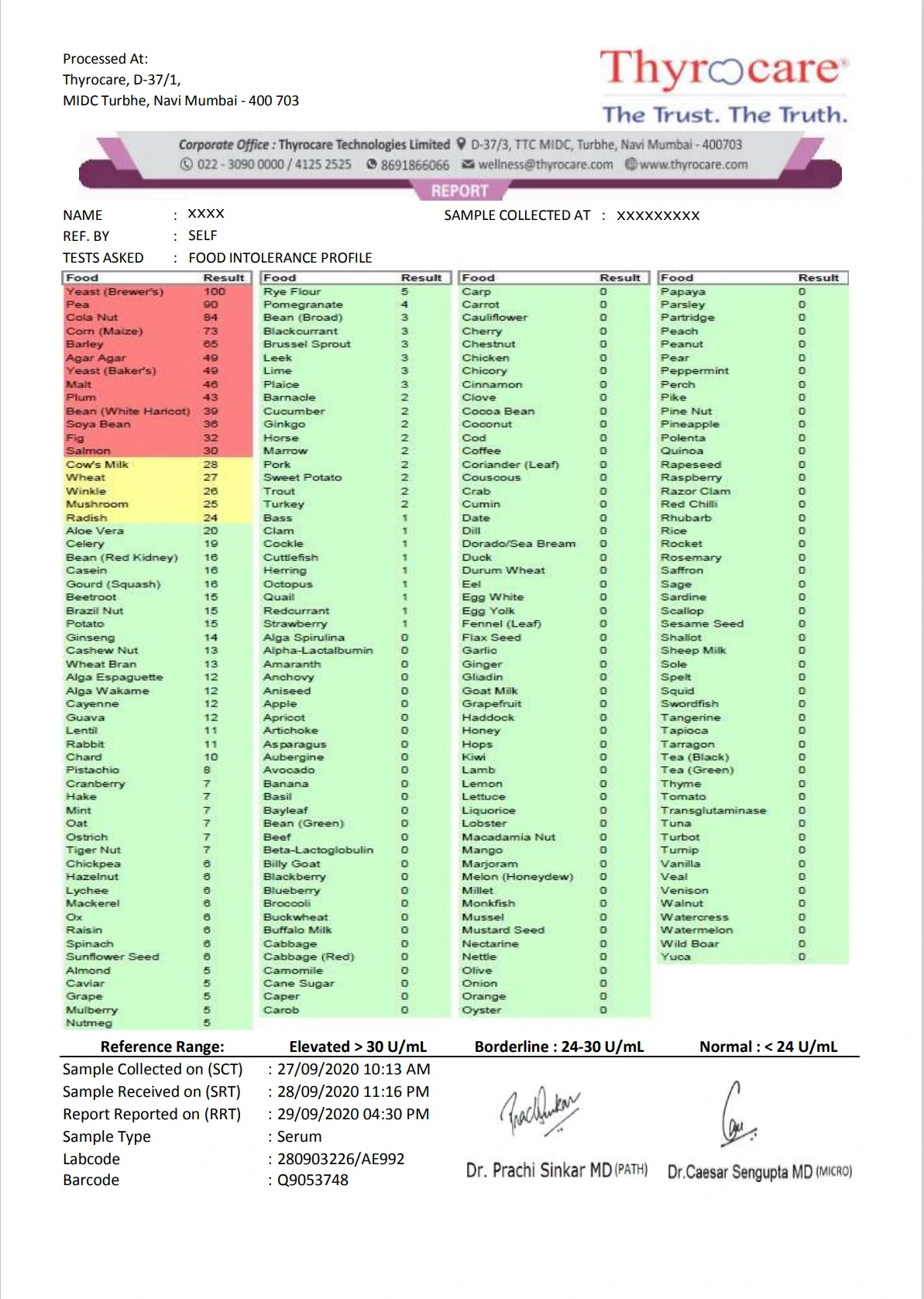
Food Intolerance Test Sample Report
Food Intolerance Profile Sample report & Ranges
Conducted at Thyrocare Labs
Lab Accreditation CAP, NABL, ICMR, NGSP, ISO
Method MicroArray
Technology ELISA
Supervision Dr. Prachi Sinkar MD (PATH), DR. Caesar Sengupta MD (MICRO)
Normal Range < 24 U/mL
Borderline Range 24-30 U/mL
Elevated Range > 30 U/mL
Results Highly Specific

How do I interpret the Food intolerance test results?

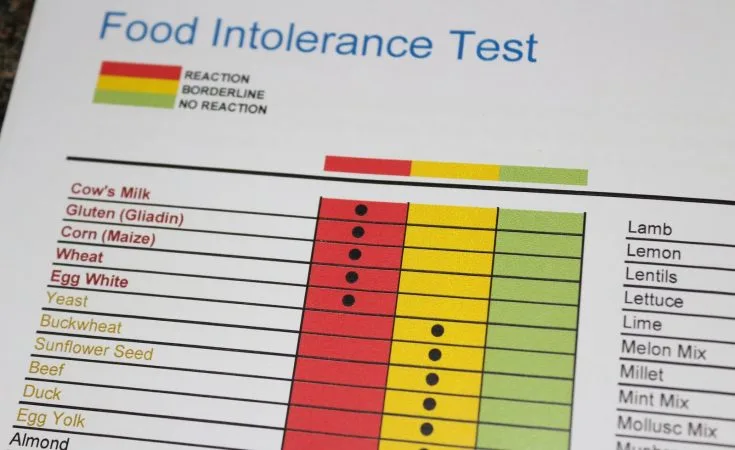
The test results show a list of foods categorized into 3 parts:-

1. The foods listed in the red color are the foods you need to eliminate from your diet. These are the foods that cause intolerance at the highest level.

2. Foods listed in the yellow section are the foods that you can include occasionally or in small doses in your diet.

3. The green section of the report includes a list of food that you eat regularly and that causes no intolerance at all. 


Food Intolerance Profile Sample Report & Ranges

Conducted at Thyrocare Labs
Lab Accreditation CAP, NABL, ICMR, NGSP, ISO
Method MicroArray
Technology ELISA
Supervision Dr. Prachi Sinkar MD (PATH), DR. Caesar Sengupta MD (MICRO)
Normal Range < 24 U/mL
Borderline Range 24-30 U/mL
Elevated Range > 30 U/mL
Results Highly Specific

How do I interpret the Food intolerance test results?

The test results show a list of foods categorized into 3 parts:-

1. The foods listed in the red color are the foods you need to eliminate from your diet. These are the foods that cause intolerance at the highest level.

2. Foods listed in the yellow section are the foods that you can include occasionally or in small doses in your diet.

3. The green section of the report includes a list of food that you eat regularly and that causes no intolerance at all. 


Food Intolerance Profile Sample Report

Food Intolerance Profile Overview

What is Food Intolerance?

Food Intolerance happens when the body is unable to digest some foods and produces antibodies in response that causes inflammation in the digestive system and causes abdominal dysfunction. This problem can happen with people of all age groups. The best way to get rid of it is to get a food intolerance test done at the earliest and eliminate the foods that are causing the intolerance. The people who are experiencing the symptoms regularly should get the test to avoid serious health problems.


Benefits of a Food Intolerance Test

A test of food intolerance measures the levels of IgG antibodies and thus provides a list of foods that you need to completely avoid. By following the diet chart and taking medical consultation, this condition can be improved completely. The benefits are explained in detail below:

  • Rebuilding a healthy gut – When food intolerance remains for a longer period of time, the abdominal health deteriorates. It happens because food intolerance mainly targets the digestive system of the body and causes problems such as diarrhea, gas, constipation, etc. Hence, getting a test done and eliminating the problem foods can help you get your gut health back. 
  • Timely elimination of problem foods – The test reports give a clear list of foods that cause the most intolerance. Therefore, it is important to stop the consumption of such foods and recover from the intolerance. So, a test helps in clarifying the list of foods and in their elimination, which is not possible to do otherwise. 
 

Why choose a Food Intolerance Test?

If you are one of those people who are suffering from the symptoms of food intolerance regularly such as gas, headaches, abdominal pain, and indigestion etc., then you need to get a food intolerance test done. The test will help you to know which foods in your diet are responsible for these reactions so that you can eliminate them and improve your overall health. The test also measures the level of IgG antibodies and an abnormal range requires immediate changes and medical attention.

The changes that you need to make involve dietary changes and some steps to maintain positive psychological health. Psychological factors also affect a person’s health negatively and cause food intolerance. Timely detection and testing can help you to take the, action to eliminate food intolerance from the root. 


What is Cost of Food Intolerance Test in Mumbai?

Health is an important aspect of a human being’s life and to maintain good health it is important to keep a check on the disorders that happen at regular intervals. To do so, the cost of health checkups should be affordable and considering the same, the food intolerance test price in Mumbai is Rs. 11499. We have tried to maintain cost-effective premium service for our customers. So. If you decide to take a food intolerance test with us, that decision will be beneficial in a long term. 


What is the procedure of a Food Intolerance Test?

The test is completed in three simple steps, i.e. booking the test online, getting ready for a home sample collection, and interpreting reports. All the steps are made convenient for the customers and do not take much time. It is also made sure that the protocol is followed in every step of the test. The procedure is given below in detail:

  • Booking the test – The booking of the test can be done online on the website using the form. It’s a simple form that contains sections such as name, address, age, phone number, gender, appointment date, and time. All you need to do is fill it out by mentioning the correct details, submit it, and your test will be booked. You will get the payment option later after your test has been booked. You can then make the payment online using UPI ID, debit card, or other modes. 
  • Home Sample Collection – After the booking process is done, a phlebotomist will be assigned to you to collect your blood sample. You will receive the details like the name & phone number of the phlebotomist on your phone, one day prior to your test. On the time and date of your appointment, the phlebotomist will arrive at your place. He will then label the test tubes with your name and other details. You will then be asked to sit comfortably, so he can tie a band on your arm, to locate a vein. He will take a few milliliters of blood from that vein and collect it in the test tube. To relieve the area of your arm, he will put a small bandage. 
  • Lab test and reports – After your blood sample is collected, it will be sent to the Thyrocare lab for testing. The testing will be done by experienced medical professionals at the lab using upgraded technologies. Based on that, the reports are made and sent to your number within 24-48 hours. 

Food Intolerance Profile FAQ's

You can prepare yourself by fasting for a minimum of 8-10 hours. Fasting is mandatory before a food intolerance test except consumption of water. Staying hydrated is beneficial before the test and is advised by medical professionals. However consuming anything else such as alcohol, sweetened beverages, carbonated drinks, etc. is prohibited before the test and it could disturb the results of the test.

Mediyaar understands the needs of its customers and provides services accordingly. First and foremost, the booking process of the test is extremely convenient and easy to understand. Then there is an availability of home sample collection which is done by a professional who follows all safety and standard procedures to do the same. Thereafter, the testing is done at Thyrocare labs that are NABL certified and follow strict guidelines in the testing process. So, if you choose the food intolerance test with us, you will not regret this decision.

Food intolerance can be caused due to various reasons such as celiac disease, IBS, psychological factors, and a shortage of digestive enzymes in the body. Due to these reasons, the body starts producing IgG antibodies which cause the digestive system to react and cause stomach pain, diarrhea, inflammation, bloating, and other abdominal disorders.

Some of the food intolerances are lactose intolerance, gluten intolerance, intolerance from sea foods and nuts, etc. The foods that cause these intolerances include dairy, yogurt, cheese, butter, peanuts, almonds, wheat, cashews, pistachios, bread, pasta, beans, cabbage, etc.

The first and foremost thing for an effective recovery process is to understand the results and accordingly eliminate the foods that are in the red category. These foods must not be consumed at all when you are in recovery. The foods in the yellow category can be consumed occasionally and in less quantity. You can also keep a record with yourself listing the foods that cause intolerance, or you can take the help of a doctor to interpret the result and eat accordingly.

It is rather easy to understand the reports of the food intolerance test. The report provides a list of foods divided into three color categories, red, yellow, and green. The foods listed in the red color are the foods that are mainly responsible for your intolerance and must be completely avoided. Foods in the yellow category can be consumed sometimes and the foods listed in the green part are the foods that can be taken regularly as they cause no intolerance to you.

Health Insights & Resources
View All Blogs →
Blog Title

August 20, 2025

The Role of AI in Medical Healthcare
Read More
Blog Title

August 19, 2025

Insulin Fasting Test: Why It’s Important
Read More
Blog Title

August 18, 2025

Why Every Indian Child Should Take a Full Body Test?
Read More
Blog Title

August 17, 2025

Food Poisoning in Hindi - फूड पॉइज़निंग क्या है? कारण, लक्षण, बचाव के
Read More
Test Conducted By
Rs. 11499
Home Sample Collection Available No Extra Charges
You will Save Rs. 0 on this Test
CAP Accredited NABL Accredited UKAS Management Systems ANAB Accredited
Lab Logo
Rs. 11499