Choose your City


This Profle Covers 22 Parameters that meaures the amount of toxic elements and nutrients in the body. Detects harmful elements- like lead, mercury, arsenic, and more.

Elements 22 Toxic And Nutrients Test in Ahmedabad

This Profle Covers 22 Parameters that meaures the amount of toxic elements and nutrients in the body. Detects harmful elements- like lead, mercury, arsenic, and more.


Group Name TOXIC
Fasting Fasting not required
Sample Type EDTA
Sample Collection Expert collect samples at Home
Reports Delivered Online within 24-48 Hrs*
Report type Email & Hardcopy ( On request )

Parameters Included in Elements 22 (toxic And Nutrients) Test

What tests are included in the Elements 22 (toxic And Nutrients) Test?


Toxic Elements (22 Tests)

  • Aluminium
  • Antimony
  • Arsenic
  • Barium
  • Beryllium
  • Bismuth
  • Cadmium
  • Caesium
  • Chromium
  • Cobalt
  • Lead
  • Manganese
  • Mercury
  • Molybdenum
  • Nickel
  • Selenium
  • Silver
  • Strontium
  • Thallium
  • Tin
  • Uranium
  • Vanadium
Elements 22 (toxic And Nutrients) Sample report & Ranges
Conducted at Thyrocare Labs
Lab Accridition CAP, NABL , ICMR , NGSP, ISO
Method COMPETITIVE ENZYME IMMUNOASSAY
TECHNOLOGY E.L.I.S.A
Supervision Dr Sachin Patil MD(Path)
Normal AMH Levels
Results Highly specific

Our labs work 365 days / 24 x 7 to ensure your Elements 22 (toxic And Nutrients) test samples reach us the same night, before midnight. We are equipped with (MUT) - India's first preanalytical barcoded vial sorter, Sample Sorter & Aptio (Siemens).

Our IT-enabled barcoded bi-directional operating systems & world-class air logistics process your blood samples within the specified time with the utmost accuracy. Once your specimen for Elements 22 (toxic And Nutrients) test is collected by our phlebotomist, Your reports will be sent to your email id within 24 to 48 hours. For hard copy requests, the reports would be delivered in 3 to 5 days. You will be informed via SMS & email once we process your report.

Elements 22 (toxic And Nutrients) Sample Report Format & Ranges

View the Elements 22 (toxic And Nutrients) sample report in the original Thyrocare PDF format. Customer name, contact details, address, barcode, order ID and lead ID are masked on the public sample copy.

Exact Thyrocare PDF preview will show here after a masked sample PDF is attached to this report.

The searchable values below support visitors looking for Elements 22 (toxic And Nutrients) report format, sample report values, normal range and reference range information.

Conducted at Thyrocare Labs
Lab Accreditation CAP, NABL, ICMR, NGSP, ISO
Reference Range < 5.7
Results Highly specific

Elements 22 (toxic And Nutrients) Reference Range Table

Parameter Unit Reference Range Method Report Section
HbA1c % < 5.7
AVERAGE BLOOD GLUCOSE (ABG) mg/dL 90-120
FASTING BLOOD SUGAR(GLUCOSE) mg/dL 70-100
URINARY MICROALBUMIN µg/mL < 25

Elements 22 (toxic And Nutrients) Report Sections Covered

Report Section Parameters in Sample Report
Toxic Elements 22
Diabetes 4
Other Counts 1
Complete Hemogram 28
Vitamin 2
Elements 1
Iron Deficiency 4
Lipid 10
Liver 12
Metabolic 1
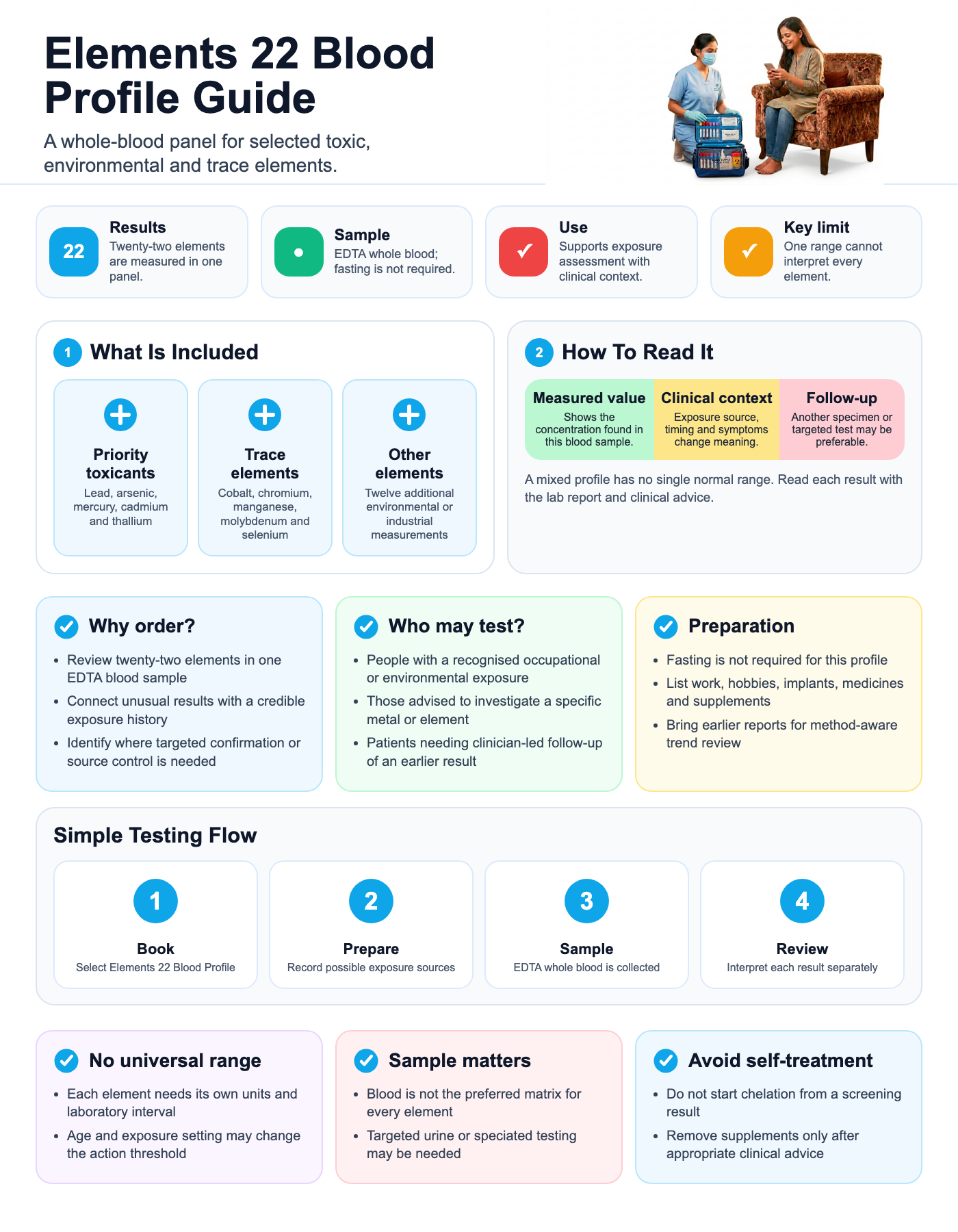
Elements 22 Toxic And Nutrients visual guide

Elements 22 Toxic and Nutrients Reference Guide in Ahmedabad

  • This profile measures twenty-two named elements in one EDTA whole-blood sample.
  • The panel combines established toxicants, biologically used trace elements and less common exposure markers.
  • Detection confirms that an element was measurable, not that it caused illness or requires treatment.
  • Every result needs its own units, method, reference interval, exposure timing and clinical context.
  • Targeted blood, urine, speciation or repeat testing may be more informative for a particular concern.
  • Medical guidance stays consistent; use this page for Ahmedabad pricing and collection details.

Why This Test Is Ordered

Understand the complete panel
  • The profile reports twenty-two separate elemental concentrations from EDTA whole blood.
  • Lead, arsenic, mercury and cadmium are included among recognised environmental toxicants.
  • Thallium, uranium and beryllium provide additional information about uncommon exposures.
  • Aluminium, barium, antimony, nickel and tin can reflect environmental or industrial contact.
  • Silver, bismuth, caesium, strontium and vanadium complete the wider element screen.
  • Cobalt, chromium, manganese, molybdenum and selenium also have biological or nutritional context.
  • The laboratory reports every element separately because their clinical meanings differ.
  • A combined panel result should never be reduced to one overall normal label.
Distinguish detection from harm
  • Modern laboratories can measure very small elemental concentrations in biological samples.
  • Finding an element confirms measurement, but does not prove poisoning or disease.
  • CDC notes that many detected environmental chemicals have uncertain effects at low levels.
  • Health risk depends on chemical form, concentration, route, timing and exposure duration.
  • Age, pregnancy, kidney function and nutritional status can alter clinical concern.
  • Symptoms from metal exposure are often nonspecific and overlap common medical conditions.
  • A result above a laboratory interval deserves context before a cause is assigned.
  • A result within range cannot exclude every past, intermittent or tissue-stored exposure.
Separate toxicants from nutrients
  • Lead has no known safe exposure level and can affect several body systems.
  • Inorganic arsenic is toxic, while common seafood arsenic is usually less harmful.
  • Mercury interpretation changes between methylmercury, inorganic mercury and elemental mercury exposure.
  • Cadmium exposure can arise from tobacco smoke, food and certain industrial processes.
  • Selenium, manganese and molybdenum support normal physiology in appropriate amounts.
  • Essential trace elements can still cause harm when exposure becomes excessive.
  • Blood concentration does not directly measure dietary intake or prove nutritional deficiency.
  • Supplement decisions should use dietary assessment and element-specific clinical evidence.
Respect specimen and timing limits
  • Blood and urine capture different exposure windows for different elements.
  • CDC routinely measures lead, cadmium, total mercury, manganese and selenium in whole blood.
  • CDC commonly uses urine for arsenic, uranium, thallium and several other panel elements.
  • A recent blood value may miss an exposure that has already cleared circulation.
  • Long-lived body stores may not be represented completely by one blood sample.
  • Arsenic evaluation often uses speciated urine to separate inorganic and seafood-related forms.
  • Urine better reflects inorganic or elemental mercury exposure in some clinical settings.
  • The clinician should select confirmatory specimens around the suspected source and timing.
Use an exposure-led interpretation
  • An exposure history gives each measured number a medically useful question.
  • Record the material, task, route, frequency, duration and protective equipment used.
  • Include drinking water, food, tobacco, cosmetics, remedies and household renovation.
  • Hobbies such as welding, ceramics, shooting and metalwork can create relevant contact.
  • Work clothing can carry contaminants home and expose other household members.
  • Metal implants can add cobalt or chromium context to selected blood results.
  • Similar symptoms among coworkers or relatives may identify a shared exposure source.
  • Stopping a confirmed source can matter more than repeatedly ordering broad panels.

Symptoms And Who Should Test

People with workplace exposure
  • Metal processing, welding, mining, smelting and battery work may involve elemental hazards.
  • Pigment, glass, ceramics, electronics and recycling work can create different exposure mixtures.
  • Job title alone is insufficient because actual daily tasks determine contact.
  • Record dust, fumes, liquids, ventilation, respiratory protection and handwashing practices.
  • Note whether symptoms improve away from work or worsen during particular processes.
  • Occupational surveillance may require a specific element, specimen and testing schedule.
  • Employer safety records can help identify the material and likely exposure route.
  • An occupational-health clinician can connect laboratory findings with workplace controls.
People with environmental concerns
  • Contaminated water, soil, dust and food can contribute to elemental exposure.
  • Groundwater is a major source of inorganic arsenic in several regions of India.
  • Old paint, informal battery recycling and contaminated dust can expose families to lead.
  • Large predatory fish can contribute methylmercury to total blood mercury.
  • Tobacco smoke is an important cadmium source and can affect household members.
  • Traditional medicines, cosmetics, cookware and spices may warrant source-specific questions.
  • Community concern should include location, duration and independently verified environmental measurements.
  • Testing the suspected water, soil or product may be necessary to control exposure.
People with metal implants
  • Some metal-on-metal hip implants can release cobalt and chromium into blood.
  • Implant symptoms, examination and imaging remain important alongside metal measurements.
  • One metal concentration cannot independently prove that an implant is failing.
  • The implant type, date, side and manufacturer should be recorded when known.
  • Kidney function and other metal hardware can influence the interpretation plan.
  • Serial monitoring should use the same specimen type, method and laboratory when possible.
  • Orthopaedic review is more appropriate than broad self-directed repeat testing.
  • This panel does not include imaging or a mechanical assessment of an implant.
Children and pregnancy concerns
  • Children are especially vulnerable to lead-related effects on the developing nervous system.
  • Pregnancy can mobilise lead stored in bone and expose the developing fetus.
  • A clinician should choose age-appropriate testing for a child with suspected exposure.
  • Venous confirmation may be required after an elevated capillary lead screening result.
  • Exposure control should include the child’s home, school, play area and caregivers.
  • Pica, renovation dust and a household worker’s clothing can increase childhood risk.
  • Pregnant patients should report occupation, water source, remedies, cosmetics and supplements.
  • Urgent specialist advice is appropriate when significant exposure is suspected clinically.
People with symptoms or incidents
  • Acute poisoning can require emergency care before a routine profile result is available.
  • Severe vomiting, confusion, weakness, breathing difficulty or collapse needs urgent assessment.
  • Chemical spills, fires or known ingestion require poison-centre or emergency guidance.
  • Bring the product label, safety data sheet or exposure photograph when safe.
  • Do not induce vomiting or attempt unprescribed chelation after a suspected ingestion.
  • Nonspecific fatigue, headache or tingling still requires evaluation for common causes.
  • A clinician may add kidney, liver, blood-count or neurological assessment as indicated.
  • The most relevant targeted test may differ from this broad screening panel.

Preparation And Interpretation Notes

Follow the blood instruction
  • Fasting is not required for the current Elements 22 profile.
  • The laboratory requires EDTA whole blood rather than serum for this package.
  • Normal food and fluid intake may continue unless another booked test requires fasting.
  • A trained professional should collect and label the blood sample correctly.
  • Trace-element collection materials require careful contamination control and laboratory validation.
  • Tell the collector about fainting, difficult draws or blood-thinning medicines.
  • Do not change prescribed medicines solely to prepare for this blood collection.
  • Emergency assessment should never wait for ideal routine collection conditions.
Document possible sources
  • List current and previous jobs with the materials handled in each role.
  • Record hobbies, home renovation, shooting, welding, ceramics and electronics repair.
  • Note drinking-water sources, seafood intake, tobacco exposure and unusual dietary products.
  • List vitamins, mineral supplements, traditional remedies, cosmetics and imported products.
  • Record metal implants, dental work and other internal medical hardware.
  • Write the suspected exposure date, duration, route and protective equipment used.
  • Bring previous element reports with their units, sample type and laboratory name.
  • A focused history helps prevent unrelated measurable elements from distracting interpretation.
Read every result separately
  • Check the element name, numerical value, unit and laboratory interval together.
  • Do not compare values that use different units without a verified conversion.
  • Reference intervals may differ between blood, serum, plasma and urine specimens.
  • Population percentiles are not automatically toxicity thresholds or treatment targets.
  • The chemical species can matter even when a report gives only total concentration.
  • Age and clinical setting can change follow-up guidance for selected elements.
  • A flagged result should be checked against the laboratory’s validated method.
  • The report should be reviewed by a clinician familiar with the suspected exposure.
Plan targeted confirmation
  • Repeat testing should answer a defined question rather than reproduce the entire panel.
  • Use a venous blood lead test when formal confirmation is clinically required.
  • Consider speciated urine when recent inorganic arsenic exposure is the concern.
  • Urinary testing may better address uranium, thallium or several other exposures.
  • Cobalt and chromium trends require consistent collection, method and laboratory conditions.
  • Exposure timing should guide whether blood, urine or another matrix is chosen.
  • Environmental sampling may be needed to identify and remove the continuing source.
  • Specialist advice can prioritise follow-up without unnecessary tests or alarm.
Act safely after results
  • Do not begin chelation because one screening value is outside its interval.
  • Chelation has medical risks and belongs under experienced clinical supervision.
  • Do not assume that every low trace-element result represents dietary deficiency.
  • Avoid high-dose supplements until the result, diet and clinical need are reviewed.
  • Reduce a credible ongoing exposure using appropriate workplace or environmental controls.
  • Follow urgent guidance when the value, symptoms or exposure event indicates immediate risk.
  • Keep the original report because units and method notes are essential for comparison.
  • Future monitoring should follow an element-specific plan with a clear clinical endpoint.

Frequently Asked Questions

What does the Elements 22 Profile measure?

It measures twenty-two named elements in EDTA whole blood.

Is fasting required for this profile?

No; fasting is not required for the current package.

Does a detected element mean poisoning?

No; detection needs concentration, exposure timing and clinical interpretation.

Can one range interpret all twenty-two results?

No; each element needs its own units, method and reference guidance.

Does this panel diagnose nutrient deficiency?

No; blood values alone do not establish every nutritional deficiency.

Is blood best for every included element?

No; urine or speciated testing may suit some exposure questions better.

Can supplements affect the interpretation?

Yes; report every vitamin, mineral, remedy and supplement before review.

Should I start chelation after a high result?

No; chelation requires confirmation and experienced medical supervision.

Can I book Elements 22 in Ahmedabad?

Elements 22 collection in Ahmedabad is available where serviceable for stable patients.

Who can review my element results in Ahmedabad?

A qualified clinician in Ahmedabad can review results with your exposure history.

Where should I seek urgent exposure care in Ahmedabad?

Seek emergency care in Ahmedabad after severe symptoms or a major exposure.

Ratings & Reviews
4.8 ★★★★★

Based on verified bookings

Good service

Sample collection was smooth and reports were delivered on time.

Health Insights & Resources
View All Blogs →
Blog Title

August 20, 2025

The Role of AI in Medical Healthcare
Read More
Blog Title

August 19, 2025

Insulin Fasting Test: Why It’s Important
Read More
Blog Title

August 18, 2025

Why Every Indian Child Should Take a Full Body Test?
Read More
Blog Title

August 17, 2025

Food Poisoning in Hindi - फूड पॉइज़निंग क्या है? कारण, लक्षण, बचाव के
Read More
Test Conducted By
Elements 22 Toxic And Nutrients Test price : Rs. 3840
Rs. 2400 38% Off
Home Sample Collection Available No Extra Charges
You will Save Rs. 1440 on this Test
CAP Accredited NABL Accredited UKAS Management Systems ANAB Accredited
Lab Logo
Elements 22 Toxic And Nutrients Test price : Rs. 3840
Rs. 2400