Choose your City


A serum electrolytes test includes 3 Tests to measure essential minerals like sodium, potassium, and chloride in the blood.

Serum Electrolytes Test in Ahmedabad

A serum electrolytes test includes 3 Tests to measure essential minerals like sodium, potassium, and chloride in the blood.


Group Name WELLNESS
Fasting Fasting not required
Sample Type SERUM
Sample Collection Expert collect samples at Home
Reports Delivered Online within 24-48 Hrs*
Report type Email & Hardcopy ( On request )

Parameters Included in Serum Electrolytes Test

What tests are included in the Serum Electrolytes Test?


Electrolytes (3 Tests)

  • Chloride
  • Potassium
  • Sodium

Serum Electrolytes Overview

What to expect during a Serum Electrolytes Blood Test?

During a Serum Electrolytes blood test, a healthcare professional takes a blood sample from your arm, which is also known as venipuncture. A lab expert known as a phlebotomist conducts this process using a needle. He locates a vein on your arm and inserts the needle to draw blood. The blood sample will be transferred into a test tube and will be taken safely to the labs for the test.

The lab technicians will test the sample by following established standards, to ensure correct reports. Thyrocare Labs has a team of professionals who are skilled and experienced. After the testing is done, your reports are sent to your email within 1-2 days. On the other hand, if you need a hard copy of the report, expect the delivery of the same within 3-5 business days.

Preparations before a Serum Electrolytes Blood Test?

For Serum Electrolytes blood tests, special preparations are not needed. However, some important steps must be taken to ensure accuracy in the test reports.

  • Serum Electrolytes test requires Fasting not, the same must be done for at least 8-10 hours. Only water can be consumed during this time. Being hydrated helps the blood draw easier and also ensures accurate results.
  • Eating junk food and consuming sweetened beverages or alcohol can alter your test results. So, it is advisable to be careful about what to consume or take the advice of a professional.
  • Consumption of certain medications is also prohibited before blood tests. You can discuss the details about the same with your doctor to be sure.
  • Avoid strenuous exercise as it can alter the readings of a blood test.

Are there any side effects of the test?

There are no side effects or risks attached to Serum Electrolytes blood tests. The test involves the collection of a blood sample from your home. A phlebotomist draws blood from your arm using a needle, which only takes a few minutes. During this process, you might feel a sting on your arm, which is not painful. The blood sample will then be sent to the labs. Our medical experts take all precautions and safety measures during sample collection and testing.
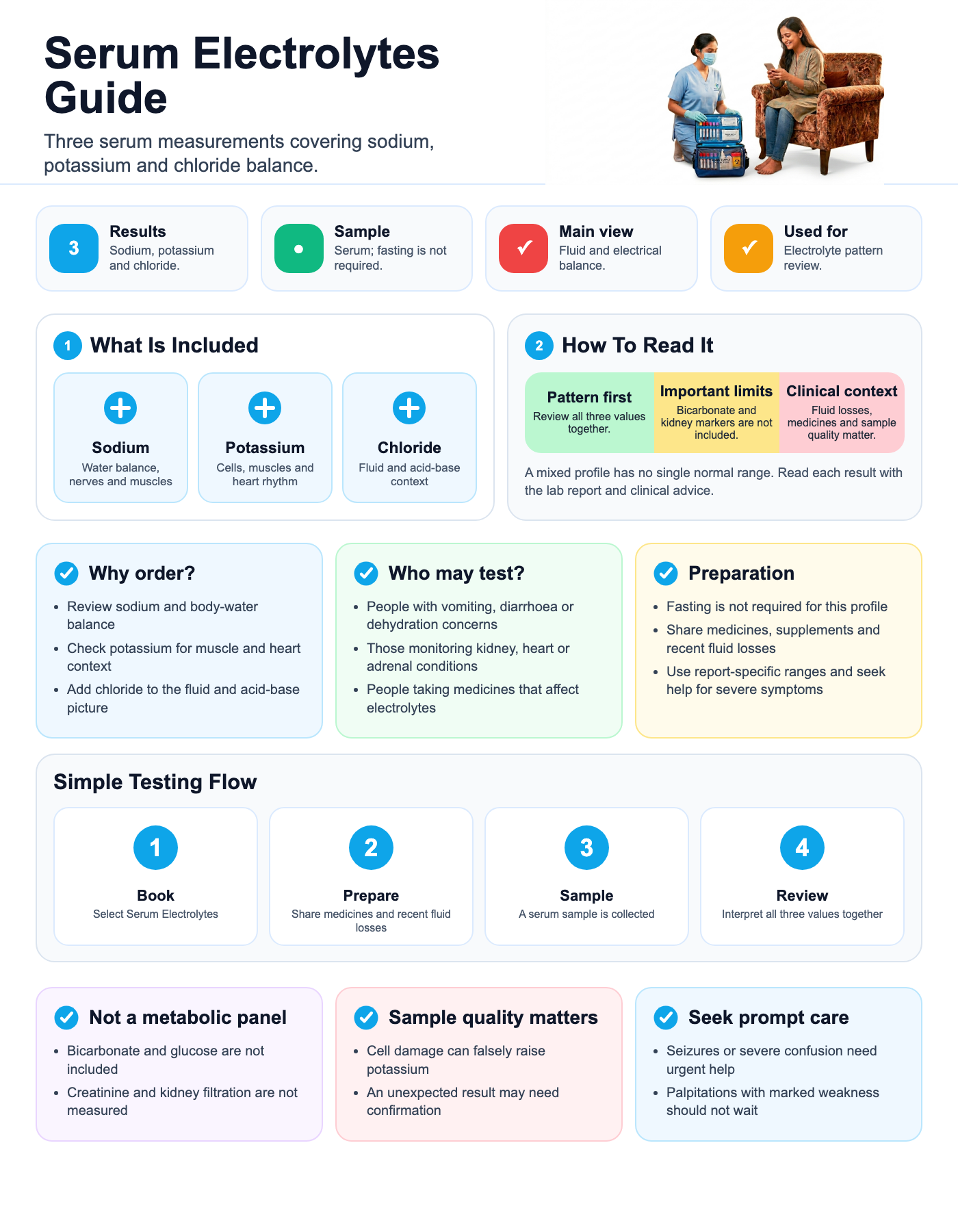
Serum Electrolytes visual guide

Serum Electrolytes Reference Guide in Ahmedabad

  • Serum Electrolytes measures sodium, potassium and chloride in a blood sample.
  • The three minerals support fluid balance, nerve signals, muscle activity and acid-base regulation.
  • This profile does not include bicarbonate, creatinine, glucose, calcium or magnesium.
  • Results should be read with symptoms, medicines, fluid changes, kidney health and sample quality.
  • Severe symptoms require prompt assessment rather than waiting for a routine report.
  • Medical guidance stays consistent; use this page for Ahmedabad pricing and collection details.

Why This Test Is Ordered

Understand the three-test scope
  • Electrolytes are charged minerals dissolved in blood and other body fluids.
  • This profile measures sodium, potassium and chloride in serum.
  • The three results provide a focused view of fluid and electrical balance.
  • Each electrolyte has distinct roles, yet their regulation is closely connected.
  • Kidneys and hormones help maintain concentrations within relatively narrow limits.
  • Food, drinks, medicines and fluid losses can influence the measured pattern.
  • One abnormal value can reflect several possible physiological or medical causes.
  • The panel supports assessment but does not name a diagnosis by itself.
Use sodium as a water-balance clue
  • Sodium helps regulate water distribution across body-fluid compartments.
  • It also supports normal nerve signalling and muscle activity.
  • Blood sodium reflects the relationship between sodium and water, not dietary salt alone.
  • Low sodium can occur when sodium is lost or body water becomes excessive.
  • High sodium commonly reflects insufficient water relative to the body’s sodium content.
  • Vomiting, diarrhoea, sweating and altered thirst can disturb this balance.
  • Kidney, heart, liver, adrenal and hormonal conditions may also affect sodium.
  • Clinical interpretation often considers glucose, osmolality, urine tests and volume status.
Review potassium for muscle and heart context
  • Potassium supports electrical activity in nerves, skeletal muscles and the heart.
  • Most body potassium remains inside cells, while only a small fraction circulates.
  • Kidneys remove excess potassium and help maintain its blood concentration.
  • Low potassium may accompany gastrointestinal losses, diuretics or reduced intake.
  • High potassium may accompany kidney dysfunction, selected medicines or cellular shifts.
  • Both low and high potassium can disturb muscle function and heart rhythm.
  • Symptoms may be absent even when a potassium result needs timely review.
  • Marked or unexpected changes should be interpreted with kidney function and an ECG when indicated.
Place chloride beside sodium and acid-base balance
  • Chloride is a negatively charged electrolyte that often moves with sodium.
  • It helps maintain fluid distribution, blood volume and electrical neutrality.
  • Chloride also contributes to the body’s acid-base balance.
  • Vomiting can lower chloride through loss of stomach fluid.
  • Diarrhoea and some acid-base disorders can produce different chloride patterns.
  • Kidney handling and intravenous fluids may also alter chloride concentration.
  • Chloride becomes more informative when reviewed with sodium and bicarbonate.
  • Bicarbonate is not included in this three-result profile.
Interpret the combined pattern carefully
  • Sodium, potassium and chloride should be reviewed as a connected pattern.
  • A coordinated shift may suggest fluid loss, fluid excess or altered kidney handling.
  • A single isolated flag may instead reflect medicine effects or sample problems.
  • The direction and size of change matter more than the flag alone.
  • Bicarbonate is required for a fuller acid-base assessment and anion-gap calculation.
  • Creatinine and estimated GFR provide kidney-filtration context but are not included.
  • Glucose can influence sodium interpretation during marked hyperglycaemia.
  • A clinician may add blood, urine or cardiac tests for the specific concern.

Symptoms And Who Should Test

People with fluid loss or dehydration
  • Repeated vomiting or diarrhoea can remove water and electrolytes together.
  • Heavy sweating, fever or reduced drinking may also disturb fluid balance.
  • Thirst, dry mouth and reduced urination can accompany dehydration.
  • Weakness, cramps, headache and dizziness are important but non-specific symptoms.
  • Sodium may rise or fall depending on the relative water and salt losses.
  • Potassium and chloride changes depend on the illness, intake and kidney response.
  • Clinical examination helps determine whether a person is depleted or fluid-overloaded.
  • Persistent losses may require broader blood tests and supervised fluid replacement.
People with kidney or heart conditions
  • Healthy kidneys adjust sodium, potassium and chloride excretion through urine.
  • Reduced kidney function can limit the body’s ability to remove potassium.
  • Heart failure can change fluid distribution and dilute serum sodium.
  • Diuretics used for swelling or blood pressure can change several electrolytes.
  • Monitoring frequency depends on kidney function, treatment and previous results.
  • This profile does not measure creatinine, estimated GFR or urine albumin.
  • Blood pressure, weight, swelling and urine output add important clinical context.
  • Rapid swelling, breathlessness or very low urine output need prompt assessment.
People taking electrolyte-affecting medicines
  • Diuretics can lower sodium or potassium, while some diuretics can raise potassium.
  • ACE inhibitors and angiotensin receptor blockers may increase potassium in susceptible people.
  • Selected painkillers, antibiotics, steroids and antacids can influence electrolyte balance.
  • Laxative overuse can cause fluid and electrolyte losses through diarrhoea.
  • Potassium supplements and salt substitutes may raise potassium unexpectedly.
  • Medicine-related risk increases with kidney disease, older age or combined treatments.
  • Testing should follow the prescriber’s schedule after starting or changing treatment.
  • Do not stop prescribed medicines solely because one result is flagged.
People with weakness or neurological symptoms
  • Muscle weakness, cramps, twitching or tingling may accompany an electrolyte imbalance.
  • Fatigue, headache, nausea and constipation can occur for many unrelated reasons.
  • Confusion or irritability may appear with important sodium or other metabolic disturbances.
  • Symptoms alone cannot identify which electrolyte is abnormal.
  • A normal three-test panel does not exclude glucose, calcium or magnesium problems.
  • Neurological symptoms may require glucose, kidney, liver or imaging assessment.
  • New seizures, severe confusion or reduced consciousness require emergency care.
  • Rapid deterioration should not wait for home collection or a routine report.
People with palpitations or treatment monitoring
  • Potassium abnormalities can affect cardiac electrical conduction and heart rhythm.
  • Palpitations may also arise from anxiety, thyroid disease, anemia or heart conditions.
  • An electrolyte panel cannot show the heart rhythm occurring during symptoms.
  • An ECG may be needed when potassium is markedly abnormal or symptoms are concerning.
  • Clinicians may repeat electrolytes during acute illness or treatment adjustment.
  • Trends can reveal a developing change before severe symptoms appear.
  • Small fluctuations may reflect ordinary biological or laboratory variation.
  • Chest pain, fainting or sustained palpitations require urgent clinical assessment.

Preparation And Interpretation Notes

Follow the profile collection instructions
  • Fasting is not required for this three-result Serum Electrolytes profile.
  • Follow stricter instructions if another booked test requires fasting.
  • A trained professional collects venous blood and prepares serum for analysis.
  • Maintain ordinary fluid intake unless a clinician has provided different instructions.
  • Do not deliberately overdrink water or load salt before testing.
  • Minor discomfort or bruising can follow a routine venous blood draw.
  • Tell the collector about fainting, difficult draws or blood-thinning medicines.
  • Preparation instructions for another electrolyte panel may differ by composition.
Report medicines and supplements
  • List prescription medicines, over-the-counter products and supplements before interpretation.
  • Mention diuretics, blood-pressure medicines, painkillers, steroids and recent antibiotics.
  • Report potassium tablets, electrolyte powders and intravenous fluids.
  • Some low-sodium salt substitutes contain substantial potassium chloride.
  • Share recent dose changes, missed doses and the timing of the last dose.
  • Do not pause medicine unless the prescribing clinician gives that instruction.
  • Bring the medicine list when testing follows a new prescription.
  • The reviewer should know whether results were measured during usual treatment.
Share recent intake and fluid losses
  • Report vomiting, diarrhoea, fever, heavy sweating and reduced drinking.
  • Mention unusually high water intake or a medically prescribed fluid restriction.
  • Share recent surgery, hospital treatment or intravenous fluid administration.
  • Record major dietary changes, fasting or use of rehydration products.
  • These details help explain the direction of sodium, potassium and chloride changes.
  • They do not automatically make the sample unsuitable for testing.
  • Acutely unwell people may need immediate assessment rather than scheduled collection.
  • Clinicians may compare blood results with urine electrolytes or osmolality.
Protect potassium sample quality
  • Potassium is concentrated inside blood cells and can leak after cell damage.
  • Haemolysis during collection or handling may falsely raise the reported potassium.
  • Repeated fist clenching during collection can also increase measured potassium.
  • Laboratories may flag a visibly or analytically haemolysed serum sample.
  • An unexpected high result may require prompt repeat collection before treatment.
  • Repeat timing depends on the result, symptoms, ECG and clinical risk.
  • A sample problem cannot be assumed when true hyperkalaemia remains possible.
  • Never delay urgent review of a critical potassium result while guessing the cause.
Review ranges, limits and urgent findings
  • Use the units and reference intervals printed on the current report.
  • Reference intervals can vary with laboratory method, age and clinical setting.
  • Compare earlier results from the same laboratory when possible.
  • This profile does not include bicarbonate, creatinine, glucose, calcium or magnesium.
  • It cannot calculate an anion gap or directly measure kidney filtration.
  • Do not self-correct a flagged value with salt, water or potassium supplements.
  • Seizures, severe confusion, fainting or breathing difficulty need emergency assessment.
  • Marked weakness or palpitations with abnormal potassium require timely clinical review.

Frequently Asked Questions

What does Serum Electrolytes include?

It includes serum sodium, potassium and chloride measurements.

Is fasting required for this profile?

No; fasting is unnecessary unless another booked test requires it.

Does this profile include bicarbonate?

No; bicarbonate is not included in the three listed results.

Does it measure kidney function?

No; creatinine, eGFR and urine albumin are not included.

Can dehydration affect the results?

Yes; water loss can alter sodium, potassium and chloride patterns.

Can medicines change electrolyte levels?

Yes; diuretics and several other medicines can change these results.

Can a sample problem raise potassium?

Yes; haemolysis during collection or handling may falsely raise potassium.

Should I change my diet after one result?

No; discuss the complete pattern before changing salt, fluids or potassium.

Can I book Serum Electrolytes in Ahmedabad?

Serum Electrolytes home collection in Ahmedabad is available where serviceable.

Who can review my electrolyte results in Ahmedabad?

A qualified clinician in Ahmedabad can review them with your history.

Where should I seek urgent care in Ahmedabad?

Use an emergency service in Ahmedabad for seizures, fainting or severe confusion.

Ratings & Reviews
4.8 ★★★★★

Based on verified bookings

Good service

Sample collection was smooth and reports were delivered on time.

Health Insights & Resources
View All Blogs →
Blog Title

August 20, 2025

The Role of AI in Medical Healthcare
Read More
Blog Title

August 19, 2025

Insulin Fasting Test: Why It’s Important
Read More
Blog Title

August 18, 2025

Why Every Indian Child Should Take a Full Body Test?
Read More
Blog Title

August 17, 2025

Food Poisoning in Hindi - फूड पॉइज़निंग क्या है? कारण, लक्षण, बचाव के
Read More
Test Conducted By
Serum Electrolytes Test Price in Ahmedabad : Rs. 752
Rs. 470 38% Off
Home Sample Collection Available No Extra Charges
You will Save Rs. 282 on this Test
CAP Accredited NABL Accredited UKAS Management Systems ANAB Accredited
Lab Logo
Serum Electrolytes Test Price in Ahmedabad : Rs. 752
Rs. 470

Home Sample Collection Areas Pincodes in Ahmedabad

We provide home blood sample collection across Ahmedabad, including Satellite, Navrangpura, Maninagar, Bopal, Vastrapur.

380001| 380002| 380003| 380004| 380005| 380006| 380007| 380008| 380009| 380013| 380014| 380015| 380016| 380018| 380019
380021| 380022| 380023| 380024| 380025| 380026| 380027| 380028| 380038| 380050| 380051| 380052| 380053| 380054| 380055
380058| 380059| 380060| 380061| 380063| 382001| 382210| 382325| 382330| 382340| 382345| 382346| 382350| 382405| 382410
382415| 382418| 382424| 382428| 382440| 382443| 382445| 382449| 382470| 382475| 382480| 382481