Choose your City


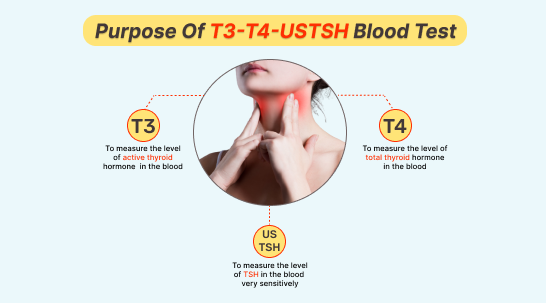
T3 T4 TSH Test including 3 Tests which helps to measures how well thyroid gland is functioning, and Monitor its Treatment.

Thyroid Test (T3 T4 TSH) in Amravati

T3 T4 TSH Test including 3 Tests which helps to measures how well thyroid gland is functioning, and Monitor its Treatment.

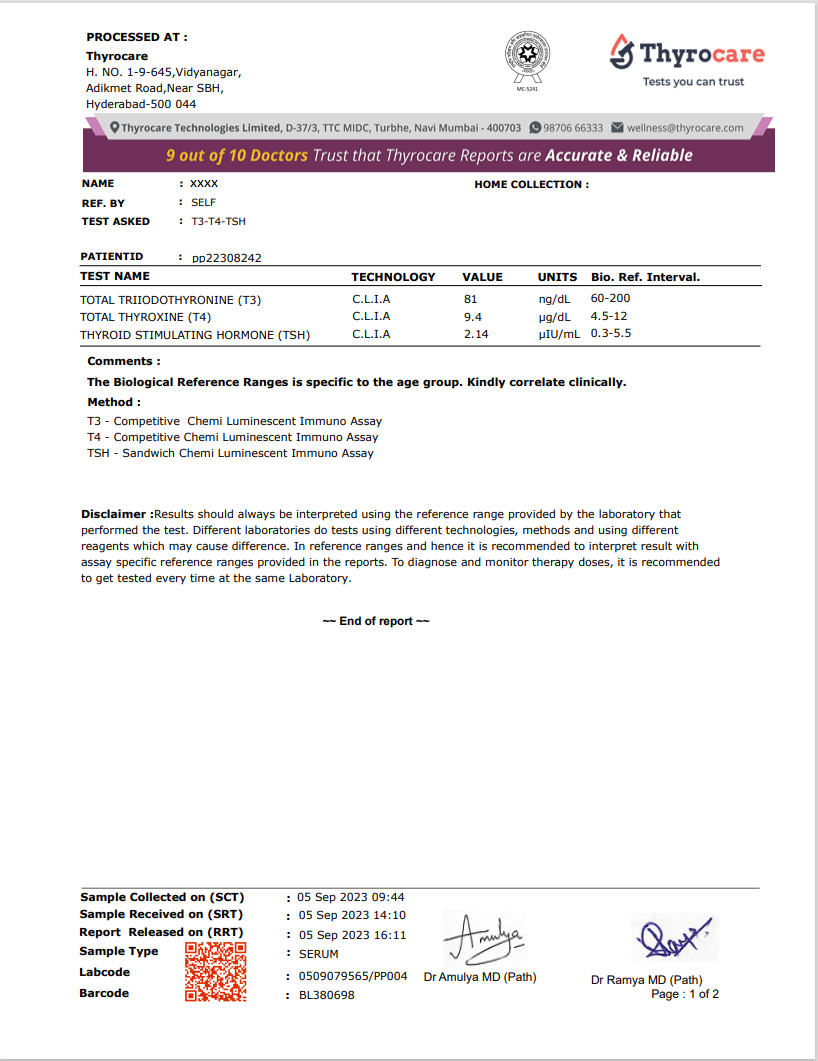
T3 T4 TSH Test Sample Report

Group Name WELLNESS
Fasting Fasting not required
Sample Type SERUM
Sample Collection Expert collect samples at Home
Reports Delivered Online within 24-48 Hrs*
Report type Email & Hardcopy ( On request )

Parameters Included in T3-t4-ustsh Test

What tests are included in the T3-t4-ustsh Test?


Thyroid (3 Tests)

  • Total thyroxine (t4)
  • Total triiodothyronine (t3)
  • Tsh - ultrasensitive
T3 T4 TSH Test Sample Report
T3-t4-ustsh Sample report & Ranges
Conducted at Thyrocare Labs
Lab Accreditation CAP, NABL, ICMR, NGSP, ISO
Technology C.L.I.A
Supervision Dr Amulya MD (Path) 
Results Highly Specific

Our labs work 365 days / 24 x 7 to ensure your  T3-t4-ustsh samples reach us the same night, before midnight. We are equipped with  (MUT) -  India's first preanalytical barcoded vial sorter, Sample Sorter  &  Aptio (Siemens).

Our IT-enabled barcoded bi-directional operating systems & world-class air logistics process your blood samples within the specified time with the utmost accuracy. Once your specimen for T3-t4-ustsh is collected by our phlebotomist, Your reports will be sent to your email id within 24 to 48 hours. For hard copy requests, the reports would be delivered in 3 to 5 days.  You will be informed via SMS & email once we process your report.


T3-t4-ustsh Sample Report Format & Ranges

View the T3-t4-ustsh sample report in the original Thyrocare PDF format. Customer name, contact details, address, barcode, order ID and lead ID are masked on the public sample copy.

Exact Thyrocare PDF preview will show here after a masked sample PDF is attached to this report.

The searchable values below support visitors looking for T3-t4-ustsh report format, sample report values, normal range and reference range information.

Conducted at Thyrocare Labs
Lab Accreditation CAP, NABL, ICMR, NGSP, ISO
Reference Range 58-159
Results Highly specific

T3-t4-ustsh Reference Range Table

Parameter Unit Reference Range Method Report Section
TOTAL TRIIODOTHYRONINE (T3) ng/dL 58-159
TOTAL THYROXINE (T4) µg/dL 4.87-11.72
TSH - ULTRASENSITIVE µIU/mL 0.35-4.94

T3-t4-ustsh Report Sections Covered

Report Section Parameters in Sample Report
Thyroid 3

T3-t4-ustsh Overview

What to expect during a T3-t4-ustsh Blood Test?

During a T3-t4-ustsh blood test, a healthcare professional takes a blood sample from your arm, which is also known as venipuncture. A lab expert known as a phlebotomist conducts this process using a needle. He locates a vein on your arm and inserts the needle to draw blood. The blood sample will be transferred into a test tube and will be taken safely to the labs for the test.

The lab technicians will test the sample by following established standards, to ensure correct reports. Thyrocare Labs has a team of professionals who are skilled and experienced. After the testing is done, your reports are sent to your email within 1-2 days. On the other hand, if you need a hard copy of the report, expect the delivery of the same within 3-5 business days.
t3 t4 tsh purpose

Preparations before a T3-t4-ustsh Blood Test?

For T3-t4-ustsh blood tests, special preparations are not needed. However, some important steps must be taken to ensure accuracy in the test reports.

  • T3-t4-ustsh test requires Fasting not, the same must be done for at least 8-10 hours. Only water can be consumed during this time. Being hydrated helps the blood draw easier and also ensures accurate results.
  • Eating junk food and consuming sweetened beverages or alcohol can alter your test results. So, it is advisable to be careful about what to consume or take the advice of a professional.
  • Consumption of certain medications is also prohibited before blood tests. You can discuss the details about the same with your doctor to be sure.
  • Avoid strenuous exercise as it can alter the readings of a blood test.

Are there any side effects of the test?

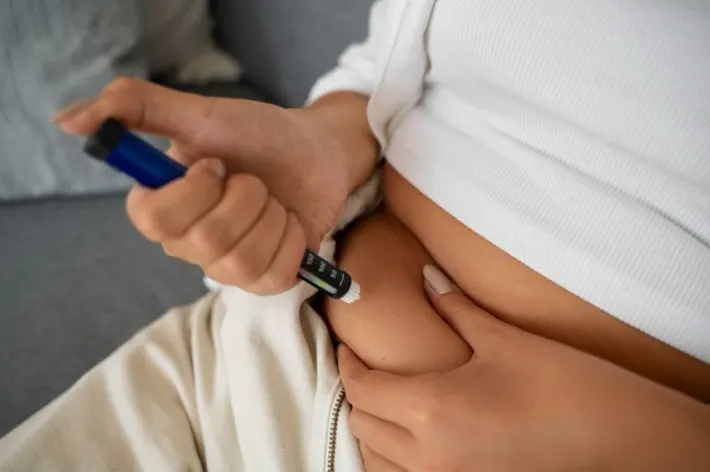
There are no side effects or risks attached to T3-t4-ustsh blood tests. The test involves the collection of a blood sample from your home. A phlebotomist draws blood from your arm using a needle, which only takes a few minutes. During this process, you might feel a sting on your arm, which is not painful. The blood sample will then be sent to the labs. Our medical experts take all precautions and safety measures during sample collection and testing.
T3 T4 Ustsh visual guide

T3-T4-Ultrasensitive TSH Reference Guide in Amravati

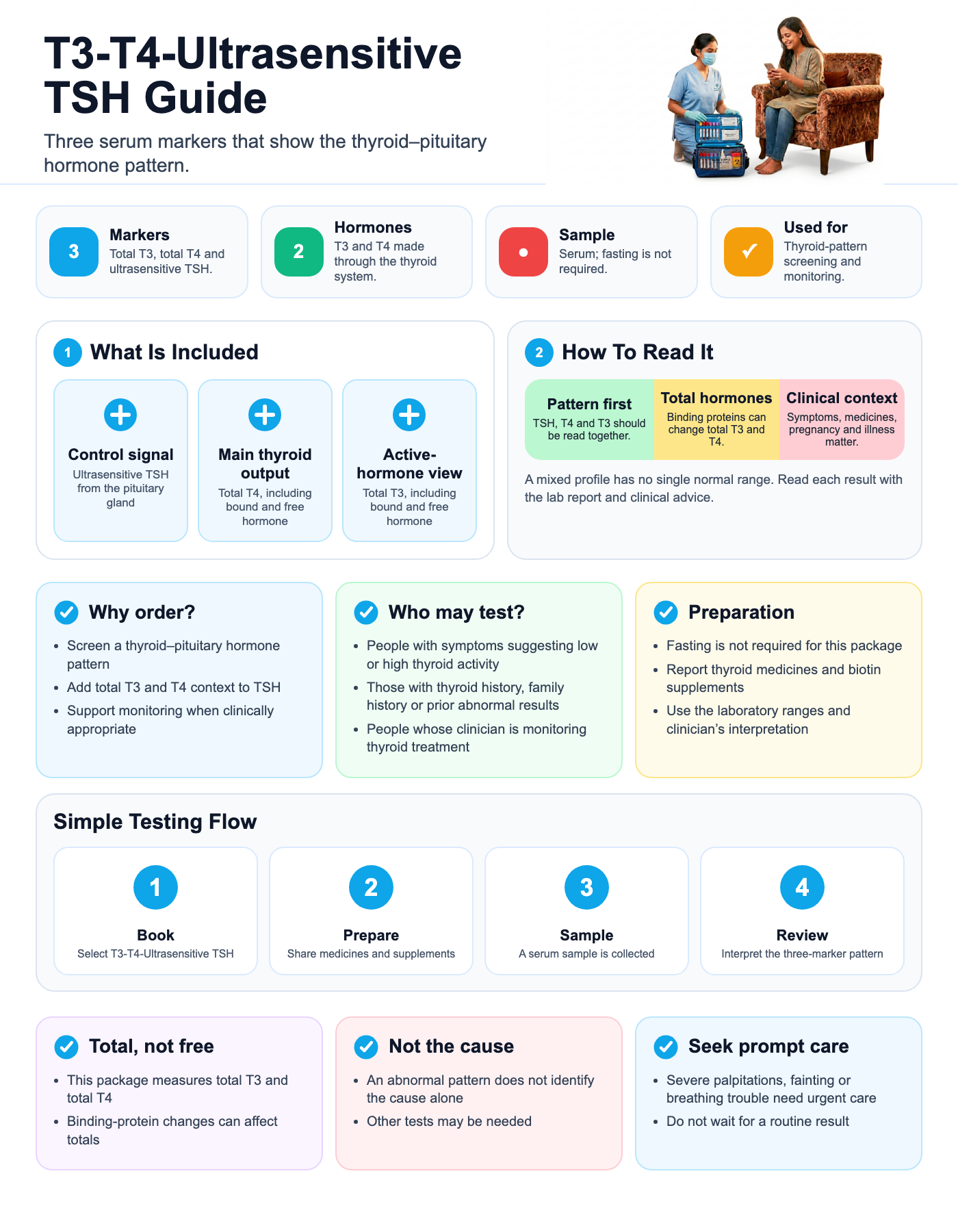
  • This serum profile combines ultrasensitive TSH, total T4 and total T3.
  • TSH reflects pituitary signalling, while T4 and T3 add thyroid-hormone context.
  • Both hormone measurements are totals, so they include protein-bound and unbound fractions.
  • The three results describe a pattern but cannot identify every thyroid disorder or its cause.
  • Interpretation should include symptoms, medicines, pregnancy, illness and earlier thyroid reports.
  • Medical guidance stays consistent; use this page for Amravati pricing and collection details.

Why This Test Is Ordered

Read the thyroid–pituitary feedback pattern
  • The pituitary gland releases TSH to regulate thyroid-hormone production.
  • The thyroid mainly releases T4 in response to this pituitary signal.
  • Body tissues convert part of circulating T4 into active T3.
  • Low circulating hormone often prompts the pituitary to release more TSH.
  • Excess circulating hormone often suppresses the pituitary TSH signal.
  • This feedback makes TSH a sensitive starting marker for primary thyroid dysfunction.
  • Pituitary disease can produce combinations that differ from common primary-thyroid patterns.
  • Always read TSH beside both hormone results and the clinical situation.
Understand what total T4 contributes
  • T4 is the principal hormone released directly by the thyroid gland.
  • This profile measures total T4 rather than free T4.
  • Total T4 combines protein-bound hormone with the much smaller unbound fraction.
  • A raised total T4 can support an overactive-thyroid pattern in suitable context.
  • A low total T4 can support an underactive-thyroid pattern in suitable context.
  • Binding-protein changes can alter total T4 without matching free-hormone changes.
  • Pregnancy and estrogen-containing medicines commonly increase thyroid-binding proteins.
  • Free T4 may be needed when total T4 conflicts with symptoms or TSH.
Use total T3 for added context
  • T3 is an active thyroid hormone that influences energy use throughout the body.
  • Much circulating T3 forms when tissues remove iodine from T4.
  • This profile measures total T3, including bound and unbound hormone.
  • Total T3 can clarify some low-TSH patterns when T4 is not clearly raised.
  • T3 may become high in some people with otherwise subtle hyperthyroid findings.
  • T3 is less useful for detecting hypothyroidism because it may stay normal longer.
  • Significant non-thyroid illness can lower T3 without proving thyroid failure.
  • Interpret total T3 beside TSH, total T4, symptoms and recent illness.
Recognise the total-hormone limitation
  • Most circulating T4 and T3 travels attached to specific transport proteins.
  • Only a small unbound fraction is available to enter body tissues.
  • Total tests combine the bound and unbound fractions into one measurement.
  • Changes in transport proteins can shift totals without equivalent thyroid dysfunction.
  • Pregnancy, oral contraception and estrogen therapy can increase binding-protein levels.
  • Severe illness and selected medicines can also complicate total-hormone interpretation.
  • A result within range does not resolve every possible binding-protein issue.
  • The reviewer may add free T4 or other testing when the pattern is discordant.
Separate function from the underlying cause
  • The three results describe thyroid function but do not automatically identify its cause.
  • Thyroid antibodies may help investigate autoimmune conditions such as Graves’ or Hashimoto’s disease.
  • A neck lump or goitre requires examination and may need ultrasound imaging.
  • Ultrasound shows thyroid structure but is not included in this blood profile.
  • Pituitary assessment may be needed when TSH and hormone values appear unexpectedly aligned.
  • This package excludes free T4, free T3 and thyroid antibody measurements.
  • It also excludes thyroglobulin, calcitonin and thyroid imaging.
  • Further tests should answer a defined clinical question rather than repeat the same panel.
Support treatment monitoring safely
  • Thyroid tests can monitor selected people taking levothyroxine or antithyroid medicine.
  • The appropriate monitoring marker depends on the condition and treatment used.
  • TSH may take weeks to reflect the full effect of a treatment change.
  • Testing too soon can misrepresent the eventual response to a new dose.
  • Dose timing and missed tablets provide essential context for serial results.
  • Pregnancy, surgery and radioactive iodine can require a tailored monitoring plan.
  • Do not increase, reduce or stop thyroid medicine from one result alone.
  • Treatment decisions belong with the clinician who knows the diagnosis and target.

Symptoms And Who Should Test

People with possible low-thyroid symptoms
  • Persistent tiredness and unusual cold sensitivity can occur with hypothyroidism.
  • Constipation, dry skin and thinning hair may also prompt thyroid review.
  • Unexplained weight gain can occur but is not specific to thyroid disease.
  • Heavy or irregular periods may accompany an underactive-thyroid pattern.
  • Low mood, slowed thinking and muscle discomfort have many possible causes.
  • Symptoms alone cannot diagnose hypothyroidism or determine its severity.
  • The three-marker pattern helps assess whether thyroid function may contribute.
  • Persistent symptoms with unremarkable results still deserve broader clinical assessment.
People with possible high-thyroid symptoms
  • Palpitations, tremor and heat intolerance can occur with hyperthyroidism.
  • Sweating, nervousness and sleep difficulty may also prompt thyroid testing.
  • Weight loss despite usual or increased appetite can be an important clue.
  • Muscle weakness and frequent bowel movements may accompany excess thyroid hormone.
  • Anxiety, infection and heart-rhythm disorders can cause overlapping symptoms.
  • TSH, T4 and T3 combinations help distinguish possible thyroid-hormone excess.
  • Chest pain, fainting or severe breathlessness requires urgent medical assessment.
  • A routine home-collection profile must never delay emergency evaluation.
People with thyroid or family history
  • Earlier abnormal thyroid results can justify planned follow-up testing.
  • A family history increases awareness but does not confirm inherited thyroid disease.
  • Known goitre, nodules or thyroiditis may lead to a broader assessment.
  • The blood profile cannot show thyroid size, nodules or inflammation directly.
  • Previous surgery or radioactive iodine changes the expected monitoring context.
  • Autoimmune disease may increase the reason to discuss thyroid testing.
  • Pituitary history matters because TSH may not behave as a standalone marker.
  • Bring earlier reports so trends can be linked to diagnosis and treatment.
People being monitored during treatment
  • People using thyroid hormone may need tests at clinician-selected intervals.
  • People taking antithyroid medicine may require a different combination of markers.
  • The dose, adherence and last-dose timing should accompany every monitoring result.
  • Recent dose changes may not yet be fully reflected by TSH.
  • Missed tablets can make a stable prescription appear ineffective.
  • Post-surgery or post-radioiodine care may require tests beyond this profile.
  • Thyroid-cancer follow-up often uses additional markers not included here.
  • Repeat frequency should follow the treatment plan rather than a fixed online schedule.
People needing tailored interpretation
  • Pregnancy and the postpartum period require condition-specific thyroid interpretation.
  • Oral contraception and estrogen therapy can raise total T3 and T4 values.
  • Severe acute illness can temporarily alter thyroid results without primary thyroid disease.
  • Guidelines discourage routine testing during acute illness unless thyroid dysfunction is suspected.
  • Amiodarone, lithium and corticosteroids can affect thyroid physiology or results.
  • High biotin intake can interfere with some thyroid laboratory methods.
  • Pituitary or hypothalamic disease can make TSH alone misleading.
  • Share these circumstances before the reviewer decides whether more testing is needed.

Preparation And Interpretation Notes

Follow the correct collection instructions
  • Fasting is not required for this three-test thyroid profile.
  • A trained professional collects venous blood and prepares a serum sample.
  • Follow stricter instructions when another booked test requires fasting.
  • Do not prolong fasting in an attempt to improve thyroid results.
  • Maintain ordinary hydration unless a clinician has advised a fluid restriction.
  • Tell the collector about fainting, difficult draws or blood-thinning treatment.
  • Minor discomfort or bruising can follow routine venous blood collection.
  • Confirm preparation again if the booked package or accompanying tests change.
Record medicines and dose timing
  • List levothyroxine, liothyronine and every antithyroid medicine before interpretation.
  • Record the dose and time when the last thyroid tablet was taken.
  • Follow the prescriber’s test-day instructions rather than general online advice.
  • Do not skip, delay or double a prescribed dose without approval.
  • Mention amiodarone, lithium, corticosteroids and estrogen-containing medicines.
  • Report recent dose changes, missed doses and changes between medicine brands.
  • Consistent collection timing can make serial results easier to compare.
  • The reviewer should connect each result to the real treatment routine.
Report biotin and other supplements
  • Biotin is common in hair, skin, nail and multivitamin products.
  • High biotin intake can create falsely high or low laboratory results.
  • The direction and size of interference depend on the laboratory method.
  • Tell the clinician or laboratory the product name and daily dose.
  • Follow their specific pause instruction before the sample is collected.
  • Do not stop medically prescribed high-dose biotin without clinical advice.
  • List iodine, kelp and non-prescribed thyroid-support supplements as well.
  • Unexpected results should prompt interference review before treatment is changed.
Flag pregnancy and binding-protein changes
  • Tell the reviewer if you are pregnant, postpartum or planning pregnancy.
  • Pregnancy changes thyroid physiology and the interpretation of TSH.
  • Estrogen can increase transport proteins and raise total T3 and total T4.
  • This effect matters because the package measures total hormone concentrations.
  • General adult intervals may not suit every stage of pregnancy.
  • Oral contraception and hormone therapy can produce similar binding-protein changes.
  • A clinician may prefer TSH with free T4 in selected situations.
  • Use an obstetric or endocrine plan when pregnancy-related thyroid disease is known.
Review the pattern and next steps
  • Use the units and reference intervals printed on the current report.
  • Laboratory methods can produce different numeric values and reference intervals.
  • Read all three markers together rather than choosing the most reassuring value.
  • Compare earlier reports with dates, doses, symptoms and pregnancy status.
  • A flagged result is an interpretation prompt, not a diagnosis by itself.
  • Discordant results may require repeat testing, free hormones or interference checks.
  • Antibodies or imaging may be added when the clinical question concerns cause.
  • Seek review sooner when symptoms worsen instead of repeatedly self-ordering tests.

Frequently Asked Questions

What does this thyroid profile include?

It includes ultrasensitive TSH, total T4 and total T3 measured from a serum sample.

Is fasting required for this package?

No; fasting is not required unless another test booked with it has stricter instructions.

Are T3 and T4 measured as total or free hormones?

This package measures total T3 and total T4, which include bound and unbound hormone.

Can biotin affect thyroid-test results?

Yes; high-dose biotin can interfere with some assays, so report supplements before testing.

Should I stop thyroid medicine before collection?

Do not stop or change thyroid medicine unless your prescriber gives specific instructions.

Can this panel identify the cause of thyroid disease?

No; antibodies, free hormones, imaging or other tests may be needed to identify the cause.

Can I book this thyroid profile with home collection in Amravati?

Home collection for this thyroid profile in Amravati is available where the address is serviceable.

Is this thyroid profile interpreted differently during pregnancy in Amravati?

Pregnancy-specific interpretation is required in Amravati just as it is in every location.

Does a normal result rule out every thyroid problem?

No; symptoms, pituitary conditions, medicines and assay limitations may require further review.

When should I repeat this thyroid profile in Amravati?

Repeat timing in Amravati should follow the clinician’s symptom- and treatment-based plan.

Is this test suitable for an emergency?

No; severe palpitations, chest pain, fainting or breathing difficulty need urgent medical care.

Ratings & Reviews
4.8 ★★★★★

Based on verified bookings

Good service

Sample collection was smooth and reports were delivered on time.

Health Insights & Resources
View All Blogs →
Blog Title

August 20, 2025

The Role of AI in Medical Healthcare
Read More
Blog Title

August 19, 2025

Insulin Fasting Test: Why It’s Important
Read More
Blog Title

August 18, 2025

Why Every Indian Child Should Take a Full Body Test?
Read More
Blog Title

August 17, 2025

Food Poisoning in Hindi - फूड पॉइज़निंग क्या है? कारण, लक्षण, बचाव के
Read More
Test Conducted By
T3 T4 TSH Test Cost in Amravati : Rs. 672
Rs. 420 38% Off
Home Sample Collection Available No Extra Charges
You will Save Rs. 252 on this Test
CAP Accredited NABL Accredited UKAS Management Systems ANAB Accredited
Lab Logo
T3 T4 TSH Test Cost in Amravati : Rs. 672
Rs. 420

Home Sample Collection Areas Pincodes in Amravati

444601| 444602| 444603| 444604| 444605| 444606| 444607| 444701| 444705| 444803| 444905