Choose your City

Lipid Profile Test Price, Procedure, Parameters & Range 2025

Lipid Profile by Thyrocare includes test on 10 Tests parameters. It comprises of essential tests on Lipid for an early detection of any potential illness in your body. This package which comes under HEART HEALTH category , now available at a discounted price of Rs. 620

A lipid profile test which includes 10 Tests measures the amount of cholesterol and triglycerides including HDL, LDL, and triglycerides. It's used to assess cardiovascular risk.

Lipid Profile Test Sample Report

Lipid Profile : Info - Procedure

Test Price
Rs. 620 (Tax included)
Group Name
HEART HEALTH
Fasting
Overnight Fasting required
Sample Type
SERUM
Sample Collection
Expert collect samples at Home
Reports
Delivered Online within 24-48 Hrs*
Report type
Email & Hardcopy ( On request )

List of test included in Lipid Profile


  • Hdl / ldl ratio
  • Hdl cholesterol - direct
  • Ldl / hdl ratio

View More

Lipid Profile Sample Report Format & Ranges

View the Lipid Profile sample report in the original Thyrocare PDF format. Customer name, contact details, address, barcode, order ID and lead ID are masked on the public sample copy.

Exact Thyrocare PDF preview will show here after a masked sample PDF is attached to this report.

The searchable values below support visitors looking for Lipid Profile report format, sample report values, normal range and reference range information.

Conducted at Thyrocare Labs
Lab Accreditation CAP, NABL, ICMR, NGSP, ISO
Reference Range < 100
Results Highly specific

Lipid Profile Reference Range Table

Parameter Unit Reference Range Method Report Section
LDL CHOLESTEROL - DIRECT mg/dL < 100
TOTAL CHOLESTEROL mg/dL < 200
HDL CHOLESTEROL - DIRECT mg/dL 40-60
TRIGLYCERIDES mg/dL < 150
VLDL CHOLESTEROL mg/dL 5 - 40
HDL / LDL RATIO Ratio > 0.40
LDL / HDL RATIO Ratio 1.5-3.5
NON-HDL CHOLESTEROL mg/dL < 160
TC/ HDL CHOLESTEROL RATIO Ratio 3 - 5
TRIG / HDL RATIO Ratio < 3.12

Lipid Profile Report Sections Covered

Report Section Parameters in Sample Report
Lipid 10

Living a city life, and dealing with health conditions is not a news, considering the unhealthy environment and hectic lifestyle. In such a scenario, people develop various health issues and getting tested for them becomes a common occurrence. A lipid profile test is also one of those routine health checkups that residents opt for in day-to-day life.

A lipid profile test includes a number of tests that examine the levels of fats in the blood. These tests are HDL, LDL, VLDL, triglycerides, etc. The excess or deficiency in these lipids may pose a threat to the heart health of an individual. Therefore, a test can clarify the need for the right kind of treatment and course of medication.


What is the need of Lipid Profile Test?

To maintain the health of cardiovascular system, lipid profile test is useful because it assesses the level of cholesterol through more than one parameter. If any imbalance in the levels is detected in the test, one can consult the doctor and start a course of treatment, medications, and diet. Lipid Profile test is also known as lipid panel which is done to measure the levels of lipids or fats in the blood.

Someone who is at a risk of developing a heart disease has disturbed levels of cholesterol and needs immediate medical attention. The test is done through more than one parameter which are different types of lipids or fats that helps in providing a comprehensive report. To understand the report after the test, you can take advice of a medical professional and take required action.


Cost of Lipid Profile Test

Keeping health checkups affordable is our priority and therefore the lipid profile test price is Rs.620 This price is inclusive of taxes and there are no other hidden fees for the test. If you decide to do a lipid profile test, make sure to choose a health provider that has quality service and affordable prices.


What does the Lipid Profile Test measure?

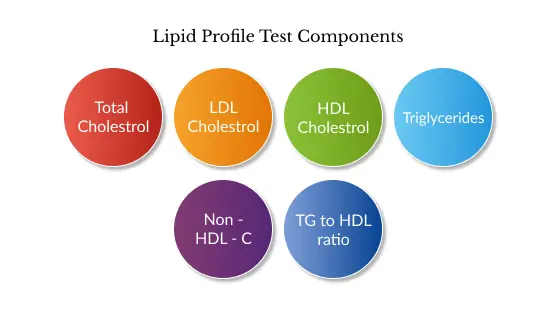
To assess the risk of heart diseases, a lipid profile test is done that checks the levels of fats or lipids in the blood. There are various types of lipids in the body such as HDL (high-density cholesterol), LDL (low-density cholesterol), VLDL (very-low-density lipoprotein), triglycerides, and total cholesterol. The body uses these lipids in the form of energy and are very important for normal and day-to-day functioning of the body. The test measures all these lipids and some of these are described below:
Lipid Profile Test

  • Cholesterol Total: This test in the lipid profile assesses the total amount of cholesterol in the blood. It helps to digest fats in the body and is made in the liver and intestines. It is vital for the body and any imbalance may cause a risk to the cardiovascular system.
  • Cholesterol HDL: It measures the levels of high-density lipoprotein cholesterol in the body which is crucial to maintain cardiovascular health. It maintains the health of the heart by passing excess LDL to liver which helps in preventing the excess formation of plaque in the blood.
  • Cholesterol LDL: A low-density-cholesterol lipoprotein cholesterol test measures the levels of LDL in the blood. Its function is to pass the cholesterol in the various body parts to help in cell formation. But it is also known as bad cholesterol because an excess amount of this cholesterol can be dangerous for the blood vessels, which could make the blood flow difficult causing heart diseases.
  • Triglycerides: It is a type of fat in the blood that the body uses as energy to maintain its functioning. The calories from food are converted into triglycerides and are used later by the body when required. High levels of this lipid can make blood vessels thick and narrow which could result in the development of cardiovascular diseases, stroke, and heart attack.
 

What is the booking process of Lipid profile Test?

The test can be booked in the following manner:

  • Search for the lipid profile test on the website.
  • Find the blue form on the website that contains various particulars.
  • Fill out the form mentioning correct details such as name, address, phone, email, date of appointment, time slot, etc.
  • Submit the form and make the payment. Now your booking process is done and your home sample collection will be done as per your chosen date and time.
 

How can I prepare for a lipid profile test?

Some compulsory and basic preparations before a lipid profile test are as follows:

  • Fasting overnight for at least 8-10 hours is the primary requirement of a lipid profile test.
  • Apart from that try to get enough sleep and rest before the test to avoid any imbalance in the test reports.
  • Also, for easy sample collection try to avoid wearing tight-fitting clothes.
  • Keep yourself hydrated as it can improve the blood composition and helps the test reports to be accurate.
 

How to interpret the results of the Lipid Profile Test?

The reports of the lipid profile test are prepared on the basis of the blood test and several parameters are taken into consideration. If the level of the parameters is higher or lower than normal, it indicates a risk of heart disease, stroke or other cardiovascular problems. Higher and lower levels indicate that there is a risk of cardiovascular diseases, and heart attack.

Additionally, if a person already has symptoms of diabetes or obesity, then there is a higher chance of the development of heart disease. In order to understand the reports with much more clarity, it is advised to consult a doctor and take necessary steps to lower the risk of cardiovascular disease or heart attack.


Why should I get the Lipid Profile test done with Mediyaar?

Mediyaar is concerned with providing quality service to its customers at an affordable price which has no hidden charges. To provide customer satisfaction, home sample collection is available here and the testing is done in the Thyrocare laboratories that are equipped with latest technologies. The labs also have the necessary certifications of CAP, NABL, and ISO that ensure genuine test reports.
Lipid Profile visual guide

Lipid Profile Reference Guide

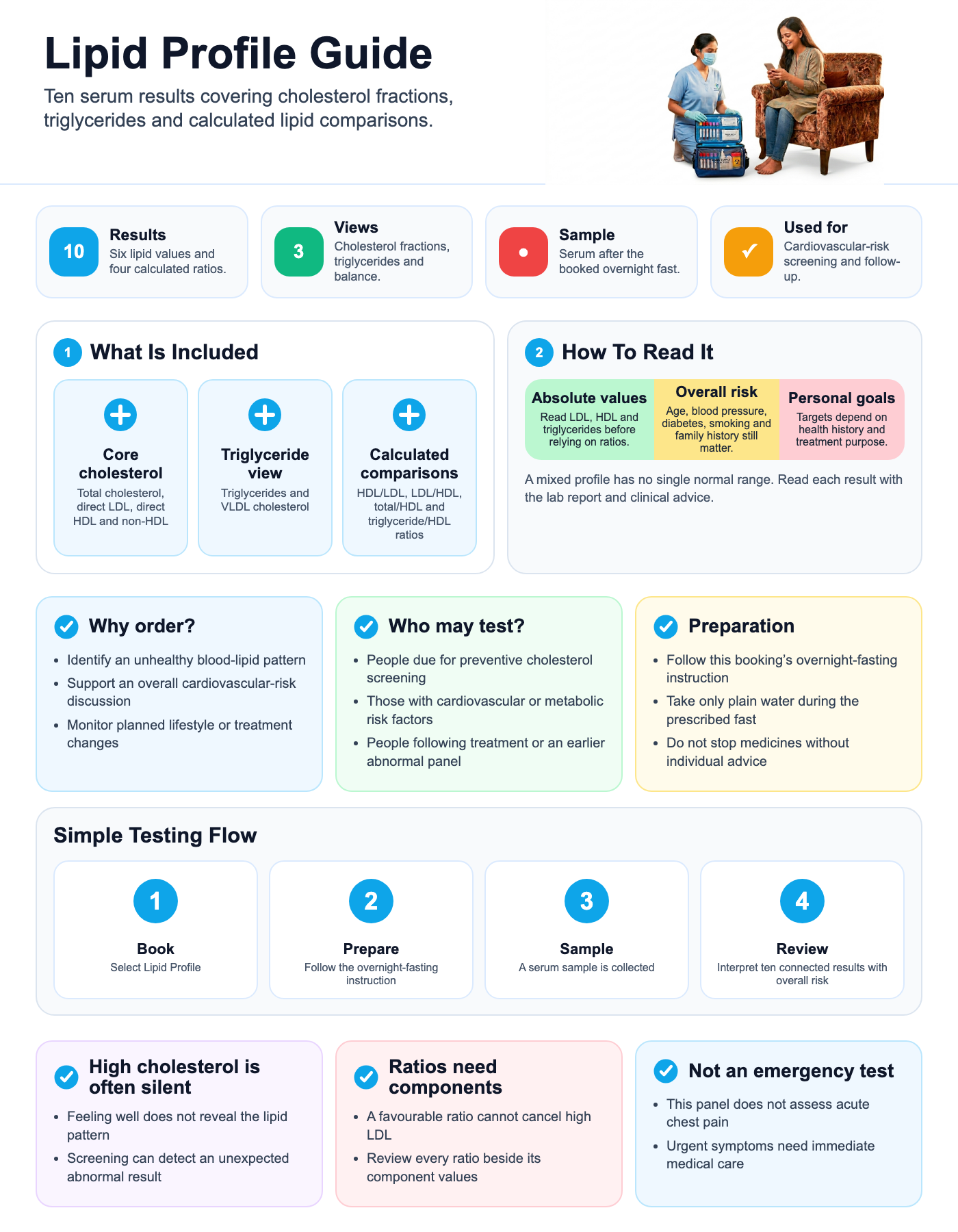
  • This profile reports ten connected serum results from one LIPID group.
  • Direct LDL and HDL sit beside total cholesterol, triglycerides, non-HDL and VLDL cholesterol.
  • Four calculated ratios compare values already present in the same panel.
  • No single result can describe a person’s complete cardiovascular risk.
  • Interpretation should combine absolute values, personal risk factors, treatment history and the laboratory report.

Why This Test Is Ordered

Start with total, LDL and HDL cholesterol
  • Total cholesterol summarises cholesterol carried across several blood lipoproteins.
  • Direct LDL reports an important artery-related cholesterol fraction in this panel.
  • Higher LDL exposure contributes to cholesterol accumulation within artery walls.
  • Direct HDL reports cholesterol carried in high-density lipoprotein particles.
  • HDL participates in cholesterol transport but does not erase other risk factors.
  • A higher HDL value cannot automatically cancel high LDL or smoking exposure.
  • Read all three values with age, blood pressure, diabetes and family history.
  • The panel cannot show whether plaque is already present in an artery.
Add triglycerides and VLDL context
  • Triglycerides are circulating fats that the body can use for energy.
  • Extra calories can be converted into triglycerides and stored in fat tissue.
  • Food, alcohol, diabetes and metabolic health can influence triglyceride levels.
  • Very high triglycerides also raise concern about acute pancreatitis risk.
  • VLDL particles carry much of the triglyceride circulating in fasting blood.
  • Laboratories may estimate VLDL using triglycerides under suitable conditions.
  • Check the report method before assuming VLDL was directly measured.
  • Interpret triglycerides beside LDL, HDL, medicines and recent preparation.
Use non-HDL as a broader cholesterol view
  • Non-HDL cholesterol equals total cholesterol minus HDL cholesterol.
  • It summarises cholesterol carried outside the HDL fraction.
  • This broader value includes LDL and other potentially atherogenic particles.
  • Non-HDL can add context when triglycerides are raised.
  • It remains a calculated value derived from two reported components.
  • Review total cholesterol and HDL before interpreting a changed non-HDL value.
  • Non-HDL does not separately measure ApoB or lipoprotein(a).
  • Those advanced markers require their own tests when clinically indicated.
Treat four ratios as supporting comparisons
  • The profile includes HDL/LDL, LDL/HDL, total/HDL and triglyceride/HDL ratios.
  • Each ratio compares two values already reported elsewhere in the panel.
  • Ratios are calculations rather than four additional blood substances.
  • A ratio can help describe balance between its two components.
  • It cannot replace the absolute LDL, HDL or triglyceride result.
  • A favourable ratio may coexist with an absolute value needing attention.
  • Never apply a copied target without checking the ratio direction and units.
  • Use the laboratory’s labels because reciprocal ratios have opposite meanings.
Detect a pattern that may cause no symptoms
  • High cholesterol commonly produces no warning symptoms during routine daily life.
  • Feeling healthy therefore cannot confirm that lipid values are favourable.
  • A blood test is needed to identify an unhealthy cholesterol pattern.
  • Screening can find raised LDL before a cardiovascular event occurs.
  • The appropriate testing interval depends on age and personal risk.
  • Heart disease, diabetes and family history can justify more frequent checks.
  • A normal panel does not guarantee that future cardiovascular disease will not occur.
  • Risk assessment still considers factors that this blood panel does not measure.
Follow response to a planned intervention
  • Repeat testing can show response to prescribed lipid-lowering treatment.
  • It can also follow sustained food, activity, weight or alcohol changes.
  • Comparable preparation and timing make trends easier to interpret.
  • Bring earlier reports rather than relying on memory of one number.
  • Improvement in LDL does not automatically resolve every cardiovascular risk factor.
  • An unexpected trend may reflect adherence, biology, illness or another medicine.
  • Repeat timing should follow the purpose of treatment and the clinician’s plan.
  • Do not change a prescribed dose solely from an unreviewed result.

Symptoms And Who Should Test

People due for preventive screening
  • Adults may need cholesterol screening even when they feel completely well.
  • Screening schedules vary with age, guideline and earlier results.
  • Heart disease or diabetes usually changes how often cholesterol is checked.
  • A family history of high cholesterol may also shorten the interval.
  • Children and adolescents can need screening under age-specific guidance.
  • Use a clinician’s recommendation instead of delaying for a generic online schedule.
  • This panel supplies lipid information but not a complete preventive examination.
  • Blood pressure, glucose and other risk factors need separate assessment.
People with cardiovascular risk factors
  • Smoking, high blood pressure and diabetes increase cardiovascular concern.
  • Chronic kidney disease and obesity can also change risk assessment.
  • Low activity and an unhealthy eating pattern may influence lipid levels.
  • Several risk factors can interact rather than simply adding one another.
  • The profile describes the lipid portion of a wider risk picture.
  • It does not measure blood pressure, glucose control or kidney function.
  • A clinician may use a formal risk calculation with the lipid results.
  • Treatment decisions should reflect total risk, not one isolated cholesterol value.
People with diabetes or metabolic concerns
  • Diabetes can accompany raised triglycerides and an unfavourable HDL pattern.
  • Excess weight and insulin resistance may produce related lipid changes.
  • ApoB can add information when triglycerides create uncertainty about particle burden.
  • ApoB is not included among these ten listed results.
  • The profile also does not include glucose or HbA1c.
  • Diabetes monitoring must continue separately from the lipid assessment.
  • Very high triglycerides deserve timely review beyond long-term heart risk.
  • Individual treatment goals depend on diabetes history and cardiovascular risk.
People with relevant family history
  • High LDL cholesterol and early cardiovascular disease can run in families.
  • Record which relative was affected and their age at diagnosis.
  • Markedly raised LDL may suggest familial hypercholesterolaemia in the right context.
  • A lipid panel alone cannot confirm an inherited genetic condition.
  • Clinical examination and a detailed family history remain important.
  • Some people need specialist review or genetic testing for confirmation.
  • Relatives should not copy another person’s medicine or cholesterol target.
  • Each family member needs an individual assessment and treatment plan.
People following an earlier abnormal result
  • An abnormal panel usually starts a clinical review rather than proving one cause.
  • A clinician may repeat selected results before making a treatment decision.
  • Diabetes, hypothyroidism and chronic kidney disease can influence cholesterol patterns.
  • Alcohol use and liver conditions can particularly affect triglycerides.
  • Pregnancy and selected medicines may also change lipid values.
  • Very high LDL can prompt assessment for an inherited cholesterol disorder.
  • The current profile does not include thyroid, glucose, kidney or liver testing.
  • Additional tests should answer the suspected cause rather than be added routinely.

Preparation And Interpretation Notes

Follow this booking’s overnight fast
  • This specific Lipid Profile booking requires overnight fasting before collection.
  • Take only plain water during the prescribed fasting window.
  • Avoid food, juice, tea, coffee and sweetened drinks while fasting.
  • Do not chew gum, smoke or exercise during the fasting period.
  • Schedule an early collection if that makes the overnight fast easier.
  • Do not extend the fast beyond the instructed duration without advice.
  • General non-fasting lipid guidance does not override this booking instruction.
  • Ask the collection service when the fasting duration is unclear.
Coordinate medicines and fasting safely
  • List prescriptions, non-prescription medicines, vitamins and supplements before collection.
  • Do not stop or delay regular medicine unless specifically instructed.
  • Some medicines can influence cholesterol or triglyceride results.
  • Abruptly stopping essential treatment can create avoidable medical risk.
  • Insulin and glucose-lowering medicines need individual planning during a fast.
  • Pregnancy, frailty or an eating disorder may also require tailored advice.
  • Record any missed or differently timed dose for the report review.
  • Contact the clinician before fasting when the instruction may be unsafe.
Keep recent habits representative
  • Follow the exact preparation message rather than attempting a short detox.
  • Avoid extreme food changes intended only to improve one laboratory number.
  • Recent alcohol can influence triglycerides in susceptible people.
  • Follow any separate alcohol-avoidance instruction provided with the booking.
  • Ordinary hydration with plain water supports routine venous collection.
  • Tell the collection team if anything except water broke the fast.
  • They can advise whether to proceed or arrange another collection.
  • The aim is a representative sample, not an artificially favourable result.
Read values, ratios and units correctly
  • Use the units and reference information printed on the current report.
  • Review direct LDL and HDL before interpreting their reciprocal ratios.
  • Read total cholesterol beside its total-to-HDL ratio.
  • Read triglycerides beside VLDL and the triglyceride-to-HDL ratio.
  • Personal LDL goals can differ after heart attack, stroke or diabetes.
  • Pregnancy, kidney disease and other conditions can change interpretation.
  • Do not select whichever absolute value or ratio looks most reassuring.
  • A clinician should reconcile apparently conflicting parts of the pattern.
Plan appropriate follow-up and urgent care
  • A Lipid Profile is a planned screening or monitoring test.
  • It cannot assess acute chest pain, breathlessness or sudden neurological symptoms.
  • Urgent symptoms need immediate medical assessment instead of routine lipid testing.
  • Routine abnormal results should be reviewed within the advised timeframe.
  • Bring previous reports, medicine details and relevant family history.
  • Follow-up may address food, activity, smoking, weight and blood pressure.
  • Medicine may be appropriate when overall risk and lipid levels justify it.
  • Avoid crash diets, unprescribed supplements and self-started cholesterol medicines.

Frequently Asked Questions

What does this Lipid Profile include?

It includes ten serum results covering cholesterol, triglycerides, VLDL, non-HDL and four ratios.

Is overnight fasting required?

Yes; follow the booked overnight-fast instruction and take only plain water.

Can I take medicines during the fast?

Ask your prescriber, and never stop regular medicine without individual advice.

Does high cholesterol always cause symptoms?

No; unhealthy cholesterol is often silent, so a blood test is needed.

Is this a complete heart check-up?

No; it measures blood lipids but does not examine the heart or arteries.

What is non-HDL cholesterol?

It is total cholesterol minus HDL and summarises cholesterol outside the HDL fraction.

Why are four lipid ratios included?

They compare existing values and must be read beside their absolute components.

Can one favourable ratio cancel high LDL?

No; absolute LDL and overall cardiovascular risk still require review.

Does this profile include ApoB or Lp(a)?

No; ApoB and lipoprotein(a) are separate tests when clinically indicated.

Can I book home collection?

Home collection is available where the entered address is serviceable.

Who should review my Lipid Profile?

A clinician should interpret it with risk factors, medicines and earlier results.

Test Conducted By

Rs. 620
Home Sample Collection Available No Extra Charges
You will Save Rs. 0 on this Test
CAP Accredited NABL Accredited UKAS Management Systems ANAB Accredited

Why Choose Thyrocare for Lipid Profile

Get tested for Lipid Profile at fully automated diagnostic laboratory Thyrocare which has Centralized Processing Lab (CPL)
for esoteric tests and Regional Processing Labs in major cities of India.

Home Based Diagnostics

Home Based & Quality Diagnostics
at an Unbeatable Price


Carefully designed Panels to provide you with the most vital information for your health.

Convenient Home Based

Affordable — Book Online

Certified Labs — NABL, CAP, ISO

Graphical Reports Online

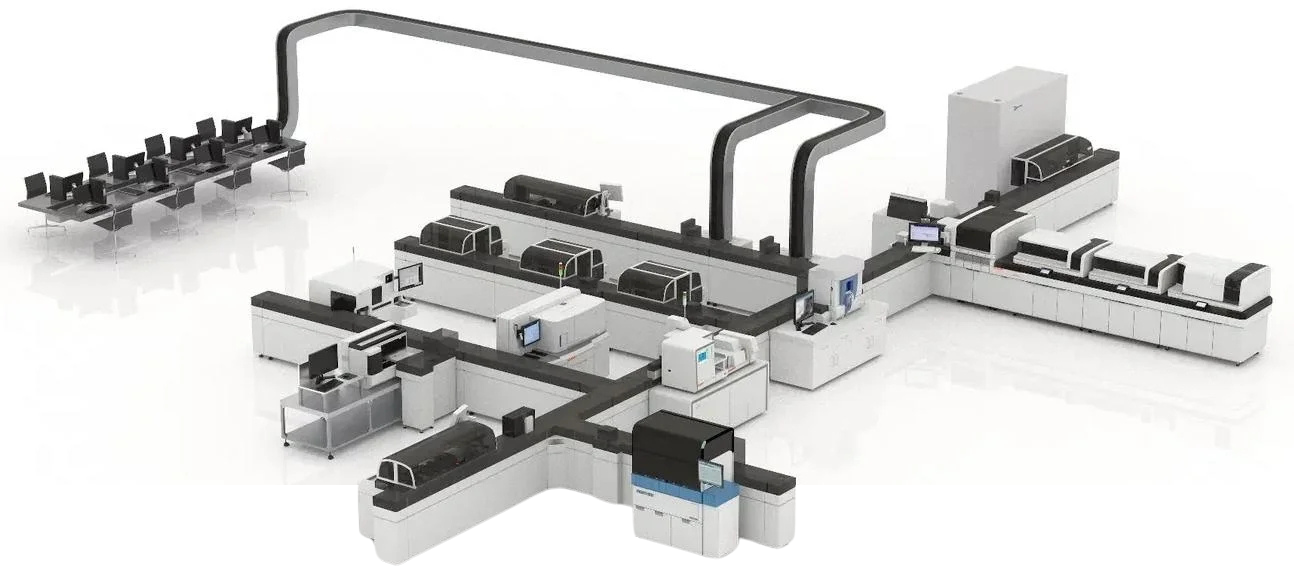
World's largest laboratory track automation

Thyrocare Technologies Limited has huge set up covering over 2 Lakh sq. ft. floor area ensures zero error processing if approx 50 thousand
specimens and over 3 lakh Clinical investigations per day is the right choice for your Lipid Profile testing.

Aptio™ Automation

Aptio Automation

Service for Lipid Profile test is available in all the major cities across India including Delhi, Pune, Kolkata, Chennai, Ghaziabad, Noida, Bangalore, Mumbai, Hyderabad, Gurgaon, Ludhiana, Cuttack, Coimbatore, Lucknow, Chandigarh, Bhopal, Nagpur, Gwalior, Amritsar, Indore, Jodhpur, Allahabad, Madurai, Guwahati, Ahmedabad, and 200 more tier 2 cities.


Living a city life, and dealing with health conditions is not a news, considering the unhealthy environment and hectic lifestyle. In such a scenario, people develop various health issues and getting tested for them becomes a common occurrence. A lipid profile test is also one of those routine health checkups that residents opt for in day-to-day life.

A lipid profile test includes a number of tests that examine the levels of fats in the blood. These tests are HDL, LDL, VLDL, triglycerides, etc. The excess or deficiency in these lipids may pose a threat to the heart health of an individual. Therefore, a test can clarify the need for the right kind of treatment and course of medication.