Choose your City

View more

A Vitamin D test in Coimbatore measures the level of vitamin D & diagnose Vitamin D Deficiencies in blood.

Vitamin D Test in Coimbatore

A Vitamin D test in Coimbatore measures the level of vitamin D & diagnose Vitamin D Deficiencies in blood.

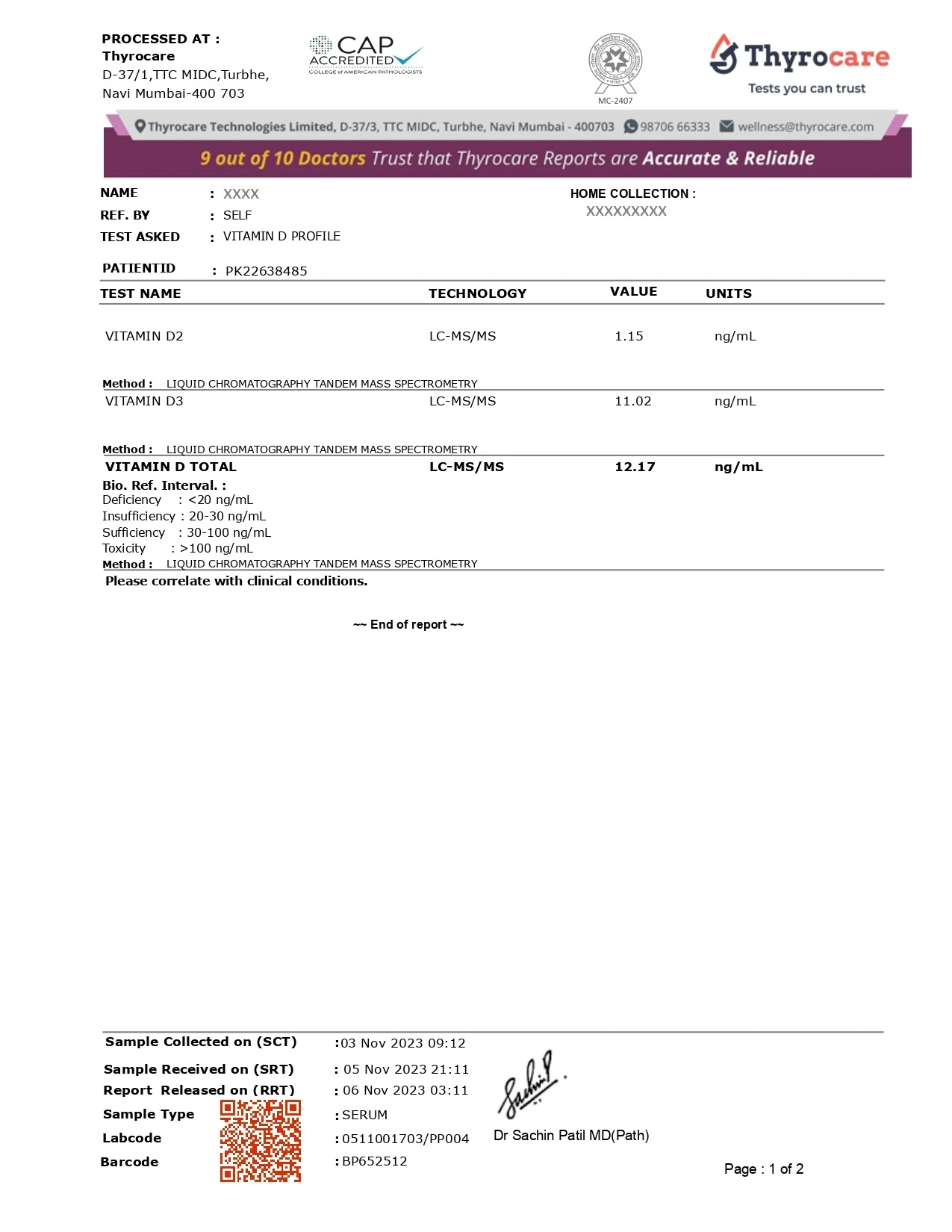
Vitamin D Profile Sample Report

Group Name VITAMIN
Fasting Fasting not required
Sample Type SERUM
Sample Collection Expert collect samples at Home
Reports Delivered Online within 24-48 Hrs*
Report type Email & Hardcopy ( On request )

Parameters Included in Vitamin D Profile

What tests are included in the Vitamin D Profile?


Vitamin (3 Tests)

  • Vitamin d total
  • Vitamin d2
  • Vitamin d3
Vitamin D Profile Sample Report
Vitamin D Profile Sample report & Ranges
Conducted at Thyrocare Labs
Lab Accreditation CAP, NABL, ICMR, NGSP, ISO
Method Liquid Chromatography-Tandem Mass Spectrometry
Technology LC-MS/MS
Supervision Dr Sachin Patil MD (Path)
Normal Vitamin D Levels 20-100 ng/mL
Low Vitamin D Levels Less Than 20 ng/mL
High Vitamin D Levels Greater Than 100 ng/mL
Results Highly Specific

The optimal range of vitamin D in an average adult must be between 20 to 100 ng/ml. Levels below 20 ng/ml are low and may cause bone problems. Whereas, levels above 100 ng/ml.


Vitamin D Profile Sample Report & Ranges

Conducted at Thyrocare Labs
Lab Accreditation CAP, NABL, ICMR, NGSP, ISO
Method Liquid Chromatography-Tandem Mass Spectrometry
Technology LC-MS/MS
Supervision Dr Sachin Patil MD (Path)
Normal Vitamin D Levels 20-100 ng/mL
Low Vitamin D Levels Less Than 20 ng/mL
High Vitamin D Levels Greater Than 100 ng/mL
Results Highly Specific

The optimal range of vitamin D in an average adult must be between 20 to 100 ng/ml. Levels below 20 ng/ml are low and may cause bone problems. Whereas, levels above 100 ng/ml.


Vitamin D Profile Sample Report

Vitamin D Profile Overview

Why is Vitamin D Profile Test done?

Taking a Vitamin D test can help you-

  • To be aware of your vitamin intake. 

  • Know the insufficiency and necessary steps to take to balance the levels.

  • Consult your doctor for further treatment courses and medication based on your reports. 

  • In managing the disease caused by low levels of vitamin D deficiency.

  • To know the range of Vitamin D, if you have been recommended because of bone disorders or other health problems.


When to take Vitamin D Profile Test?

The need to take a Vitamin D test arises if you are experiencing any deficiency symptoms, such as fatigue, weakness, muscle cramps, and bone disorders. Or else, if you have been experiencing any serious health conditions such as liver dysfunction, kidney failure, obesity, digestion issues, or bone deformity.

Your doctor may recommend you to get the test done if he detects any sign which might be due to the deficiency. It is best to get the test in time to prevent the health problems from getting worse. If you decide to book the vitamin D test in Coimbatore, you will get affordable pricing with Mediyaar.


Symptoms of Vitamin D deficiency

The major symptoms of vitamin D deficiency comprise:

  • Bone pain and weakness

  • Muscle cramps

  • Trouble maintaining balance

  • Eating disorders

  • Pale and dull skin

  • Fatigue

  • Problems in digestion

  • Neurological disorders

  • Confusion

  • Mood swings


Causes of Vitamin D deficiency

  • Insufficient sunlight exposure is the biggest cause of low Vitamin D deficiency among individuals.

  • Not eating a balanced diet, including leafy vegetables, fruits, and nuts, adds to the deficiency.

  • Some prolonged illnesses such as kidney or liver dysfunction may also make it difficult to maintain vitamin D levels in the blood.

  • Malabsorption disorder makes it difficult for the body to absorb sufficient vitamin D levels through diet or supplements.


Parameters of Vitamin D Test

The Vitamin D Profile test includes 3 main parameters, namely, Vitamin D total, Vitamin D2, and D3. Your test results will be based on these three parameters. 

Vitamin D total, D2, and D3 are forms of vitamin D essential for the human body’s healthy functioning. The deficiency of these vitamins may cause the bones to become weak and brittle and may cause other serious health issues. Sunlight is a major source of vitamin D. It can be balanced also by eating a balanced diet. Food sources include both animal-based and plant-based foods. Other food sources are dietary products, cereals, fish, and beef. In certain cases, supplements are also necessary. 


Book Vitamin D Test Online at home with Mediyaar in Coimbatore

Once you search ‘vitamin D profile test near me’, the search engine will provide you with the link to Mediyaar. Here, you can read all about the test and proceed to fill out the form. You can also book the test for more than one person. The option of doing the same is available in the form. After the booking process is complete, you can make the payment online and your appointment will be fixed with our healthcare expert.
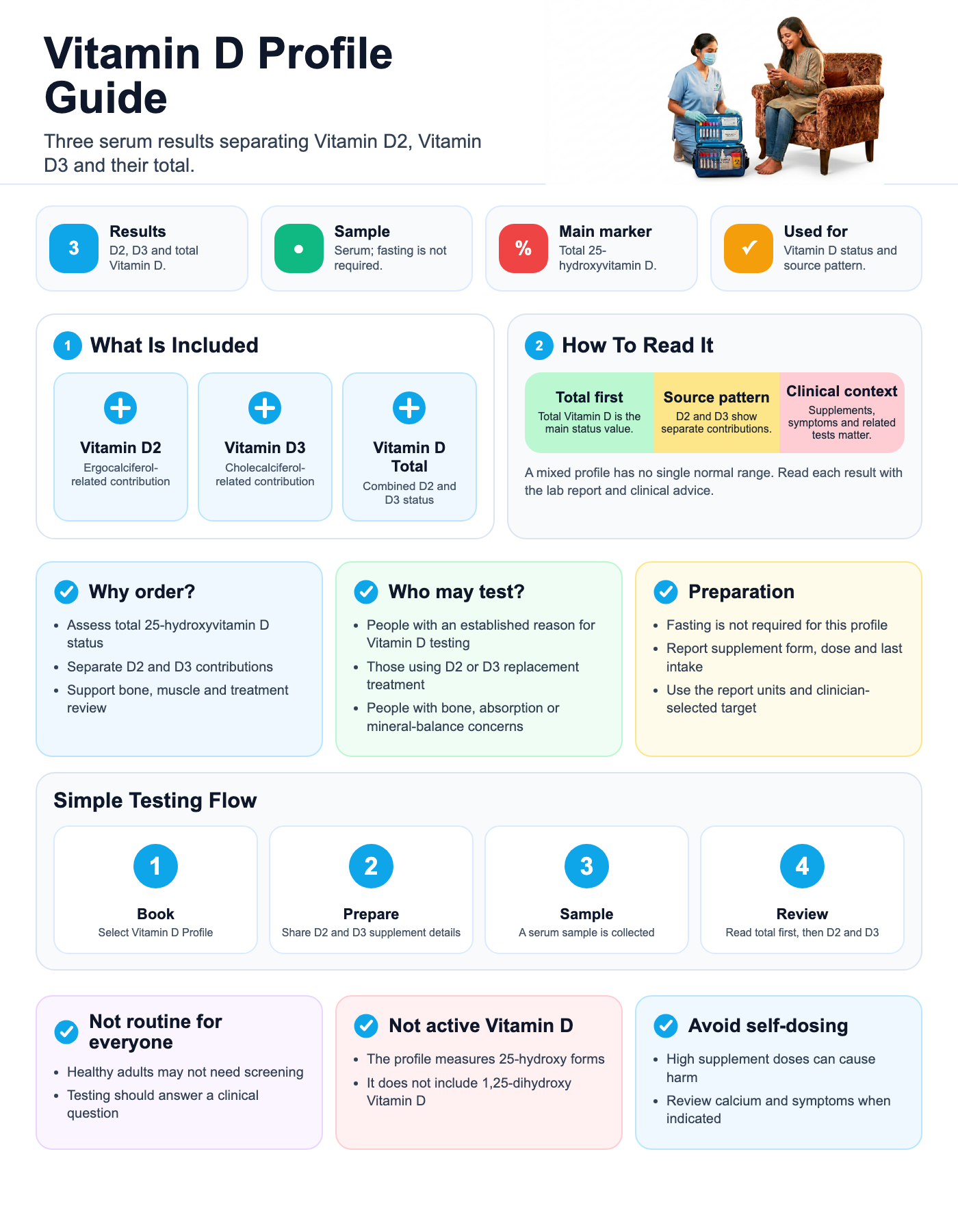
Vitamin D Profile visual guide

Vitamin D Profile Reference Guide in Coimbatore

  • Vitamin D Profile reports Vitamin D2, Vitamin D3 and their combined total in serum.
  • The total 25-hydroxyvitamin D result is the main marker used to assess Vitamin D status.
  • Separate D2 and D3 results can clarify dietary, sunlight and supplement contributions.
  • The profile does not include active 1,25-dihydroxyvitamin D or related mineral tests.
  • Interpretation should reflect symptoms, treatment, calcium balance, health conditions and the report method.
  • Medical guidance stays consistent; use this page for Coimbatore pricing and collection details.

Why This Test Is Ordered

Understand the three-result profile
  • Vitamin D Profile separates 25-hydroxyvitamin D2 and D3 in serum.
  • It also reports a total representing the combined D2 and D3 contribution.
  • The total result is usually the main value for assessing Vitamin D stores.
  • Separate fractions provide extra information about the likely form entering the body.
  • D2 and D3 follow similar metabolic pathways after absorption or skin production.
  • Both forms can contribute to the circulating total 25-hydroxyvitamin D concentration.
  • Three reported values therefore describe one connected Vitamin D status pattern.
  • They should not be interpreted as three independent deficiencies or diseases.
Use total Vitamin D as the status marker
  • The liver converts Vitamin D into 25-hydroxyvitamin D for circulation and storage assessment.
  • Most routine status testing measures this 25-hydroxy form rather than active Vitamin D.
  • The total combines measured D2 and D3 contributions into the principal report value.
  • A low total can support deficiency assessment when the clinical context is appropriate.
  • One result cannot identify the reason for a low concentration.
  • Sun exposure, diet, absorption, body composition and organ health can all matter.
  • Laboratory methods and clinical guidelines may apply different interpretive thresholds.
  • Use the report range and clinician-selected goal instead of a universal target.
Read the Vitamin D2 contribution
  • Vitamin D2 is also called ergocalciferol and is available in selected supplements.
  • Some fortified foods and fungal sources can also contribute Vitamin D2.
  • The liver converts absorbed D2 into circulating 25-hydroxyvitamin D2.
  • A detectable D2 fraction may reflect diet or an ergocalciferol treatment product.
  • A low D2 fraction alone does not establish overall Vitamin D deficiency.
  • Total Vitamin D may remain adequate when the D3 contribution is sufficient.
  • D2 measurement can help evaluate response when prescribed treatment specifically contains ergocalciferol.
  • Supplement labels and prescription records are essential for meaningful D2 interpretation.
Read the Vitamin D3 contribution
  • Vitamin D3 is also called cholecalciferol and can be produced in exposed skin.
  • Fatty fish, egg yolks, fortified foods and supplements can also provide D3.
  • The liver converts D3 into circulating 25-hydroxyvitamin D3.
  • D3 often forms most of the total in people not taking Vitamin D2.
  • A measured D3 result does not quantify recent sunlight exposure precisely.
  • Season, clothing, skin pigmentation, latitude and outdoor habits affect skin production.
  • D3 supplements may raise total 25-hydroxyvitamin D differently from equivalent D2 doses.
  • Interpret the fraction beside the supplement form, dose and treatment duration.
Connect Vitamin D with bone and muscle health
  • Vitamin D supports calcium absorption and normal bone mineralisation.
  • Severe deficiency can contribute to rickets in children or osteomalacia in adults.
  • Low status may accompany bone pain, muscle weakness or fracture risk.
  • These symptoms are common and can arise from many other conditions.
  • Vitamin D testing does not directly measure bone density or fracture strength.
  • Calcium, phosphate, alkaline phosphatase and parathyroid hormone may provide related context.
  • Bone imaging or density testing answers questions not covered by this profile.
  • Treatment decisions should combine laboratory findings with age, history and clinical risk.

Symptoms And Who Should Test

People with a clinical testing indication
  • Routine Vitamin D screening is not recommended for every healthy adult.
  • Testing is more useful when it addresses a defined symptom, condition or treatment question.
  • A clinician may investigate suspected rickets, osteomalacia or abnormal calcium balance.
  • Low bone density, fragility fractures or persistent bone pain may also prompt testing.
  • Muscle weakness can support assessment but is not specific for Vitamin D deficiency.
  • Testing may be considered before or during selected bone-health treatments.
  • The reason for testing should guide which related investigations are added.
  • A screening result should not replace a complete clinical assessment.
People at risk of poor absorption
  • Conditions affecting fat absorption can reduce uptake of fat-soluble Vitamin D.
  • Coeliac disease, inflammatory bowel disease and selected pancreatic disorders may increase risk.
  • Bariatric surgery can also change Vitamin D absorption and supplement requirements.
  • Liver disease may affect conversion into circulating 25-hydroxyvitamin D.
  • Kidney disease affects later activation and overall mineral metabolism.
  • This profile does not measure calcium, phosphate, parathyroid hormone or kidney function.
  • Monitoring plans should follow the underlying condition and prescribed treatment.
  • Dietitian or specialist input may be needed when malabsorption is established.
People with limited Vitamin D sources
  • Limited outdoor exposure can reduce the skin’s opportunity to produce Vitamin D3.
  • Covering most skin, season and latitude can also reduce ultraviolet exposure.
  • Darker skin pigmentation can reduce Vitamin D production from a given exposure.
  • Older skin generally produces less Vitamin D3 than younger skin.
  • Few foods naturally contain substantial Vitamin D without fortification.
  • These factors indicate risk but do not prove a low blood concentration.
  • Sun exposure advice must also consider skin-cancer prevention and individual circumstances.
  • Testing decisions should follow clinical need rather than risk factors alone.
People taking D2 or D3 treatment
  • Separate fractions can help show whether D2 or D3 contributes to treatment response.
  • Bring the supplement or prescription label when the product form is uncertain.
  • Record the dose, schedule, start date and timing of the last dose.
  • Adherence, absorption and treatment duration can all affect the measured response.
  • A total that remains low does not prove that the prescribed product failed.
  • The clinician may review dose accuracy, adherence, absorption and related medical conditions.
  • Repeat timing should allow enough time for the planned treatment response.
  • Do not switch between D2 and D3 products solely from one fraction result.
People at risk from excessive supplementation
  • Very high supplement intake can raise total Vitamin D and blood calcium.
  • Vitamin D toxicity usually relates to excessive supplements rather than ordinary sunlight exposure.
  • Possible effects include nausea, weakness, thirst, frequent urination and kidney problems.
  • Symptoms are non-specific and require calcium and kidney assessment when concerning.
  • This profile does not include serum calcium or kidney-function measurements.
  • High-dose therapy needs a defined indication, dose plan and monitoring schedule.
  • Do not combine multiple Vitamin D products without checking their total dose.
  • Confusion, repeated vomiting or marked dehydration needs prompt clinical assessment.

Preparation And Interpretation Notes

Follow the profile collection instructions
  • Fasting is not required for this three-result Vitamin D Profile.
  • Follow stricter instructions when another booked test requires fasting.
  • A trained professional collects venous blood and prepares serum for analysis.
  • Maintain ordinary food and fluid habits unless a clinician advises otherwise.
  • Do not take an extra supplement dose to improve the test result.
  • Minor discomfort or bruising can follow a routine venous blood draw.
  • Tell the collector about fainting, difficult draws or blood-thinning medicines.
  • Preparation for another Vitamin D method may differ from this profile.
Document supplements and medicines
  • List every Vitamin D, calcium and multivitamin product before interpretation.
  • Identify whether each product contains D2, D3 or an unspecified form.
  • Record the strength in international units or micrograms and the dosing schedule.
  • Mention prescription loading doses, injections or combination bone-health products.
  • Some medicines can alter Vitamin D metabolism or absorption over time.
  • Report anticonvulsants, glucocorticoids and medicines used for fat-malabsorption when relevant.
  • Do not stop prescribed treatment unless the treating clinician advises it.
  • The last-dose timing helps compare results across repeated measurements.
Share diet, sunlight and health context
  • Describe major changes in outdoor exposure, diet or fortified-food intake.
  • Mention recent prolonged illness, reduced mobility or major weight change.
  • Share known liver, kidney, digestive, parathyroid or bone conditions.
  • Report pregnancy, older age or previous bariatric surgery when relevant.
  • Seasonal variation may affect D3 contribution and the total result.
  • These factors provide context and do not automatically invalidate the sample.
  • A recent short sunny period does not guarantee an adequate total concentration.
  • Avoid unsafe ultraviolet exposure solely to change a laboratory number.
Interpret total, fractions and units
  • Review the total result first because it represents combined D2 and D3.
  • Then compare each fraction with the reported supplement form and clinical history.
  • A low D2 value can coexist with an adequate D3-driven total.
  • A detectable D2 value may reflect ergocalciferol intake rather than a disorder.
  • Check whether the report uses nanograms per millilitre or nanomoles per litre.
  • Do not compare numbers across different units without a correct conversion.
  • Interpretive thresholds vary among laboratories and professional guidance.
  • Use trends cautiously when the laboratory method or supplement regimen changes.
Know the profile limits and next steps
  • This profile does not include active 1,25-dihydroxyvitamin D.
  • Active Vitamin D testing answers different kidney and calcium questions.
  • Calcium, phosphate, alkaline phosphatase and parathyroid hormone are not included.
  • Kidney and liver tests may be relevant when conversion or toxicity is questioned.
  • A clinician may repeat testing or add targeted investigations before changing treatment.
  • Do not self-start a high-dose course from one low result.
  • Do not continue excessive doses when a high result or toxicity is suspected.
  • Severe vomiting, confusion or dehydration needs prompt medical assessment.

Frequently Asked Questions

What does Vitamin D Profile include?

It includes Vitamin D2, Vitamin D3 and their combined total.

Is fasting required for this profile?

No; fasting is unnecessary unless another booked test requires it.

Which result shows overall Vitamin D status?

The combined total is usually the main status result.

Why are D2 and D3 reported separately?

They help show the contributions from different sources and supplements.

Does this include active Vitamin D?

No; 1,25-dihydroxyvitamin D is not included.

Does everyone need routine Vitamin D testing?

No; testing is most useful when a clinical indication exists.

Can supplements affect the result?

Yes; form, dose, schedule and treatment duration affect the pattern.

Does this profile include calcium?

No; calcium and related mineral tests are separate.

Can I book Vitamin D Profile in Coimbatore?

Vitamin D Profile home collection in Coimbatore is available where serviceable.

Who can review my Vitamin D report in Coimbatore?

A qualified clinician in Coimbatore can review it with your history.

When should I repeat Vitamin D testing in Coimbatore?

Repeat testing in Coimbatore should follow the clinician’s treatment plan.

Ratings & Reviews
4.8 ★★★★★

Based on verified bookings

Good service

Sample collection was smooth and reports were delivered on time.

Health Insights & Resources
View All Blogs →
Blog Title

August 20, 2025

The Role of AI in Medical Healthcare
Read More
Blog Title

August 19, 2025

Insulin Fasting Test: Why It’s Important
Read More
Blog Title

August 18, 2025

Why Every Indian Child Should Take a Full Body Test?
Read More
Blog Title

August 17, 2025

Food Poisoning in Hindi - फूड पॉइज़निंग क्या है? कारण, लक्षण, बचाव के
Read More
Test Conducted By
Vitamin D Test Price in Coimbatore : Rs. 3056
Rs. 1910 38% Off
Home Sample Collection Available No Extra Charges
You will Save Rs. 1146 on this Test
CAP Accredited NABL Accredited UKAS Management Systems ANAB Accredited
Lab Logo
Vitamin D Test Price in Coimbatore : Rs. 3056
Rs. 1910

Home Sample Collection Areas Pincodes in Coimbatore

641001| 641002| 641003| 641004| 641005| 641006| 641009| 641011| 641012| 641013| 641014| 641015| 641017| 641018| 641019
641020| 641022| 641025| 641027| 641028| 641029| 641030| 641031| 641033| 641034| 641035| 641036| 641037| 641038| 641041
641043| 641044| 641045| 641049| 641107| 642001| 642002| 642003| 642004| 642005| 642006