Choose your City

View more

Complete Vitamins Checkup including 14 Tests to assesses essential vitamins in the body, providing comprehensive insights into nutritional status & overall health.

Complete Vitamin Profile Test in Darbhanga

Complete Vitamins Checkup including 14 Tests to assesses essential vitamins in the body, providing comprehensive insights into nutritional status & overall health.

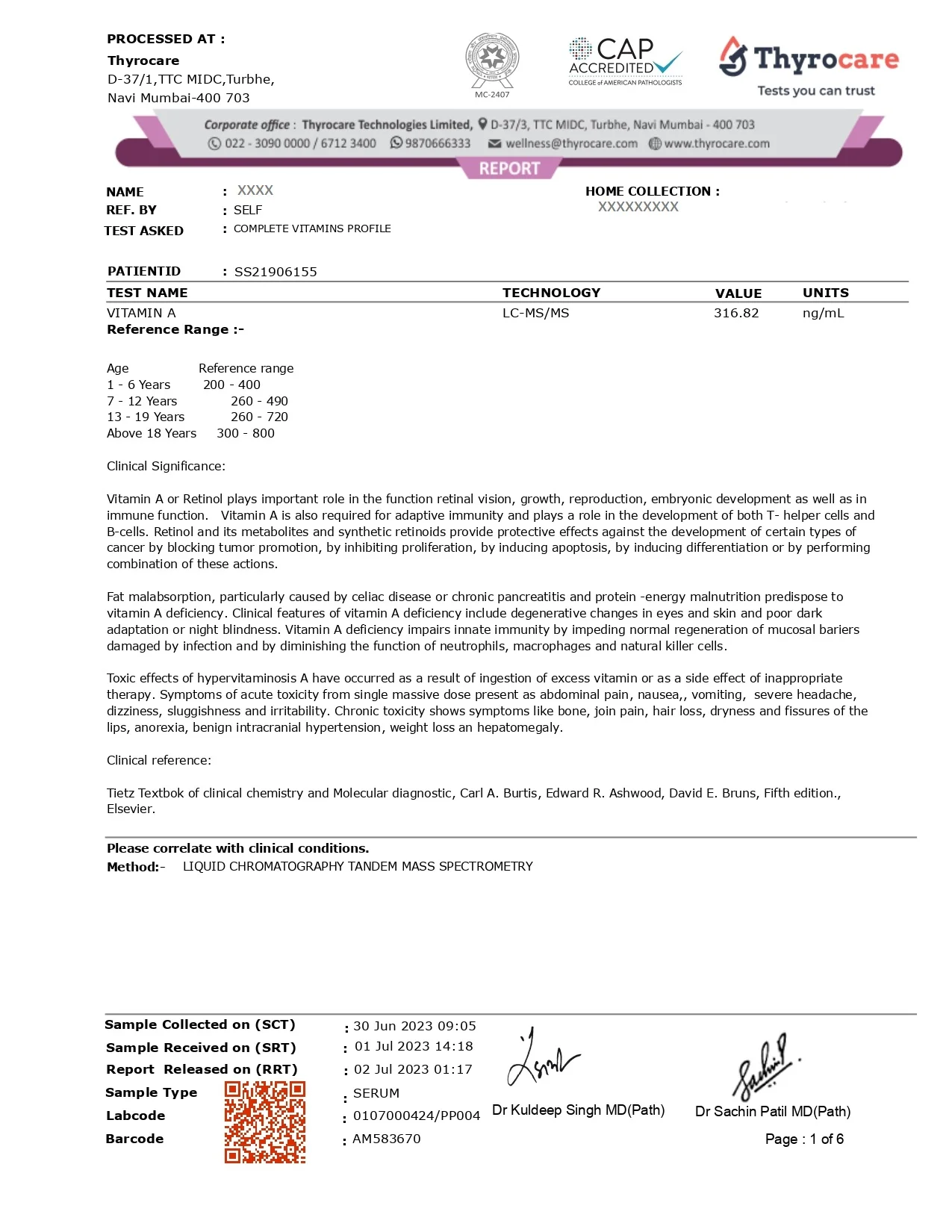
Complete Vitamin Profile Sample Report

Group Name WELLNESS
Fasting Fasting not required
Sample Type SERUM
Sample Collection Expert collect samples at Home
Reports Delivered Online within 24-48 Hrs*
Report type Email & Hardcopy ( On request )

Parameters Included in Complete Vitamins Profile

What tests are included in the Complete Vitamins Profile?


Vitamin (14 Tests)

  • Vitamin a
  • Vitamin b-12
  • Vitamin b1/thiamin
  • Vitamin b2/riboflavin
  • Vitamin b3/nicotinic acid
  • Vitamin b5/pantothenic
  • Vitamin b6/p5p
  • Vitamin b7/biotin
  • Vitamin b9/folic acid
  • Vitamin d total
  • Vitamin d2
  • Vitamin d3
  • Vitamin e
  • Vitamin k
Complete Vitamin Profile Sample Report
  • Previous        
  • Next
Complete Vitamins Profile Sample report & Ranges
Conducted at Thyrocare Labs
Lab Accreditation CAP, NABL, ICMR, NGSP, ISO
Method Liquid Chromatography-Tandem Mass Spectrometry
Technology LC-MS/MS
Supervision Dr Kuldeep Singh MD (Path), Dr Sachin Patil MD (Path)
Normal Vitamin D Levels 20-100 ng/mL
High Vitamin D Levels Greater Than 100 ng/mL
Low Vitamin D Levels Less Than 20 ng/mL
Results Highly Specific

Complete Vitamins Profile Sample Report & Ranges

Conducted at Thyrocare Labs
Lab Accreditation CAP, NABL, ICMR, NGSP, ISO
Method Liquid Chromatography-Tandem Mass Spectrometry
Technology LC-MS/MS
Supervision Dr Kuldeep Singh MD (Path), Dr Sachin Patil MD (Path)
Normal Vitamin D Levels 20-100 ng/mL
High Vitamin D Levels Greater Than 100 ng/mL
Low Vitamin D Levels Less Than 20 ng/mL
Results Highly Specific
Complete Vitamins Profile Sample Report

Complete Vitamins Profile Overview

Key role of Vitamins in our body

Vitamins help the body in the development, growth, and supporting metabolism. For our body to work, vitamins & minerals are necessary. It helps the bones to be strong, regulates hormones, and fights infection. Also, it increases immunity, helps in wound healing, and keeps the muscle healthy.


Benefits of Complete Vitamin Profile Test

  • In order to know the exact state of your health, a vitamin profile test is important for you. 

  • It can help to determine the levels of vitamins and minerals in your body. 

  • If you are suffering from a health condition, the test can help your doctor to make a better decision about your treatment.

  • The test reports help to prevent future health disorders.


What does vitamin deficiency do?

Vitamin deficiency can cause serious health problems. It is important to maintain balance. Some symptoms of the deficiency may include:

  • Bone and muscle pain

  • Weakness and fatigue

  • Weight loss or gain

  • Pale and dull skin

  • Neurological problems

  • Difficulty maintaining balance

  • Lightheadedness

  • Weak immunity

  • Frequent infections

  • Hair loss

  • Shortness of breath


Why do you get Vitamin Deficiency?

Insufficient levels of vitamins can be because of a number of reasons. They also depend on the individual’s medical history and overall health. Lifestyle factors play a major role in affecting the health. A hectic schedule, not taking a balanced diet, overconsumption of alcohol, and regular smoking can be some major causes. To maintain the normal levels of vitamins, diet changes and supplements help a lot.


Who is eligible for the Complete Vitamin Profile Test?

  • There are various parameters of eligibility.

  • The individual experiencing deficiency symptoms can take the test.

  • A person having major health issues and diseases.

  • Someone with a major vitamin deficiency requiring medical care is eligible for the test too.

  • Lastly, people having conditions like anemia are prescribed the test.


Precautions before the Vitamin Profile Test

There are no special preparations, such as fasting, needed before taking this test. You might need to take advice from your doctor in case you have a medical condition which requires special care. You might also be advised by the doctor to keep stress and anxiety at a distance. Some medications may have an impact on the results of the test. Therefore, it is best if you consult your doctor or the healthcare provider from our team to guide you about the same.


Book a Vitamin Profile test in Darbhanga at home

You can easily book the vitamin test in Darbhanga at home if you choose Mediyaar. All you need to do is search for a vitamin test in Darbhanga near me, and it will lead you to our website page. There you will find a form to fill out to book your test. You can select the time and date in the form Medical expert from our team collects the blood sample from your home.
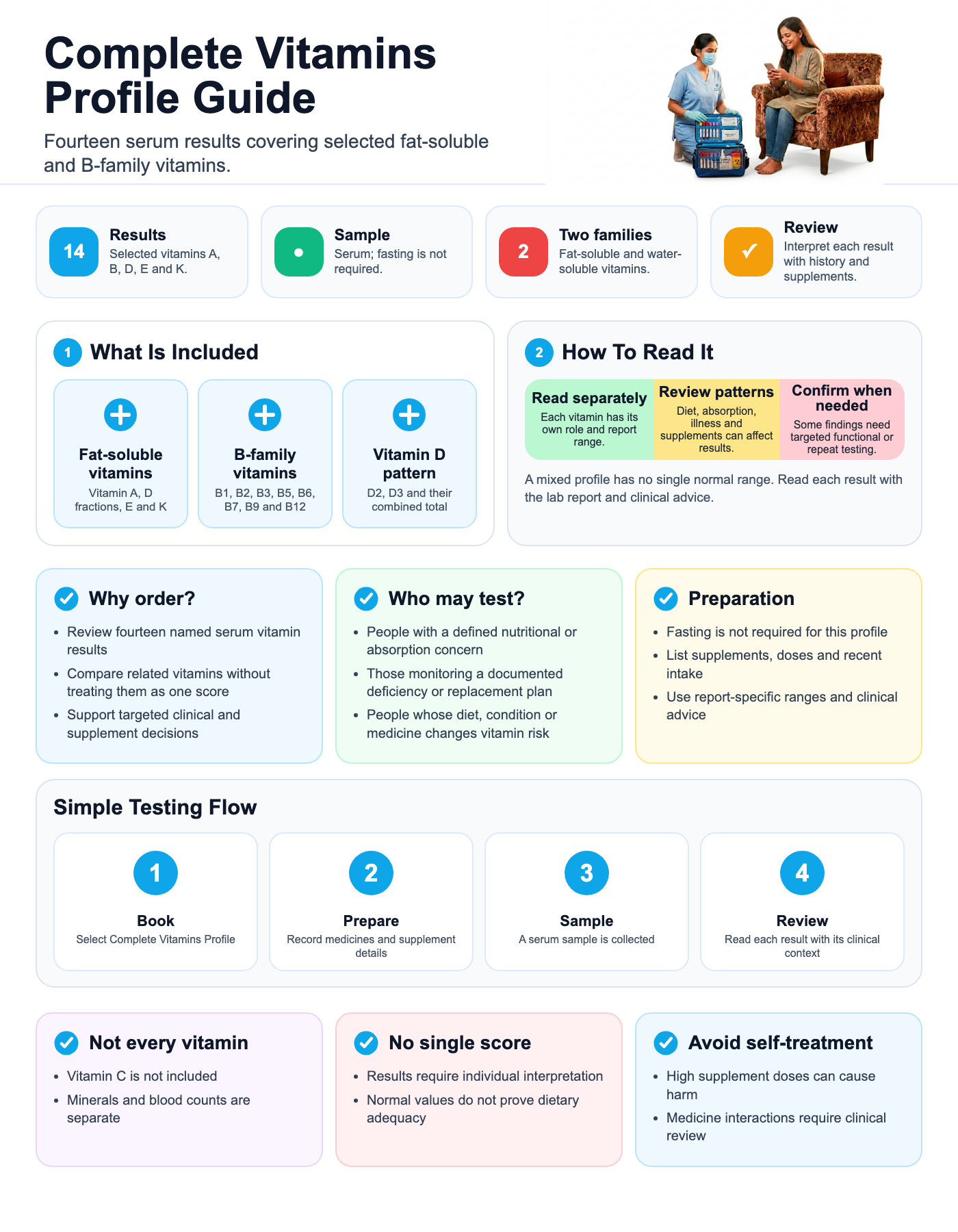
Complete Vitamins Profile visual guide

Complete Vitamins Profile Reference Guide in Darbhanga

  • Complete Vitamins Profile contains fourteen serum results for selected fat-soluble and B-family vitamins.
  • The panel includes vitamins A, E, K, eight named B vitamins, Vitamin D2, Vitamin D3 and Vitamin D Total.
  • Each result answers a different question; the profile does not produce one overall nutrition score.
  • Vitamin C, minerals, blood counts, iron studies and functional deficiency markers are not included.
  • Interpret results with symptoms, diet, absorption, medicines, supplements and the laboratory report.
  • Medical guidance stays consistent; use this page for Darbhanga pricing and collection details.

Why This Test Is Ordered

Understand the fourteen-result composition
  • The profile reports fourteen named vitamin measurements from a serum sample.
  • Fat-soluble coverage includes vitamins A, D, E and K.
  • Vitamin D appears as separate D2, D3 and combined total results.
  • B-family coverage includes B1, B2, B3, B5, B6 and B7.
  • The profile also includes folate as B9 and cobalamin as B12.
  • Vitamin C is not part of the verified profile composition.
  • Minerals, iron studies and a complete blood count are not included.
  • Every result requires its own range, units and clinical interpretation.
Review fat-soluble vitamins carefully
  • Vitamins A, D, E and K are absorbed with dietary fat.
  • Liver, pancreatic or intestinal disorders can disturb their absorption or handling.
  • Vitamin A supports vision, cell development and normal immune function.
  • Vitamin D supports calcium absorption, bone mineralisation and muscle function.
  • Vitamin E acts as an antioxidant protecting cells from oxidative damage.
  • Vitamin K supports normal activation of several blood-clotting proteins.
  • Blood concentrations do not describe every tissue store or functional effect.
  • Excessive fat-soluble vitamin supplementation can accumulate and cause harm.
Understand the included B-family markers
  • B vitamins support related but distinct cellular and metabolic pathways.
  • Thiamin B1 helps enzymes release energy from carbohydrate metabolism.
  • Riboflavin B2 and niacin B3 support energy-producing oxidation reactions.
  • Pantothenic acid B5 contributes to coenzyme A and fatty-acid metabolism.
  • Vitamin B6 supports amino-acid metabolism, neurotransmitters and haemoglobin formation.
  • Biotin B7 supports enzymes involved in carbohydrate, fat and protein metabolism.
  • Folate B9 and Vitamin B12 both support DNA and healthy blood-cell formation.
  • One abnormal B-vitamin result should not be generalised to the entire family.
Read Vitamin D2, D3 and total together
  • Vitamin D2 is also called ergocalciferol and occurs in selected supplements.
  • Vitamin D3 is cholecalciferol from skin production, foods or supplements.
  • The liver converts both forms into circulating 25-hydroxyvitamin D fractions.
  • Vitamin D Total combines the measured D2 and D3 contributions.
  • The total is usually the principal result for assessing Vitamin D status.
  • Separate fractions can help relate the pattern to the supplement form.
  • A low D2 alone does not prove an overall Vitamin D deficiency.
  • This profile does not include active 1,25-dihydroxyvitamin D measurement.
Know what serum results cannot prove
  • A serum vitamin result is not a complete assessment of dietary quality.
  • Recent supplements can influence some concentrations without resolving the underlying cause.
  • Inflammation and illness can alter selected blood vitamin measurements.
  • Serum retinol may remain stable until Vitamin A stores are substantially reduced.
  • Serum B12 can require methylmalonic acid confirmation when results are borderline.
  • Plasma Vitamin K does not fully represent tissue stores or clotting function.
  • Laboratory methods and report ranges can differ between testing providers.
  • Clinical decisions should not rely on a colour flag alone.

Symptoms And Who Should Test

People with a defined deficiency concern
  • Testing is most useful when it answers a specific clinical question.
  • Persistent symptoms may justify targeted assessment after clinical evaluation.
  • Fatigue alone cannot identify which vitamin, if any, is low.
  • Night-vision problems can occur with significant Vitamin A deficiency.
  • Numbness or balance changes may prompt evaluation of Vitamin B12 or B6.
  • Bone pain or muscle weakness can support Vitamin D assessment.
  • Easy bruising or bleeding needs broader evaluation beyond Vitamin K concentration.
  • Urgent or progressive symptoms should not wait for a routine panel.
People following restrictive eating patterns
  • A vegan diet contains no natural animal-derived Vitamin B12 sources.
  • Vegetarian diets may provide variable B12 without fortified foods or supplements.
  • Very limited diets can reduce several vitamin sources simultaneously.
  • Low food intake may accompany illness, frailty or an eating disorder.
  • Alcohol dependence can increase risk of thiamin and other nutrient problems.
  • Dietary history remains essential because blood testing cannot grade meal quality.
  • A dietitian can identify gaps that one laboratory panel cannot show.
  • Testing should support, not replace, a practical nutrition assessment.
People with possible malabsorption
  • Coeliac disease can impair absorption of several vitamins and other nutrients.
  • Inflammatory bowel disease may alter intake, absorption and nutritional requirements.
  • Pancreatic or bile disorders can reduce absorption of fat-soluble vitamins.
  • Bariatric surgery changes anatomy, intake and long-term supplement needs.
  • Stomach surgery or pernicious anaemia can impair Vitamin B12 absorption.
  • Chronic diarrhoea or unexplained weight loss requires clinical investigation.
  • The underlying condition determines which additional tests are appropriate.
  • Protein, minerals and blood counts may need separate assessment.
People using medicines or supplements
  • Metformin and acid-suppressing medicines can affect Vitamin B12 status over time.
  • Selected anticonvulsants can alter Vitamin D metabolism or folate status.
  • Antibiotics and bile-acid medicines can influence Vitamin K-related risk.
  • High-dose biotin can interfere with some laboratory test methods.
  • Vitamin E supplements can increase bleeding risk with anticoagulant medicines.
  • Vitamin K intake requires consistency when warfarin treatment is used.
  • Multiple products may contain overlapping vitamins under different brand names.
  • A complete product list prevents missed doses and duplicate supplementation.
People monitoring treatment or earlier results
  • A previous low result may need follow-up after an agreed treatment interval.
  • Repeat testing should answer whether the management plan changed the marker.
  • The supplement form matters when comparing Vitamin D2 and D3 fractions.
  • Treatment response also depends on adherence, absorption and the underlying cause.
  • A normal follow-up does not automatically justify indefinite high-dose treatment.
  • Unexpectedly high results require review of every supplement and fortified product.
  • Comparable laboratories and units make trends easier to interpret.
  • The clinician should define the next test before frequent panel repetition.

Preparation And Interpretation Notes

Follow the verified collection instruction
  • Fasting is not required for the current Complete Vitamins Profile.
  • Follow stricter preparation when another booked test requires fasting.
  • A trained professional collects venous blood and prepares serum for analysis.
  • Maintain ordinary meals and fluids unless your clinician advises otherwise.
  • Do not take extra vitamins to improve the laboratory result.
  • Minor discomfort or bruising can follow a routine blood draw.
  • Tell the collector about fainting, difficult draws or blood-thinning medicines.
  • Confirm instructions again if the booked profile or laboratory changes.
Document every supplement and medicine
  • List multivitamins, single vitamins, powders, injections and fortified nutrition products.
  • Record each product name, strength, schedule and last taken dose.
  • Check labels because one product may contain several included vitamins.
  • Mention prescription Vitamin D, folic acid and Vitamin B12 treatment.
  • Report biotin because it can interfere with selected laboratory assays.
  • Include metformin, acid suppressants, anticonvulsants and anticoagulant medicines.
  • Do not stop prescribed medicines without advice from the treating clinician.
  • Bring photographs of labels when exact ingredients are difficult to recall.
Share diet, health and symptom context
  • Describe vegan, vegetarian, highly restricted or medically prescribed eating patterns.
  • Mention recent poor intake, vomiting, diarrhoea or unexplained weight change.
  • Share known liver, kidney, pancreatic, intestinal or bleeding conditions.
  • Report bariatric, stomach or bowel surgery and its approximate date.
  • Record when symptoms began and whether they are stable or worsening.
  • Mention recent infection because inflammation can affect selected measurements.
  • Pregnancy and older age can change nutritional needs and interpretation.
  • This context helps separate dietary risk from absorption or treatment questions.
Interpret each result with its limits
  • Use the laboratory range printed beside each individual vitamin result.
  • Do not combine fourteen results into an average wellness score.
  • Review Vitamin D Total before interpreting its D2 and D3 fractions.
  • Borderline Vitamin B12 may need methylmalonic acid or other confirmation.
  • Folate interpretation may require a blood count and Vitamin B12 context.
  • Vitamin K-related bleeding questions often require clotting tests and clinical review.
  • A normal serum result does not exclude every functional or tissue deficiency.
  • Repeat or confirm unexpected results before making major treatment changes.
Act safely on abnormal findings
  • Do not self-start high-dose replacement from one flagged result.
  • Excess Vitamin A can harm the liver and pregnancy development.
  • Excess Vitamin D can raise calcium and damage kidneys.
  • High Vitamin E intake can increase bleeding risk in some people.
  • Long-term excessive Vitamin B6 can damage sensory nerves.
  • Vitamin K changes can affect warfarin treatment and clotting control.
  • The treatment dose should reflect cause, severity and follow-up planning.
  • Severe weakness, confusion, bleeding or breathing difficulty needs prompt care.

Frequently Asked Questions

How many results are included?

The profile contains fourteen named serum vitamin results.

Is fasting required for this profile?

No; fasting is not required for this profile.

Does this profile include Vitamin C?

No; Vitamin C is not included in the verified composition.

Which B vitamins are included?

It includes B1, B2, B3, B5, B6, B7, B9 and B12.

Why are three Vitamin D results reported?

D2 and D3 are reported separately and combined as Vitamin D Total.

Does one result show overall nutrition?

No; every vitamin result requires separate clinical interpretation.

Can supplements affect these results?

Yes; product, dose, schedule and recent intake can affect interpretation.

Can a normal panel exclude deficiency?

No; some concerns require targeted functional or repeat testing.

Can I book Complete Vitamins Profile in Darbhanga?

Complete Vitamins Profile collection in Darbhanga is available where serviceable.

Who can review my vitamin report in Darbhanga?

A qualified clinician in Darbhanga can review the complete result pattern.

Can I discuss supplements with a clinician in Darbhanga?

A clinician in Darbhanga can review safe, result-based supplementation.

Ratings & Reviews
4.8 ★★★★★

Based on verified bookings

Good service

Sample collection was smooth and reports were delivered on time.

Health Insights & Resources
View All Blogs →
Blog Title

August 20, 2025

The Role of AI in Medical Healthcare
Read More
Blog Title

August 19, 2025

Insulin Fasting Test: Why It’s Important
Read More
Blog Title

August 18, 2025

Why Every Indian Child Should Take a Full Body Test?
Read More
Blog Title

August 17, 2025

Food Poisoning in Hindi - फूड पॉइज़निंग क्या है? कारण, लक्षण, बचाव के
Read More
Test Conducted By
Complete Vitamin Test Price in Darbhanga : Rs. 9232
Rs. 5770 38% Off
Home Sample Collection Available No Extra Charges
You will Save Rs. 3462 on this Test
CAP Accredited NABL Accredited UKAS Management Systems ANAB Accredited
Lab Logo
Complete Vitamin Test Price in Darbhanga : Rs. 9232
Rs. 5770

Home Sample Collection Areas Pincodes in Darbhanga

846001| 846002| 846003| 846004| 846005| 846008| 846009| 847306