Choose your City


Renal profile test including 11 Tests to determine how well the kidneys are functioning. Also helps to detect kidney disorders and overall renal health.

Advanced Renal Profile Test in Gurgaon

Renal profile test including 11 Tests to determine how well the kidneys are functioning. Also helps to detect kidney disorders and overall renal health.

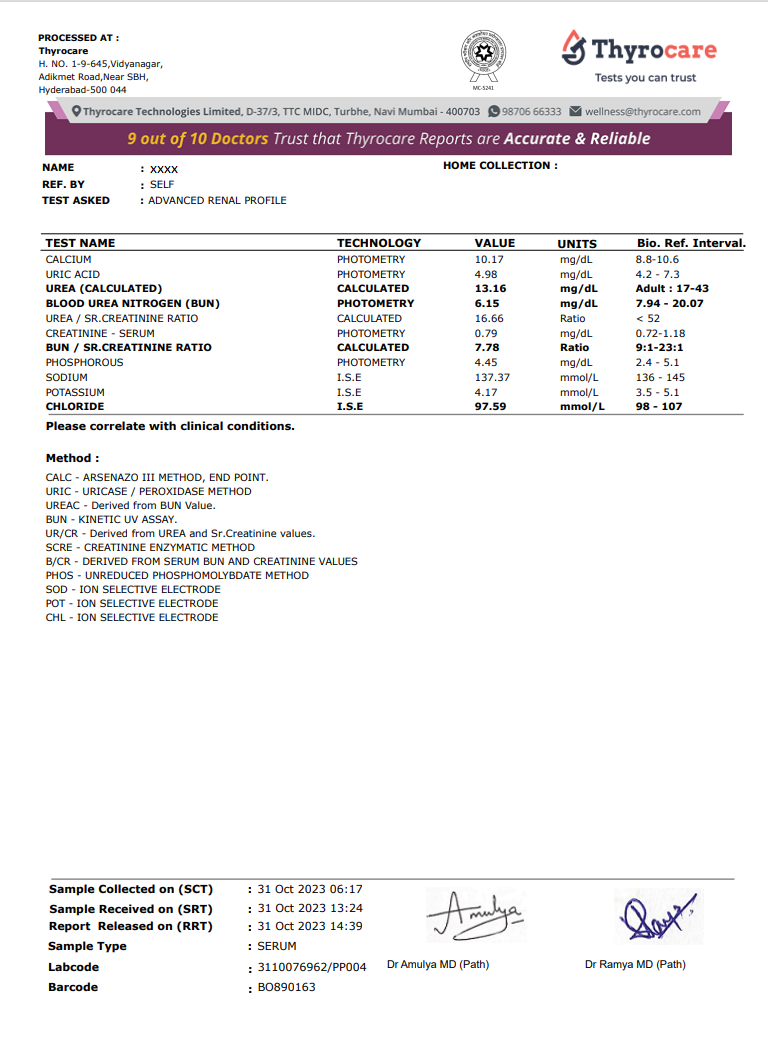
Advanced Renal Profile Test Sample Report

Group Name RENAL,DIABETES
Fasting Fasting Not Required
Sample Type SERUM
Sample Collection Expert collect samples at Home
Reports Delivered Online within 24-48 Hrs*
Report type Email & Hardcopy ( On request )

Parameters Included in Advanced Renal Profile

What tests are included in the Advanced Renal Profile?


Arthritis (1 Test)

  • Phosphorous

Electrolytes (3 Tests)

  • Chloride
  • Potassium
  • Sodium

Renal (7 Tests)

  • Blood urea nitrogen (bun)
  • Bun / sr.creatinine ratio
  • Calcium
  • Creatinine - serum
  • Urea (calculated)
  • Urea / sr.creatinine ratio
  • Uric acid
Advanced Renal Profile Test Sample Report
Advanced Renal Profile Sample report & Ranges
Conducted at Thyrocare Labs
Lab Accreditation CAP, NABL, ICMR, NGSP, ISO
Supervision Dr Amulya MD (Path)
Results Highly Specific

Our labs work 365 days / 24 x 7 to ensure your  Advanced Renal Profile samples reach us the same night, before midnight. We are equipped with  (MUT) -  India's first preanalytical barcoded vial sorter, Sample Sorter  &  Aptio (Siemens).

Our IT-enabled barcoded bi-directional operating systems & world-class air logistics process your blood samples within the specified time with the utmost accuracy. Once your specimen for Advanced Renal Profile is collected by our phlebotomist, Your reports will be sent to your email id within 24 to 48 hours. For hard copy requests, the reports would be delivered in 3 to 5 days.  You will be informed via SMS & email once we process your report.


Advanced Renal Profile Sample Report & Ranges

Conducted at Thyrocare Labs
Lab Accreditation CAP, NABL, ICMR, NGSP, ISO
Supervision Dr Amulya MD (Path)
Results Highly Specific

Our labs work 365 days / 24 x 7 to ensure your  Advanced Renal Profile samples reach us the same night, before midnight. We are equipped with  (MUT) -  India's first preanalytical barcoded vial sorter, Sample Sorter  &  Aptio (Siemens).

Our IT-enabled barcoded bi-directional operating systems & world-class air logistics process your blood samples within the specified time with the utmost accuracy. Once your specimen for Advanced Renal Profile is collected by our phlebotomist, Your reports will be sent to your email id within 24 to 48 hours. For hard copy requests, the reports would be delivered in 3 to 5 days.  You will be informed via SMS & email once we process your report.


Advanced Renal Profile Sample Report

Advanced Renal Profile Overview

What to expect during a Advanced Renal Profile Blood Test?

During a Advanced Renal Profile blood test, a healthcare professional takes a blood sample from your arm, which is also known as venipuncture. A lab expert known as a phlebotomist conducts this process using a needle. He locates a vein on your arm and inserts the needle to draw blood. The blood sample will be transferred into a test tube and will be taken safely to the labs for the test.

The lab technicians will test the sample by following established standards, to ensure correct reports. Thyrocare Labs has a team of professionals who are skilled and experienced. After the testing is done, your reports are sent to your email within 1-2 days. On the other hand, if you need a hard copy of the report, expect the delivery of the same within 3-5 business days.

Preparations before a Advanced Renal Profile Blood Test?

For Advanced Renal Profile blood tests, special preparations are not needed. However, some important steps must be taken to ensure accuracy in the test reports.

  • Advanced Renal Profile test requires Fasting Not Required the same must be done for at least 8-10 hours. Only water can be consumed during this time. Being hydrated helps the blood draw easier and also ensures accurate results.
  • Eating junk food and consuming sweetened beverages or alcohol can alter your test results. So, it is advisable to be careful about what to consume or take the advice of a professional.
  • Consumption of certain medications is also prohibited before blood tests. You can discuss the details about the same with your doctor to be sure.
  • Avoid strenuous exercise as it can alter the readings of a blood test.

Are there any side effects of the test?

There are no side effects or risks attached to Advanced Renal Profile blood tests. The test involves the collection of a blood sample from your home. A phlebotomist draws blood from your arm using a needle, which only takes a few minutes. During this process, you might feel a sting on your arm, which is not painful. The blood sample will then be sent to the labs. Our medical experts take all precautions and safety measures during sample collection and testing.
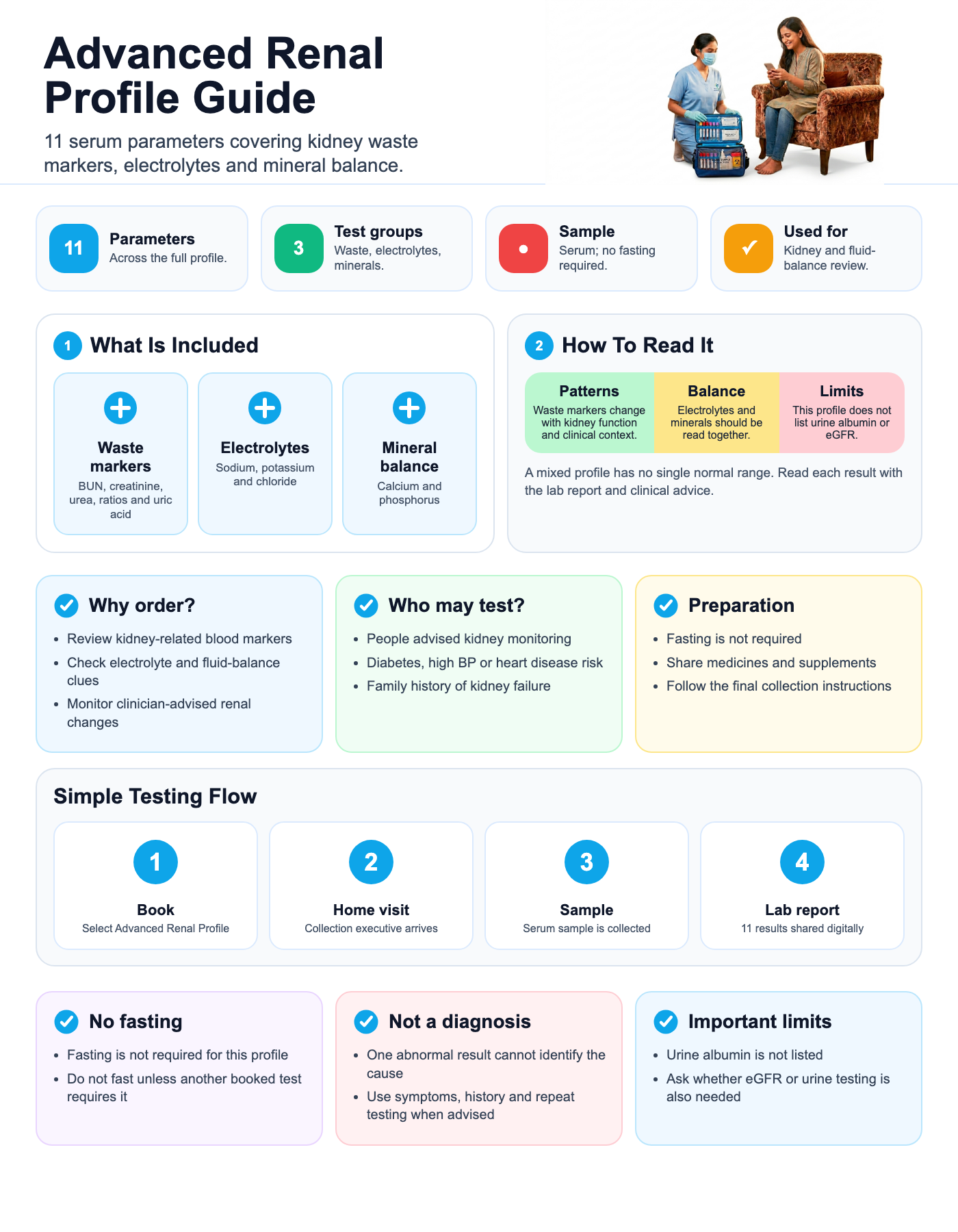
Advanced Renal Profile visual guide

Advanced Renal Profile Reference Guide in Gurgaon

  • This profile combines 11 serum results covering waste handling, electrolytes and mineral balance.
  • Six results relate to creatinine, urea, BUN, calculated ratios and uric acid.
  • Sodium, potassium and chloride provide fluid and electrolyte context.
  • Calcium and phosphorus add information about mineral regulation.
  • The package does not list urine albumin or an explicit eGFR result.
  • Medical guidance stays consistent; use this page for Gurgaon pricing and collection details.

Why This Test Is Ordered

Start with serum creatinine
  • Creatinine is a muscle-related waste product removed from blood by the kidneys.
  • Reduced filtration can raise creatinine, but one result cannot identify the cause.
  • Age, muscle mass, meat intake and recent exercise can influence creatinine.
  • Dehydration, acute illness and selected medicines may also change the result.
  • Clinicians use stable creatinine with personal details to estimate glomerular filtration.
  • An explicit eGFR result is not listed among these 11 parameters.
  • Ask whether eGFR appears elsewhere on the report or is required separately.
  • Rapid creatinine change needs clinical assessment rather than routine trend interpretation.
Understand BUN and calculated urea
  • BUN measures the nitrogen portion of urea produced during protein breakdown.
  • Calculated urea expresses closely related information rather than another kidney function.
  • Reduced kidney clearance can raise BUN, but the change is not disease-specific.
  • Dehydration, high protein intake and gastrointestinal bleeding may also increase BUN.
  • Some medicines and illnesses change BUN without directly indicating kidney damage.
  • Low BUN may occur with low protein intake or selected liver conditions.
  • Read BUN and urea beside creatinine, symptoms and recent health changes.
  • A single unusual value may need confirmation after temporary influences are reviewed.
Use calculated ratios with their components
  • The package calculates BUN-to-creatinine and urea-to-creatinine ratios from included results.
  • These ratios compare related measurements rather than testing separate kidney functions.
  • A changed ratio may reflect its numerator, denominator or both components.
  • Neither ratio can diagnose dehydration, bleeding or kidney disease independently.
  • Review actual BUN, urea and creatinine values before interpreting either ratio.
  • Check units because laboratory calculation conventions can differ.
  • Trend each ratio beside its components and the reason for repeat testing.
  • Do not count calculated ratios as additional independent evidence of kidney damage.
Add uric acid context
  • Uric acid forms when the body breaks down purines from cells and food.
  • Kidneys remove much of this waste, while production also affects blood levels.
  • High uric acid can accompany gout or uric-acid stones without proving either.
  • Many people with raised serum urate never develop gout or stones.
  • Joint symptoms and sometimes fluid testing guide a gout diagnosis.
  • A serum result cannot identify the type or location of a kidney stone.
  • Diet, alcohol, diuretics, cancer treatment and metabolic health can influence urate.
  • Uric acid answers a different question from creatinine, BUN and electrolyte results.
Read sodium and chloride together
  • Sodium helps regulate body water, nerves and muscle function.
  • Chloride commonly changes with sodium and contributes to fluid and acid-base balance.
  • High or low results can reflect water balance rather than total body stores alone.
  • Vomiting, diarrhoea, fever and altered fluid intake can influence these electrolytes.
  • Diuretics and other medicines may change sodium or chloride levels.
  • Kidney, heart, liver and hormonal conditions can also affect the pattern.
  • Interpret both values with symptoms, examination and other chemistry results.
  • Important electrolyte abnormalities may need prompt confirmation and treatment.
Give potassium special attention
  • Potassium supports normal nerve, muscle and heart electrical activity.
  • Kidneys help control potassium by adjusting how much leaves in urine.
  • Kidney impairment and selected medicines can raise blood potassium.
  • Vomiting, diarrhoea, diuretics and other conditions may lower potassium.
  • Collection-related cell damage can sometimes produce an unexpectedly high result.
  • A flagged potassium value may require prompt repeat testing or clinical action.
  • Weakness, palpitations or fainting with an abnormal result needs urgent assessment.
  • Do not change potassium supplements or medicines without professional advice.
Connect calcium with phosphorus
  • Calcium supports bones, nerves, muscles, the heart and blood clotting.
  • Phosphorus in blood is measured as phosphate and supports bones and cellular energy.
  • Kidneys remove extra phosphate and help regulate mineral balance.
  • Calcium and phosphorus are linked with vitamin D and parathyroid hormone.
  • Kidney disease can disturb this relationship, especially in more advanced stages.
  • This package does not list albumin, vitamin D or parathyroid hormone.
  • An abnormal mineral result may therefore need additional targeted testing.
  • Neither calcium nor phosphorus directly measures glomerular filtration.

Symptoms And Who Should Test

People at increased kidney-disease risk
  • Diabetes and high blood pressure are major settings for chronic kidney disease risk.
  • Cardiovascular disease and kidney disease can overlap and influence treatment choices.
  • A family history of kidney failure can justify personalised risk assessment.
  • Early chronic kidney disease may cause no obvious symptoms.
  • NIDDK identifies eGFR and urine albumin as key kidney-disease markers.
  • This package does not explicitly list either complete screening component.
  • Testing frequency should reflect diagnosis, age, medicines and previous results.
  • A normal creatinine does not replace urine albumin testing when clinically indicated.
People monitoring known kidney disease
  • A clinician may use selected serum markers to follow known kidney disease.
  • Creatinine trends can support eGFR monitoring when values are clinically stable.
  • Electrolytes may require monitoring as kidney function or treatment changes.
  • Calcium and phosphorus become important in selected chronic kidney disease settings.
  • Urine albumin and blood pressure remain important monitoring information.
  • The correct panel and interval depend on disease stage and treatment.
  • Bring previous reports so changes can be compared with a personal baseline.
  • Sudden deterioration needs urgent assessment rather than routine scheduled monitoring.
People taking kidney-relevant medicines
  • Selected blood-pressure medicines can affect creatinine and potassium after initiation.
  • Diuretics can alter sodium, potassium, hydration and uric acid.
  • Anti-inflammatory painkillers may affect kidney blood flow in susceptible people.
  • Calcium, vitamin D and phosphate-containing products can influence mineral results.
  • A clinician may order testing after starting or changing relevant treatment.
  • Record the medicine name, dose and timing relative to collection.
  • Do not stop prescribed treatment solely because a laboratory result is flagged.
  • Urgent symptoms require clinical advice before waiting for routine follow-up.
People with swelling or changed urination
  • Changed urination, foamy urine or blood in urine may prompt kidney evaluation.
  • Swelling around the eyes or ankles can occur in kidney and non-kidney conditions.
  • Persistent fatigue, itching, cramps or nausea are important but non-specific symptoms.
  • Serum markers may add clues without identifying the symptom cause.
  • Urinalysis, urine albumin, examination or imaging may still be necessary.
  • Normal-looking urine does not exclude albumin leakage or early kidney damage.
  • Very low urine output, breathlessness or rapidly worsening swelling needs prompt care.
  • Confusion, severe weakness or repeated vomiting should not await routine results.
People with fluid or electrolyte concerns
  • Prolonged vomiting or diarrhoea can disturb fluid, sodium, chloride and potassium balance.
  • Fever, poor intake and dehydration can change both electrolytes and waste markers.
  • Heart, liver, kidney and hormonal conditions may produce overlapping electrolyte patterns.
  • Weakness, cramps or palpitations can accompany electrolyte disturbances.
  • Symptoms alone cannot show which electrolyte is abnormal or how severely.
  • A clinician may add bicarbonate, magnesium, glucose or osmolality testing.
  • Severe symptoms need urgent assessment rather than an unsupervised home panel.
  • Treatment should address the cause, not only the laboratory number.
People with gout or stone concerns
  • Clinicians may review uric acid when gout symptoms or earlier stones are present.
  • The panel adds calcium and phosphorus but cannot determine stone composition.
  • Urine testing and stone analysis may be needed for recurrent stones.
  • One high uric-acid result should not trigger self-started treatment.
  • Sudden severe joint pain, redness and warmth need clinical assessment.
  • Side pain with fever, vomiting or reduced urination needs urgent care.
  • Possible infection or obstruction requires more than routine serum testing.
  • Stone-prevention advice should reflect the actual stone type and clinical history.

Preparation And Interpretation Notes

Follow the correct collection instructions
  • Fasting is not required for the 11 results listed in this profile.
  • Follow stricter preparation when another booked test requires fasting.
  • A trained professional collects blood from a vein and prepares serum.
  • Maintain normal hydration unless a clinician has advised fluid restriction.
  • Do not overdrink water or prolong fasting to alter laboratory values.
  • Minor discomfort or bruising can follow routine venous collection.
  • Tell the collector about fainting, difficult draws or blood-thinning medicines.
  • Check preparation separately before applying these instructions to another test.
Report medicines and supplements
  • List prescriptions, over-the-counter medicines and supplements before interpretation.
  • Mention diuretics, blood-pressure medicines, painkillers and gout treatments.
  • Report creatine, protein, potassium, calcium, vitamin D and herbal products.
  • Some products affect kidney blood flow, hydration, electrolytes or minerals.
  • Creatine products and recent exercise can complicate creatinine interpretation.
  • Do not stop essential treatment unless the treating clinician advises it.
  • Record recent dose changes, missed doses and suspected side effects.
  • The reviewer should know whether testing occurred on the usual regimen.
Share diet, exercise and recent illness
  • A meat-heavy meal, protein intake or creatine use can influence waste markers.
  • Intense exercise or muscle injury may temporarily affect creatinine and potassium.
  • Dehydration, fever, vomiting or diarrhoea can alter several included results.
  • Alcohol and purine-rich intake may influence serum uric acid.
  • Dietary salt and fluid changes can affect the clinical context.
  • These factors provide context and do not automatically invalidate the sample.
  • Maintain ordinary habits unless specific preparation advice was provided.
  • Seek medical advice if acute illness prevents normal fluid intake.
Interpret electrolytes with symptoms
  • Use the current report units and laboratory-specific reference intervals.
  • Read sodium, chloride and water balance as a connected clinical pattern.
  • Give an unexpected potassium result prompt attention because heart rhythm can be affected.
  • A repeat sample may be needed when collection-related interference is suspected.
  • Do not correct sodium rapidly or take potassium without medical supervision.
  • Electrolyte treatment depends on severity, symptoms and the underlying cause.
  • Bicarbonate and magnesium are not listed among this package composition.
  • A clinician may add those tests when the pattern requires them.
Review kidney markers and package limits
  • Read related waste measurements as one pattern rather than separate kidney diseases.
  • Compare current results with earlier reports from the same laboratory when possible.
  • Ask whether creatinine generated an eGFR result elsewhere on the report.
  • Ask whether urine albumin-to-creatinine ratio is needed for kidney assessment.
  • The package does not include urinalysis, albumin, imaging or diagnostic examination.
  • Calcium and phosphorus may require vitamin D or parathyroid testing for explanation.
  • A clinician may repeat results or add targeted blood and urine tests.
  • Do not diagnose kidney failure, gout or stones from this profile alone.

Frequently Asked Questions

What does Advanced Renal Profile include?

It includes 11 serum results covering waste markers, electrolytes, calcium and phosphorus.

Is fasting required for this profile?

No; fasting is not required unless another booked test needs it.

Does the profile include eGFR?

An explicit eGFR is not listed, so ask whether it appears separately.

Does it include urine albumin?

No; urine albumin-to-creatinine ratio is not part of the listed package.

Can creatinine alone diagnose kidney disease?

No; eGFR, urine albumin, trends and clinical context may also be needed.

Why are BUN, urea and two ratios included?

They provide related waste-handling measurements and calculations that must be read together.

Can dehydration affect these results?

Yes; dehydration can influence waste markers, sodium and other included values.

Why are calcium and phosphorus measured together?

They provide connected mineral information influenced by kidneys, vitamin D and parathyroid hormone.

Can I book Advanced Renal Profile home collection in Gurgaon?

Advanced Renal Profile home collection in Gurgaon is available where the address is serviceable.

Who can review my Advanced Renal Profile in Gurgaon?

A qualified clinician in Gurgaon can review it with your medical history.

When is urgent assessment needed?

Seek prompt care for very low urine output, breathlessness, confusion, fainting or severe weakness.

Ratings & Reviews
4.8 ★★★★★

Based on verified bookings

Good service

Sample collection was smooth and reports were delivered on time.

Health Insights & Resources
View All Blogs →
Blog Title

August 20, 2025

The Role of AI in Medical Healthcare
Read More
Blog Title

August 19, 2025

Insulin Fasting Test: Why It’s Important
Read More
Blog Title

August 18, 2025

Why Every Indian Child Should Take a Full Body Test?
Read More
Blog Title

August 17, 2025

Food Poisoning in Hindi - फूड पॉइज़निंग क्या है? कारण, लक्षण, बचाव के
Read More
Test Conducted By
Advanced Renal Profile Test Price in Gurgaon : Rs. 1704
Rs. 1065 38% Off
Home Sample Collection Available No Extra Charges
You will Save Rs. 639 on this Test
CAP Accredited NABL Accredited UKAS Management Systems ANAB Accredited
Lab Logo
Advanced Renal Profile Test Price in Gurgaon : Rs. 1704
Rs. 1065