Complete Urine Analysis Test
Complete Urine Analysis Info & Procedure
Tests included
24 parameters listedExplore the tests in Complete Urine Analysis by category.
Complete Urine Analysis24
- APPEARANCE
- BACTERIA
- BILE PIGMENT
- BILE SALT
- CASTS
- COLOUR
- CRYSTALS
- EPITHELIAL CELLS
- LEUCOCYTE ESTERASE
- MUCUS
- NITRITE
- PARASITE
- PH
- RED BLOOD CELLS
- SPECIFIC GRAVITY
- URINARY BILIRUBIN
- URINARY GLUCOSE
- URINARY LEUCOCYTES (PUS CELLS)
- URINARY PROTEIN
- URINE BLOOD
- URINE KETONE
- UROBILINOGEN
- VOLUME
- YEAST
Complete Urine Analysis Sample Report Format & Ranges
Relevant details from a Thyrocare sample report are shown below. A standalone PDF preview for Complete Urine Analysis is not available here. Reference intervals may vary by method and patient factors. Use the interval printed on your own final report.
| Conducted at | Thyrocare Labs |
|---|---|
| Lab Accreditation | CAP, NABL, UKAS, ANAB |
Complete Urine Analysis Thyrocare Sample-Report Range Table
| Parameter | Unit | Reference Range |
|---|---|---|
| HbA1c | % | < 5.7 |
| AVERAGE BLOOD GLUCOSE (ABG) | mg/dL | 90-120 |
| FASTING BLOOD SUGAR(GLUCOSE) | mg/dL | 70-100 |
Complete Urine Analysis Report Sections Covered
| Report Section | Parameters in Sample Report |
|---|---|
| Diabetes | 3 |
| Other Counts | 1 |
| Complete Hemogram | 28 |
| Vitamins | 2 |
| Lipid | 10 |
| Liver | 12 |
| Electrolytes | 2 |
| Thyroid | 3 |
| Renal | 8 |
| Iron Deficiency | 1 |
What is the importance of a Urine Analysis Test?
Urine is maintained and filtered through entirely within the kidneys of the body. Whenever there is any type of issue that arises within the body, be it an infection, a specific disorder, organ failure and metabolic imbalance, the first traces for the same often show up when you are urinating. The entire purpose of a Complete Urine Analysis Test is that it not only pinpoints the cause for UTIs or Urinary Tract Infections, but it can encompass a much wider area in different parts of the body where it has the ability to unearth problems that were not originally found by other similar tests. These hidden problems are centered around the kidneys, parts of the liver, certain diabetic conditions and even hydration issues.
The test has been able to be both affordable as well as offering high value results through the amount of tests that are provided by the analysis. It is especially resourceful whenever it can provide useful data for individuals who have not yet shown any type of symptoms or signs for potential UTIs in your body.
What it helps detect
- Early onset of Kidney Damage.
- Unusual amounts of protein and sugar were located in the urine samples.
- Experiencing both disorders with the liver and the bile within it.
- Urine blood detected.
- High amounts of Glucose and Ketone are also present within the urinal sample.
- Having a very dehydrated body or too much of fluid being in your body, which causes the urinary tract to shut down.
Physical examination of the urine
After the Complete Urine Analysis Test has been taken, the first important thing many experts do it physically examine the urine samples provided. In case there have been any changes in the clarity, volume and color of the urine sample in comparison to a healthy one, it is grounds for various early warning signs that may be indicative for serious complications to the disposal of any waste products through the urinary tract.
KEY PARAMETERS TESTED
If the appearance of your urine is somewhat cloudy, it may indicate some form of infection, crystallization of some waste products, or even leakage of pus into the urinary tract.
In case the color of the urine is a pale yellow, it means that the body is healthy, and if it is a dark amber color instead, it means that the body is not receiving any hydration that is adequate. Red and brown color urine are the ones to keep a lookout for, as these colors usually indicate a lot of blood is present alongside the waste products being excreted. This is also a very major cause for concern and requires immediate medical attention as soon as possible.
If the urine volume is either too high or too low, it may be indicative of a dehydration issue that the body is going through or another issue in relation to the kidneys.
Chemical composition of urine
After the physical examination has been concluded, the next test to occcur will be a detailed chemical examination, which will give essential insights on the various different compounds present in the body as well as ensuring your metabolism is up to par, the kidneys are functioning as intended, and the liver is providing for the body without any dysfunction present.
Key Parameters Tested
The pH levels in the kidney will show how acidic and how much alkaline is present while processing the urine, and is vital for checking for dangerous and serious medical conditions and infections such as kidney stones from occurring.
High levels of urinary glucose have been shown to suggest diabetic conditions as well as metabolism condition in relation to glucose.
Urinary Ketones are present in the body for the sole purpose of getting rid of excess fat in the body, as well as during uncontrolled fasting and diabetes.
If there is a significant amount of protein loss detected during the chemical examination, it may point towards the damage to the kidney that must have drained all the available protein out through urination.
Microscopic analysis of urine
Lastly, the final examination required for the Complete Urine Analysis Test is to check for any signs of infection or disorders through the lens of a microscope. The urine sample can provide a lot of new insights for infections through the microscopic traces of cells, crystals and even small organisms that might have been able to give inflammations, profuse bleeding, damage found in the kidneys and even certain infections.
Key parameters included
The most important compound in the body is the Red Blood cell or RBCs. If there are some indications of blood appearing in the tests from the urinary tract, the presence of kidney stones and even blunt force trauma by an outside force directly on top of the kidneys.
If there is any blood present while urinating, it should immediately raise some awareness for getting proper medical attention, as it may indicate that there has been large amounts of damage in the urinary tract.
If there is the presence of Leucocytes in the urine sample, it means that the urinary tract might have received a UTI or even inflammation that requires immediate response from healthcare centers.
Sample contamination is a very common issue that has been present in most of the samples that have been collected. If there are epithelial cells that are more than anticipated in level and amount, it would usually indicate a lot of infections happening in the urinary tract.
What are some of the most common symptoms that require a test?
In case you find yourself slowly being affected by urinary infections and conditions, yet do not know the cause for the infection and are thus confused as to what needs to be done to find a cure and help yourself, the Complete Urine Analysis Test by Mediyaar Healthcare is available at your fingertips. Many of our doctors and medical practitioners will also suggest adding this test to your very own annual health checkups for the monitoring of life-altering conditions such as Diabetes and Hypertension.
Book a test if you encounter any one of these symptoms.
- Diabetic conditions along with very high amounts of blood pressure and having kidney disease.
- Erratic changes in the color of your urine.
- Visible amounts of blood that come with your urine.
- Feeling a need to go to the bathroom many times a day or during the night.
- Experiencing a very sharp and painful sensation whenever you relive yourself.
- Getting a lot of unexplained fatigue and fever during urination problems.
- Having very foul-smelling urine.
Why should you select Mediyaar for Urine Test?
Mediyaar Healthcare is capable of providing you with only the very best diagnostic solutions to your urine dilemma, all from the comfort and safety of your very home. With some of the quickest, most reliable and accurate tests for urine sample collection available in the country. The affordability for the tests is also second to none, with many partnerships occurring from various different labs that are certified and full of staff that are eloquently trained y some of the best medical centers in the business.
What is the process for booking the complete urine analysis test?
- The first step requires you to visit our website at www.mediyaar.com for a better look at the offers provided.
- Once you have opened the website, search for the "Complete Urine Analysis Test" in our search bar.
- Once you find the perfect option, select the city you reside in as well as the appropriate date and time slot for the home sample collection to happen in.
- Then you will be asked to enter your personal details before selecting 'Confirm' for booking your home sample collection for the urine sample.
- One of our best medical lab technicians will arrive at your doorstep to take and collect the urine sample for testing at our state-of-the-art laboratory to commence the testing process for the sample.
- This sample collection requires no fasting for the test to be effective.
Who should take this test regularly?
- Specific individuals who are under diabetic conditions or are having issues with their kidneys.
- People who have had familial history with liver and kidney diseases are required to take this test.
- Pregnant women who have been asked to take the test during their prenatal checkups.
- Individuals who have showcased several signs for having severe UTIs and Kidney Stones.
- Geriatric people who have been given this test simply as part of a wellness profile given by their own doctors.
CONCLUSION
Taking this specific urine test will be able to tell you the current state of your overall health internally. Mediyaar's variation of these tests will be able to provide more than just relief for your urine issues and kidney problems. It acts like a reinforced shield against diseases and conditions that are very silent before they can cause major damage. By properly analyzing the samples that you have graciously provided, we will be able to catch any type of medical condition before it springs out of hand and creates a lot of medical issues with the organs as well as any chronic condition that may arise from them.
*Medical Disclaimer - The information that has been written is only to be used for educational purposes. There has been no information presented by this website, be it test, images and graphics, which should be taken as professional medical advice. Always consult with your own doctor regarding any medical advice that may relate to your condition.
Profile visual guide
Tap the guide to enlarge it and read every detail.
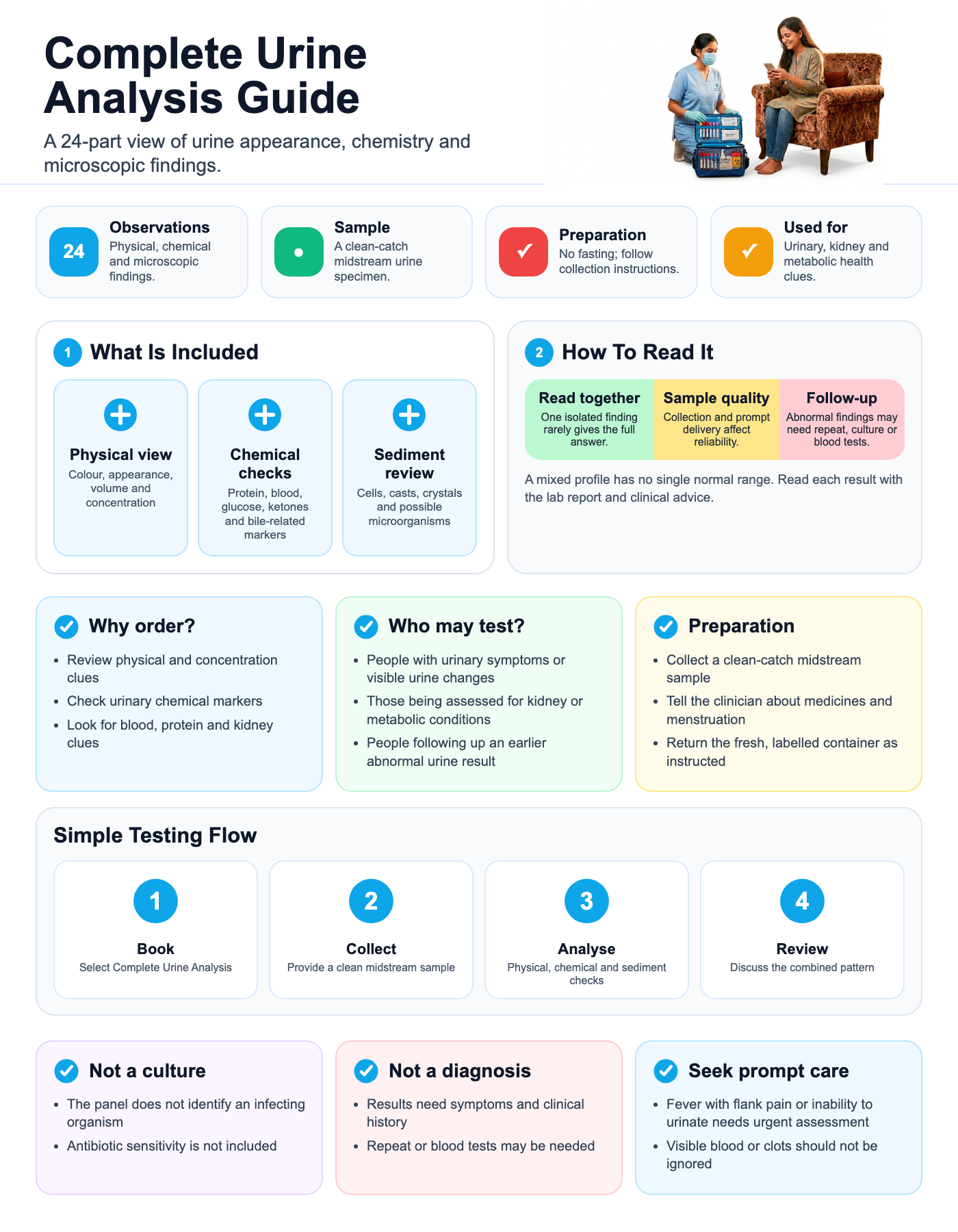
Complete Urine Analysis Reference Guide
- Complete Urine Analysis reports 24 physical, chemical and microscopic urine observations.
- The profile covers appearance, concentration, cells, protein, glucose, ketones and bile-related markers.
- It also checks infection clues such as leucocytes, nitrite and bacteria.
- Each finding is a clue rather than a separate diagnosis.
- Symptoms, collection quality, medicines and related tests shape the final interpretation.
Why This Test Is Ordered
| Reason | Description |
|---|---|
| See urine’s physical character and concentration |
|
| Survey chemical markers in one specimen |
|
| Look for blood and protein that may need follow-up |
|
| Find infection and inflammation clues without calling it a culture |
|
| Use the sediment examination to add context |
|
Symptoms And Who Should Test
| Situation | Description |
|---|---|
| People with burning, urgency or frequent urination |
|
| People with visible blood, foam or changed urine appearance |
|
| People with kidney, blood-pressure or diabetes risk |
|
| People being assessed for liver or metabolic clues |
|
| People repeating or monitoring an earlier finding |
|
Preparation And Interpretation Notes
| Topic | Guidance |
|---|---|
| Collect a clean-catch midstream specimen |
|
| No fasting, but coordinate other booked tests |
|
| Prevent menstrual and genital contamination |
|
| Keep the sample fresh and follow transport instructions |
|
| Review the combined report and know the limits |
|
Frequently Asked Questions
What does Complete Urine Analysis include?
It reports 24 physical, chemical and microscopic urine observations.
Is fasting required for this urine profile?
No; fasting is not required unless another test in the same booking needs it.
How should I collect the sample?
Use the sterile container and provide a clean-catch midstream specimen as instructed.
Is Complete Urine Analysis the same as urine culture?
No; it does not identify the infecting organism or antibiotic sensitivity.
Can a negative nitrite result rule out a UTI?
No; symptoms and other findings may still justify clinical review or culture.
What should I do if I am menstruating?
Tell the collection team because outside blood can affect the result.
Can I book home sample collection?
Home collection is available where the entered address is serviceable.
How quickly should the urine sample reach the lab?
Return it within the laboratory’s stated time and follow any storage instructions.
Can this profile diagnose kidney disease?
No; persistent abnormalities need clinical review and often targeted urine or blood tests.
Should abnormal urine results be repeated?
Repeat timing depends on the finding, symptoms, collection quality and clinician’s advice.
Who can explain my urine report?
A clinician should interpret the combined pattern with your symptoms and history.