Tests included 7 parameters listed
Explore the tests in Infertility Basic by category.
Infertility 4 ANTI MULLERIAN HORMONE (AMH) FOLLICLE STIMULATING HORMONE (FSH) LUTEINISING HORMONE (LH) PROLACTIN (PRL)
Thyroid 3 TOTAL THYROXINE (T4) TOTAL TRIIODOTHYRONINE (T3) TSH - ULTRASENSITIVE
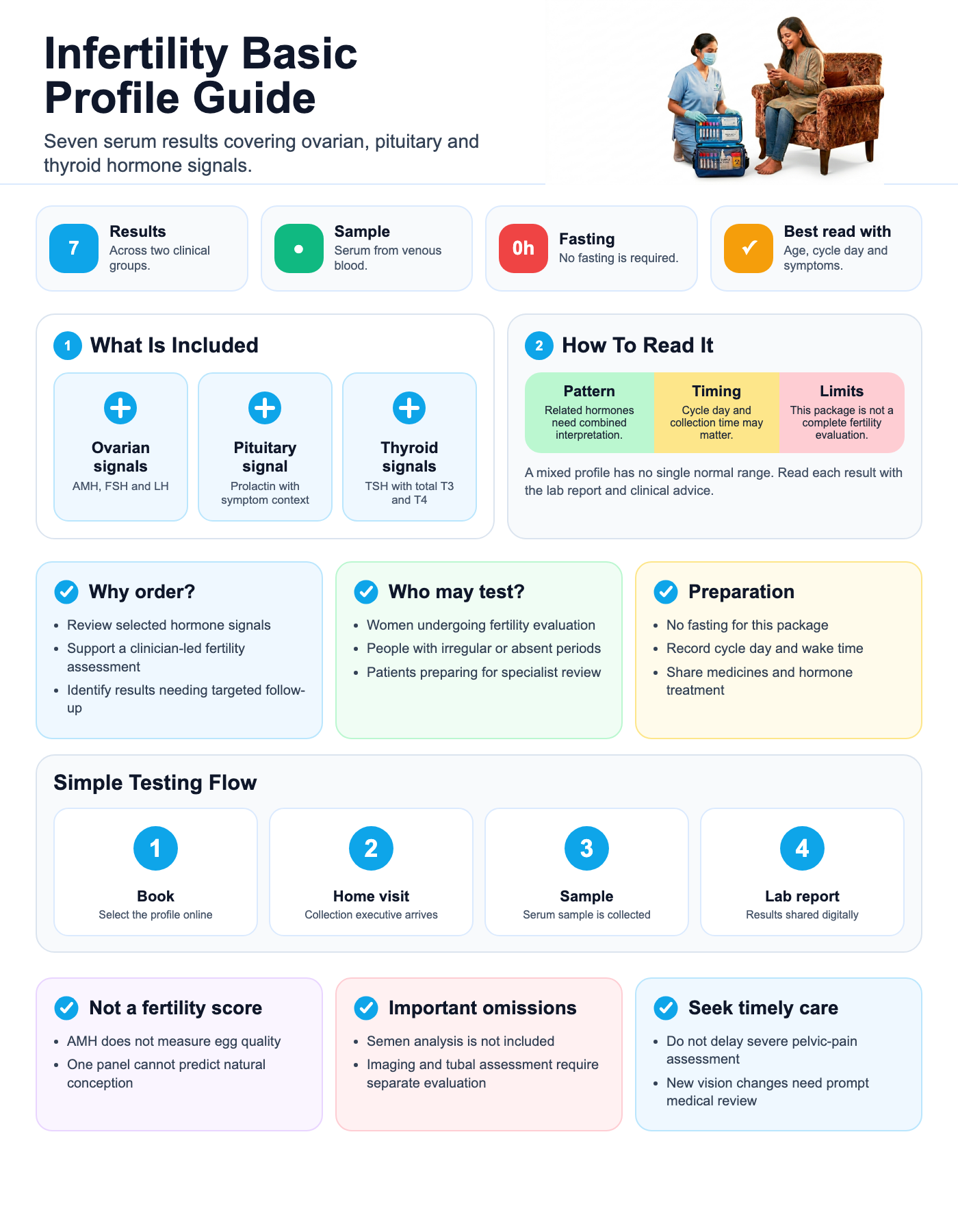
Profile visual guide View larger ↗
Tap the guide to enlarge it and read every detail.
Pinch with two fingers to zoom. Swipe to explore, or use + and −.
Infertility Basic Profile Reference Guide
This profile combines seven ovarian, pituitary and thyroid hormone results. The results support selected questions within a wider fertility assessment. Age, cycle day, symptoms and medicines affect interpretation. The package cannot assess every female or male infertility factor.
Why This Test Is Ordered
Reason Description Understand the package scope AMH, FSH and LH provide different ovarian and pituitary signals. Prolactin can help investigate selected ovulation or pituitary concerns. TSH, total T3 and total T4 describe thyroid hormone patterns. No single result provides a complete fertility assessment. Read ovarian reserve markers carefully AMH reflects the remaining follicle pool more than egg quality. AMH can help predict ovarian response during fertility treatment. AMH alone cannot predict natural conception or treatment success. FSH interpretation depends on age, cycle timing and other results. Interpret LH, FSH and prolactin together FSH and LH are pituitary hormones involved in reproductive function. Their meaning changes with sex, age and menstrual stage. High prolactin may disrupt periods, ovulation or reproductive hormones. Small prolactin elevations may need confirmation under calmer conditions. Use thyroid results as one pattern TSH reflects pituitary signalling to the thyroid gland. Total T3 and T4 include hormone bound to blood proteins. Pregnancy, medicines and binding proteins can alter total hormone levels. Abnormal TSH usually needs targeted thyroid follow-up.
Symptoms And Who Should Test
Situation Description Women receiving fertility evaluation A clinician may select these hormones after reviewing reproductive history. Testing should follow symptoms, age and the clinical question. Partner evaluation often proceeds alongside female fertility assessment. This package does not include semen analysis or reproductive imaging. People with irregular or absent periods FSH, LH, prolactin and TSH may support menstrual-cycle evaluation. Pregnancy should be excluded when periods stop unexpectedly. Galactorrhoea can support prolactin testing but may be absent. Pelvic ultrasound or additional hormones may still be needed. Patients planning fertility treatment AMH can help estimate response to ovarian stimulation. Age remains essential when discussing reproductive potential. A low AMH result does not prove pregnancy is impossible. Treatment decisions should not rely on AMH alone. People with thyroid or pituitary clues Thyroid disease can affect menstrual cycles and reproductive health. Unexpected milk production may prompt prolactin assessment. Persistent headaches or vision changes need clinical assessment. Abnormal results may require repeat or more specific tests.
Preparation And Interpretation Notes
Topic Guidance Follow the package fasting instruction No fasting is required for this seven-result package. Drink water normally unless your clinician gives different instructions. Follow any separate instructions issued for concurrent tests. Do not alter medicines merely to simplify preparation. Record menstrual timing Write down the first day of your latest period. FSH is often interpreted during the early follicular phase. AMH is generally less dependent on menstrual-cycle day. Record irregular bleeding, missed periods or fertility treatment dates. Prepare for prolactin collection Prolactin changes with sleep, stress, exercise and breast stimulation. Collection is commonly scheduled several hours after waking. Rest quietly before collection when the laboratory advises it. A mildly raised result may need repeat confirmation. Share medicines and clinical context List prescription medicines, supplements and hormone treatments. Tell the clinician about pregnancy, breastfeeding or contraceptive use. Never stop prescribed medicine without professional advice. Bring earlier hormone reports for trend comparison.
Frequently Asked Questions
What tests are included?
The package includes AMH, FSH, LH, prolactin, TSH, total T3 and total T4.
Is fasting required?
No; the current package instruction says fasting is not required.
Does AMH show egg quality?
No; AMH mainly reflects follicle quantity and does not directly measure egg quality.
Can this profile predict pregnancy?
No; these hormones cannot independently predict natural conception or treatment success.
Does cycle day matter?
Yes; record cycle day because FSH and LH interpretation depends on menstrual timing.
Can it confirm ovulation?
No; progesterone testing, cycle tracking or ultrasound may be needed for ovulation assessment.
Does it assess male infertility?
No; semen analysis and key male reproductive hormones are not included.
Why might prolactin be repeated?
Stress, sleep, exercise and medicines can cause temporary or mild prolactin elevations.
Should I stop medicines before testing?
No; list your medicines and change them only with professional advice.
Who should interpret the report?
A gynaecologist, fertility specialist or qualified clinician should interpret the complete pattern.
Can I book home collection?
Home collection is available where the entered address is serviceable.