Jaanch - Winter Fever Panel Advanced
Jaanch - Winter Fever Panel Advanced Info & Procedure
Tests included
39 parameters listedExplore the tests in Jaanch - Winter Fever Panel Advanced by category.
Cardiac Risk Markers1
- C-REACTIVE PROTEIN (CRP)
Complete Hemogram28
- BASOPHILS
- BASOPHILS - ABSOLUTE COUNT
- EOSINOPHILS
- EOSINOPHILS - ABSOLUTE COUNT
- HEMATOCRIT(PCV)
- HEMOGLOBIN
- IMMATURE GRANULOCYTE PERCENTAGE(IG%)
- IMMATURE GRANULOCYTES(IG)
- LYMPHOCYTE
- LYMPHOCYTES - ABSOLUTE COUNT
- MEAN CORP.HEMO.CONC(MCHC)
- MEAN CORPUSCULAR HEMOGLOBIN(MCH)
- MEAN CORPUSCULAR VOLUME(MCV)
- MEAN PLATELET VOLUME(MPV)
- MONOCYTES
- MONOCYTES - ABSOLUTE COUNT
- NEUTROPHILS
- NEUTROPHILS - ABSOLUTE COUNT
- NUCLEATED RED BLOOD CELLS
- NUCLEATED RED BLOOD CELLS %
- PLATELET COUNT
- PLATELET DISTRIBUTION WIDTH(PDW)
- PLATELET TO LARGE CELL RATIO(PLCR)
- PLATELETCRIT(PCT)
- RED CELL DISTRIBUTION WIDTH (RDW-CV)
- RED CELL DISTRIBUTION WIDTH - SD(RDW-SD)
- TOTAL LEUCOCYTES COUNT (WBC)
- TOTAL RBC
Fever3
- CHIKUNGUNYA-IGM
- PLASMODIUM FALCIPARUM
- PLASMODIUM VIVAX
Infectious Disease3
- DENGUE NS1 ANTIGEN - ELISA
- DENGUE-IGG - ELISA
- DENGUE-IGM - ELISA
Liver3
- ALANINE TRANSAMINASE (SGPT)
- ASPARTATE AMINOTRANSFERASE (SGOT )
- SGOT / SGPT RATIO
Other Counts1
- ERYTHROCYTE SEDIMENTATION RATE (ESR)
Profile visual guide
Tap the guide to enlarge it and read every detail.
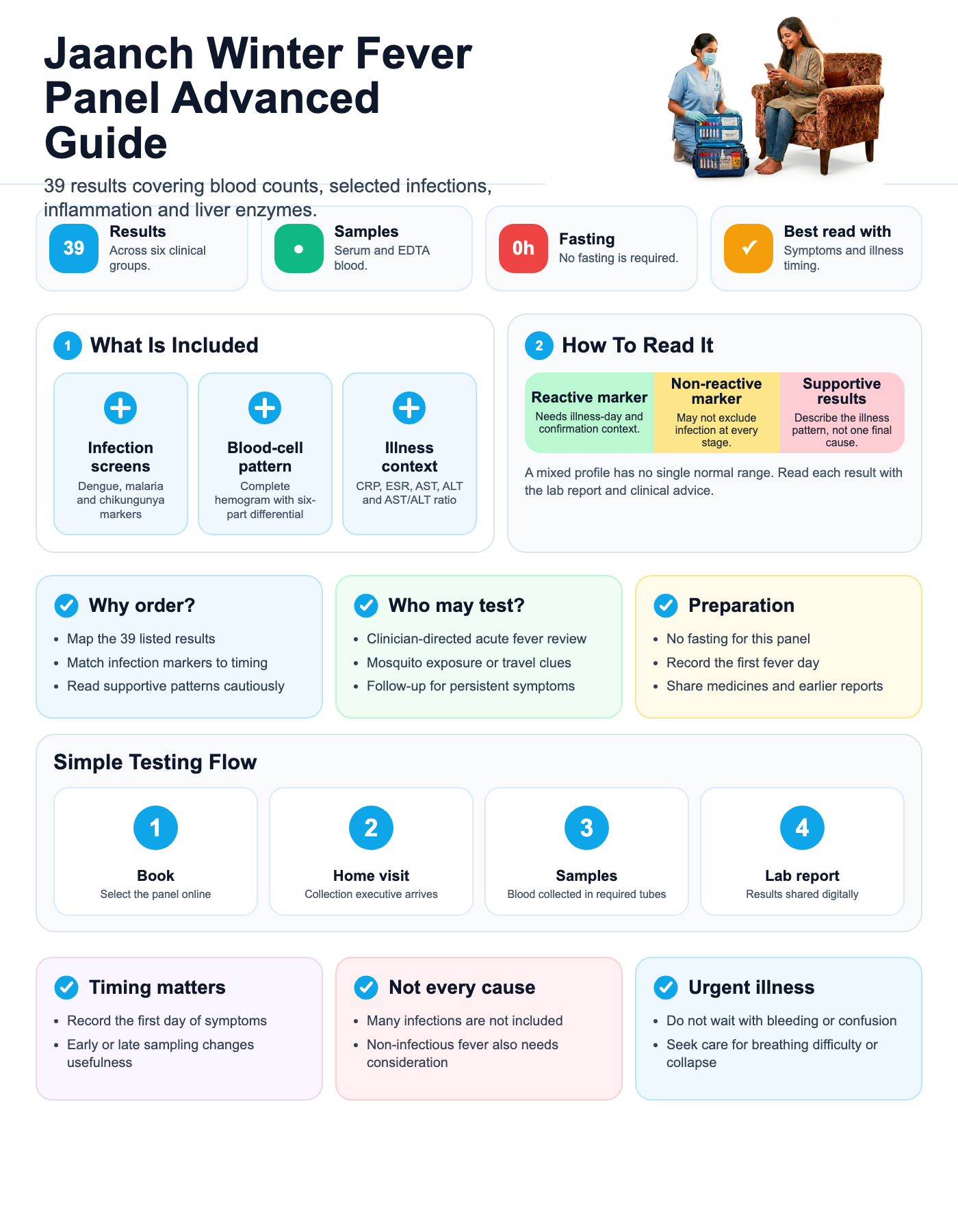
Jaanch Winter Fever Panel Advanced Reference Guide
- This panel combines 39 results across six clinical groups.
- Infection markers must be matched to the day symptoms began.
- Blood counts and inflammation markers provide context, not a final diagnosis.
- Negative results cannot exclude every infectious or non-infectious fever.
Why This Test Is Ordered
| Reason | Description |
|---|---|
| See what the package covers |
|
| Match dengue markers to timing |
|
| Review malaria and chikungunya screens |
|
| Use supportive results carefully |
|
Symptoms And Who Should Test
| Situation | Description |
|---|---|
| People with unexplained acute fever |
|
| People with mosquito exposure clues |
|
| People with compatible symptom patterns |
|
| People needing urgent assessment |
|
Preparation And Interpretation Notes
| Topic | Guidance |
|---|---|
| Follow the collection instructions |
|
| Record the illness timeline |
|
| Share medicines and treatment |
|
| Interpret negative results safely |
|
Frequently Asked Questions
What does this fever panel include?
It includes 39 results covering hemogram, selected infections, inflammation and liver enzymes.
Is fasting required for this panel?
No; fasting is not required unless another booked test has separate instructions.
Which samples are collected?
The listed groups use serum and EDTA blood collected in separate tubes.
Can this panel identify every fever cause?
No; many infectious and non-infectious causes require different evaluation.
When is dengue NS1 most useful?
NS1 is generally most useful during the first seven illness days.
Can dengue IgG confirm acute dengue?
No; a single IgG result may reflect earlier infection or related exposure.
Can early chikungunya IgM be negative?
Yes; antibodies usually develop toward the end of the first illness week.
Can negative malaria antigens exclude malaria?
Not always; strong suspicion may require prompt microscopy or repeat testing.
Can I book home collection?
Home collection is available where the entered address is serviceable.
Who should review the report?
A qualified clinician should review it with symptoms, timing, travel and medicines.
When should urgent care replace home testing?
Seek urgent care for breathing difficulty, confusion, collapse, bleeding or rapid worsening.