Choose your City


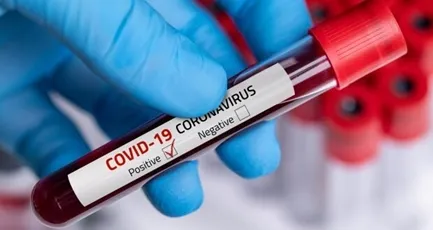
Covid-19 tests detect the presence of the virus, helping diagnose and control its spread, & checking if one is COVID positive or not.

COVID-19 (RT PCR) Test in Jaipur

Covid-19 tests detect the presence of the virus, helping diagnose and control its spread, & checking if one is COVID positive or not.


Group Name
Fasting Fasting not required
Sample Type Swabs,Bal,Sputum
Sample Collection Expert collect samples at Home
Reports Delivered Online within 24-48 Hrs*
Report type Email & Hardcopy ( On request )

Parameters Included in Covid-19 Test

What tests are included in the Covid-19 Test?


(1 Test)

  • Covid-19 rt pcr

Covid-19 Overview

What to expect during a Covid-19 Blood Test?

During a Covid-19 blood test, a healthcare professional takes a blood sample from your arm, which is also known as venipuncture. A lab expert known as a phlebotomist conducts this process using a needle. He locates a vein on your arm and inserts the needle to draw blood. The blood sample will be transferred into a test tube and will be taken safely to the labs for the test.

The lab technicians will test the sample by following established standards, to ensure correct reports. Thyrocare Labs has a team of professionals who are skilled and experienced. After the testing is done, your reports are sent to your email within 1-2 days. On the other hand, if you need a hard copy of the report, expect the delivery of the same within 3-5 business days.

Preparations before a Covid-19 Blood Test?

For Covid-19 blood tests, special preparations are not needed. However, some important steps must be taken to ensure accuracy in the test reports.

  • Covid-19 test requires Fasting not, the same must be done for at least 8-10 hours. Only water can be consumed during this time. Being hydrated helps the blood draw easier and also ensures accurate results.
  • Eating junk food and consuming sweetened beverages or alcohol can alter your test results. So, it is advisable to be careful about what to consume or take the advice of a professional.
  • Consumption of certain medications is also prohibited before blood tests. You can discuss the details about the same with your doctor to be sure.
  • Avoid strenuous exercise as it can alter the readings of a blood test.

Are there any side effects of the test?

There are no side effects or risks attached to Covid-19 blood tests. The test involves the collection of a blood sample from your home. A phlebotomist draws blood from your arm using a needle, which only takes a few minutes. During this process, you might feel a sting on your arm, which is not painful. The blood sample will then be sent to the labs. Our medical experts take all precautions and safety measures during sample collection and testing.
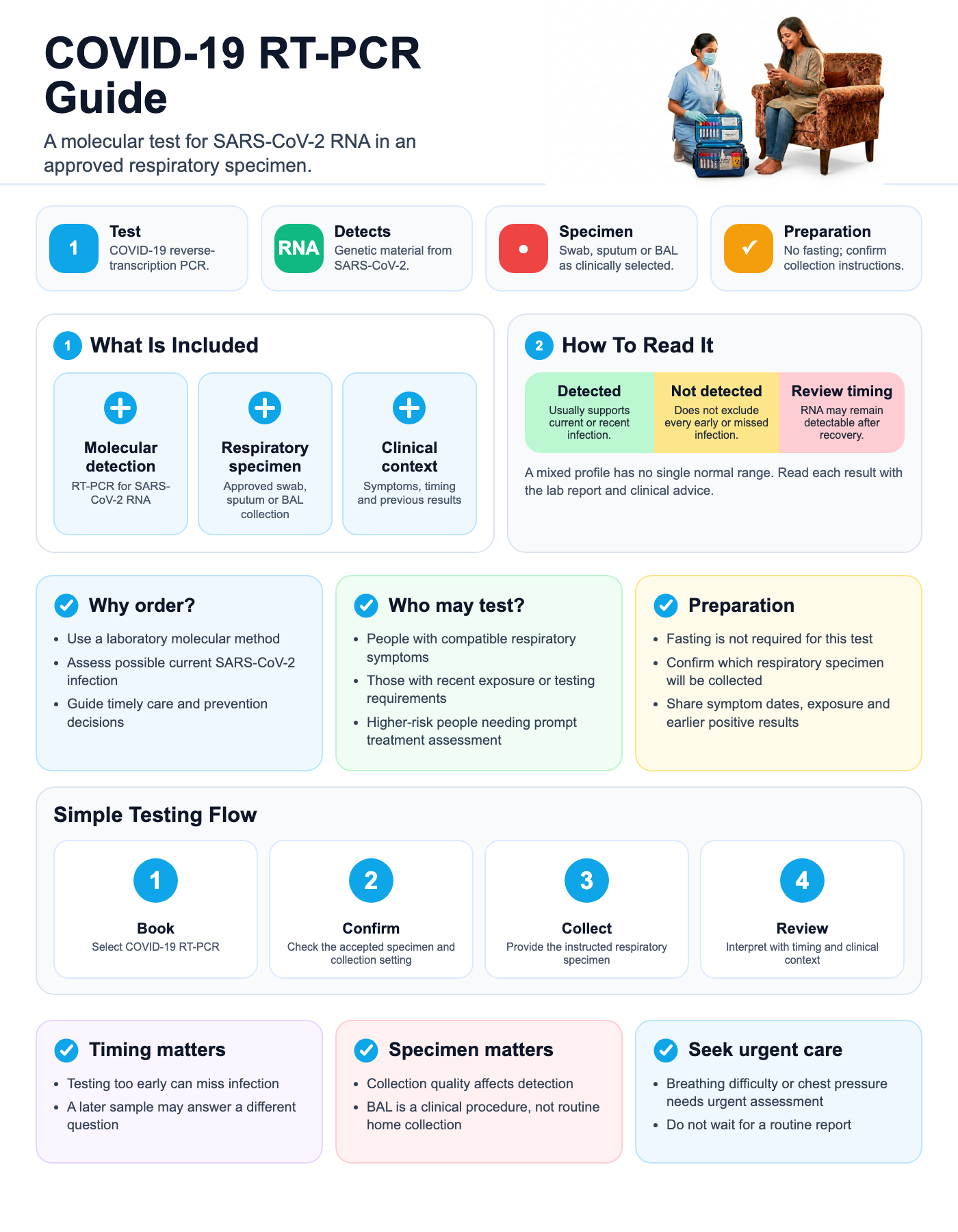
Covid 19 visual guide

COVID-19 RT-PCR Test Reference Guide in Jaipur

  • This profile contains one laboratory RT-PCR test for SARS-CoV-2 RNA.
  • The live catalog lists swabs, sputum and bronchoalveolar lavage as possible respiratory specimens.
  • The actual specimen and collection setting must be confirmed before booking or travel.
  • Result meaning depends on symptom timing, exposure, collection quality and previous infection.
  • Use the report with current local health guidance and prompt clinical advice when risk is high.
  • Medical guidance stays consistent; use this page for Jaipur pricing and collection details.

Why This Test Is Ordered

Understand what the RT-PCR test detects
  • This profile contains one COVID-19 reverse-transcription polymerase chain reaction test.
  • RT-PCR is a nucleic acid amplification method used for molecular diagnosis.
  • The test looks for genetic material called RNA from SARS-CoV-2.
  • SARS-CoV-2 is the virus that causes coronavirus disease 2019.
  • The test does not measure antibodies produced after infection or vaccination.
  • It also does not measure immunity, disease severity or treatment response.
  • Laboratory molecular tests generally detect infection more reliably than antigen tests.
  • The final report must still be interpreted for the tested person and timing.
Read a detected result in context
  • A detected RT-PCR result means SARS-CoV-2 RNA was found in the specimen.
  • That finding usually supports a current or recently resolved infection.
  • Viral RNA may remain detectable after symptoms improve and transmission risk falls.
  • RT-PCR does not directly prove that live, transmissible virus is present.
  • The result alone cannot show when the infection was acquired.
  • It also cannot predict whether illness will remain mild or become severe.
  • People at higher risk should seek treatment advice promptly after symptoms begin.
  • Follow current local guidance for care, precautions, work and travel decisions.
Understand what a negative result cannot prove
  • A not-detected result means viral RNA was not found in that specimen.
  • The result is a snapshot around the time the sample was collected.
  • Testing very early can occur before viral levels become detectable.
  • Poor collection or an unsuitable specimen can reduce the chance of detection.
  • A negative result therefore cannot exclude every SARS-CoV-2 infection.
  • Persistent symptoms may justify clinical review or repeat testing at another time.
  • Influenza, RSV and other illnesses can cause similar respiratory symptoms.
  • This single-target profile does not test for those other respiratory viruses.
Match the specimen to the clinical situation
  • The catalog lists swabs, sputum and bronchoalveolar lavage as accepted categories.
  • It does not state which specimen will be used for every booking.
  • Upper-respiratory swabs are commonly collected for current infection testing.
  • Some swab locations require collection by a trained healthcare professional.
  • Sputum is a deep-cough specimen and is not the same as saliva.
  • Sputum collection is relevant only when a productive cough is present.
  • Bronchoalveolar lavage is an invasive lower-respiratory procedure performed clinically.
  • Confirm the exact specimen and setting before relying on collection availability.
Know the important limits of one PCR result
  • RT-PCR does not distinguish COVID-19 from influenza by symptoms alone.
  • This profile does not include influenza, RSV or a multiplex respiratory panel.
  • A result cannot replace examination when breathing or chest symptoms are severe.
  • A molecular result cannot measure oxygen levels or respiratory illness severity.
  • The laboratory report does not replace assessment of worsening clinical symptoms.
  • Vaccination does not cause a SARS-CoV-2 viral NAAT to become positive.
  • A recent infection can complicate interpretation because RNA may persist for weeks.
  • Use current guidance when testing is required for a specific administrative purpose.

Symptoms And Who Should Test

People with symptoms compatible with COVID-19
  • Fever, chills, cough and sore throat can occur with COVID-19.
  • Runny nose, congestion, fatigue and headache may also be present.
  • Breathlessness, body aches, nausea or diarrhoea can occur in some people.
  • Loss of taste or smell remains possible but is not required.
  • Symptoms overlap considerably with influenza and other respiratory infections.
  • Testing can help distinguish SARS-CoV-2 when the result may change decisions.
  • Higher-risk people should contact a clinician early even with mild symptoms.
  • Trouble breathing, chest pressure, confusion or severe drowsiness needs urgent care.
People after a recent possible exposure
  • A close or household exposure may prompt testing under current local guidance.
  • The exposure date helps determine whether a PCR test is timed appropriately.
  • Testing immediately after exposure may be too early to detect infection.
  • New symptoms after a negative result can change the testing plan.
  • People without symptoms may follow different timing from symptomatic people.
  • Masks, ventilation and reduced close contact can protect others while uncertain.
  • Workplace, school and travel rules may use different testing definitions.
  • Confirm the accepting organisation’s required method, timing and report details.
People at higher risk of severe illness
  • Older age increases the risk of severe outcomes from COVID-19.
  • Chronic lung or heart disease can also increase individual risk.
  • Cancer treatment and immune-suppressing conditions may increase vulnerability.
  • Risk rises further when several important medical conditions occur together.
  • Early testing may support timely assessment for authorised antiviral treatment.
  • Treatment eligibility depends on age, health, medicines and local clinical guidance.
  • Some treatments must begin within a few days after symptoms start.
  • Do not delay clinical contact while waiting for routine report delivery.
People needing testing for healthcare or travel
  • A hospital or procedure may request a specific molecular test and specimen.
  • Travel authorities may define an exact collection window before departure.
  • Employers and institutions may update their testing requirements without notice.
  • Confirm whether a laboratory RT-PCR report is currently accepted.
  • Check required identification, collection time and report language before booking.
  • A home-collected specimen may not satisfy every formal testing requirement.
  • Bronchoalveolar lavage is not a routine administrative or travel specimen.
  • Mediyaar content cannot replace the receiving authority’s current written rules.
People with a recent positive COVID result
  • Molecular tests can remain positive after the acute illness has resolved.
  • Viral RNA may sometimes be detectable for up to ninety days.
  • Repeat RT-PCR is therefore not a universal test of recovery or infectiousness.
  • New symptoms within that period need an individual testing and care plan.
  • A clinician may prefer another testing approach depending on timing and risk.
  • Previous positive dates and treatment history should be shared before collection.
  • Persistent symptoms may need assessment beyond another SARS-CoV-2 PCR test.
  • Urgent warning signs require care regardless of the latest test result.

Preparation And Interpretation Notes

Follow the verified no-fasting instruction
  • Fasting is not required for the current COVID-19 RT-PCR profile.
  • Continue ordinary meals and fluids unless your clinician advises otherwise.
  • Specimen-specific instructions may still apply shortly before collection.
  • Follow the collection team’s instructions for the exact swab or specimen.
  • Do not change specimen preparation without instructions from the collection team.
  • Keep taking prescribed medicines unless the treating clinician changes them.
  • Tell the collection team about nasal surgery, bleeding or severe obstruction.
  • Reconfirm preparation if the selected specimen changes before the appointment.
Confirm the specimen and collection setting
  • Ask whether the booking uses a nasal, throat or another swab.
  • Confirm whether collection occurs at home, a centre or a clinical facility.
  • Do not assume every listed specimen is available through home collection.
  • Nasopharyngeal and throat swabs usually require a trained healthcare collector.
  • Sputum collection should follow guidance from a trained healthcare professional.
  • Bronchoalveolar lavage is collected during a clinical respiratory procedure.
  • The laboratory should confirm the accepted container and transport method.
  • A mismatched or poorly collected specimen can produce an unreliable result.
Make respiratory collection safer and reliable
  • Wear a well-fitting mask when attending collection with respiratory symptoms.
  • Tell staff about symptoms before entering a shared collection area.
  • Follow hand hygiene and respiratory etiquette throughout the visit.
  • Remain still and follow the collector’s breathing and positioning instructions.
  • Tell the collector immediately if you cannot tolerate the sampling procedure.
  • Do not touch the swab tip, transport tube interior or collected material.
  • Sputum means material from a deep cough, not ordinary saliva or spit.
  • Never attempt to collect bronchoalveolar lavage outside an appropriate clinical setting.
Record timing and previous COVID history
  • Write down when symptoms began and how they have changed.
  • Record the date and type of any recent known exposure.
  • Share dates of previous positive PCR or antigen test results.
  • Mention whether the last positive result occurred within ninety days.
  • Tell the reviewer about vaccination without expecting it to alter PCR positivity.
  • List current medicines and any COVID-19 treatment already started.
  • Keep earlier reports available when repeat testing is being considered.
  • Timing information helps distinguish early testing from persistent RNA detection.
Act on results without delaying urgent care
  • Follow current local guidance after a detected SARS-CoV-2 result.
  • Reduce close contact and improve ventilation when infection is possible.
  • Use a well-fitting mask around others when current guidance recommends it.
  • Higher-risk people should seek treatment assessment promptly after symptom onset.
  • A negative result should not override severe or worsening respiratory symptoms.
  • Ask about repeat or alternative testing when clinical suspicion remains high.
  • Seek urgent care for breathing difficulty, chest pressure or new confusion.
  • Do not wait for report delivery when someone is difficult to wake.

Frequently Asked Questions

What test is included in this profile?

It contains one laboratory COVID-19 RT-PCR test.

Is fasting required for COVID-19 RT-PCR?

No; fasting is not required for this profile.

What specimen is used for this test?

Confirm the selected swab, sputum or clinical BAL specimen before collection.

What does COVID-19 RT-PCR detect?

It detects SARS-CoV-2 viral RNA in an approved respiratory specimen.

Can a negative PCR rule out COVID-19?

No; timing, specimen choice and collection quality can affect detection.

Does a positive PCR prove I am contagious?

No; RNA detection alone cannot measure current infectiousness.

Can PCR remain positive after recovery?

Yes; viral RNA may remain detectable after the acute illness.

Does vaccination make RT-PCR positive?

No; vaccination does not cause a viral NAAT to become positive.

Can I book COVID-19 collection in Jaipur?

Confirm specimen eligibility and address serviceability for collection in Jaipur.

Who can review my COVID-19 result in Jaipur?

A qualified clinician in Jaipur can review timing, symptoms and treatment risk.

Where should I seek urgent COVID-19 care in Jaipur?

Use an emergency service in Jaipur for severe warning symptoms.

Ratings & Reviews
4.8 ★★★★★

Based on verified bookings

Good service

Sample collection was smooth and reports were delivered on time.

Health Insights & Resources
View All Blogs →
Blog Title

August 20, 2025

The Role of AI in Medical Healthcare
Read More
Blog Title

August 19, 2025

Insulin Fasting Test: Why It’s Important
Read More
Blog Title

August 18, 2025

Why Every Indian Child Should Take a Full Body Test?
Read More
Blog Title

August 17, 2025

Food Poisoning in Hindi - फूड पॉइज़निंग क्या है? कारण, लक्षण, बचाव के
Read More
Test Conducted By
Covid-19 Test Cost in Jaipur : Rs. 792
Rs. 495 38% Off
Home Sample Collection Available No Extra Charges
You will Save Rs. 297 on this Test
CAP Accredited NABL Accredited UKAS Management Systems ANAB Accredited
Lab Logo
Covid-19 Test Cost in Jaipur : Rs. 792
Rs. 495