Choose your City


Urine Routine Test including 24 Tests to detects conditions like UTI, Diabetes, or Kidney Disease, and helps to diagnose early detection and effective treatment.

Complete Urine Routine Analysis Test in Kurnool

Urine Routine Test including 24 Tests to detects conditions like UTI, Diabetes, or Kidney Disease, and helps to diagnose early detection and effective treatment.

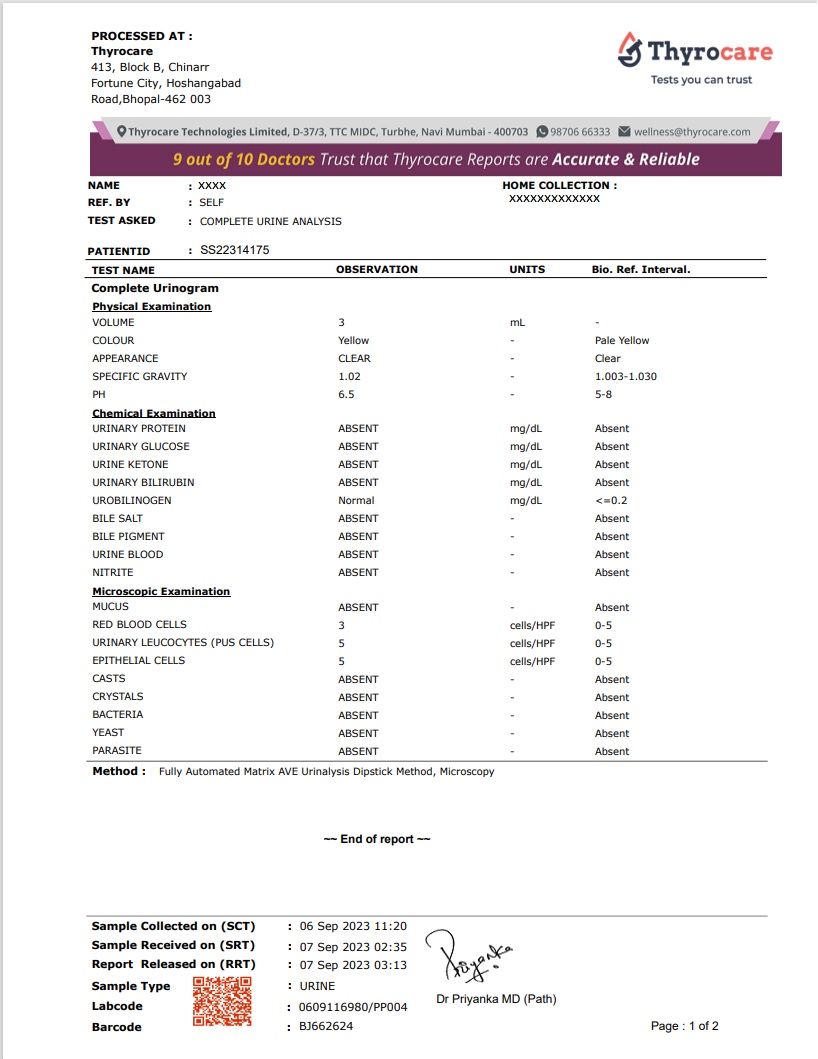
Complete Urine Analysis Test Sample Report

Group Name WELLNESS
Fasting Fasting not required
Sample Type URINE
Sample Collection Expert collect samples at Home
Reports Delivered Online within 24-48 Hrs*
Report type Email & Hardcopy ( On request )

Parameters Included in Complete Urine Analysis Test

What tests are included in the Complete Urine Analysis Test?


Complete Urine Analysis (24 Tests)

  • Appearance
  • Bacteria
  • Bile pigment
  • Bile salt
  • Casts
  • Colour
  • Crystals
  • Epithelial cells
  • Microalbumin
  • Mucus
  • Nitrite
  • Parasite
  • Ph
  • Red blood cells
  • Specific gravity
  • Urinary bilirubin
  • Urinary glucose
  • Urinary leucocytes (pus cells)
  • Urinary protein
  • Urine blood
  • Urine ketone
  • Urobilinogen
  • Volume
  • Yeast
Complete Urine Analysis Test Sample Report
Complete Urine Analysis Sample report & Ranges
Conducted at Thyrocare Labs
Lab Accreditation CAP, NABL, ICMR, NGSP, ISO
Method Fully Automated Matrix AVE Urinalysis Dipstick Method, Microscopy
Supervision Dr Priyanka MD (Path)
Results Highly Specific

Our labs work 365 days / 24 x 7 to ensure your  Complete Urine Analysis samples reach us the same night, before midnight. We are equipped with  (MUT) -  India's first preanalytical barcoded vial sorter, Sample Sorter  &  Aptio (Siemens).

Our IT-enabled barcoded bi-directional operating systems & world-class air logistics process your blood samples within the specified time with the utmost accuracy. Once your specimen for Complete Urine Analysis is collected by our phlebotomist, Your reports will be sent to your email id within 24 to 48 hours. For hard copy requests, the reports would be delivered in 3 to 5 days.  You will be informed via SMS & email once we process your report.


Complete Urine Analysis Sample Report Format & Ranges

View the Complete Urine Analysis sample report in the original Thyrocare PDF format. Customer name, contact details, address, barcode, order ID and lead ID are masked on the public sample copy.

Exact Thyrocare PDF preview will show here after a masked sample PDF is attached to this report.

The searchable values below support visitors looking for Complete Urine Analysis report format, sample report values, normal range and reference range information.

Conducted at Thyrocare Labs
Lab Accreditation CAP, NABL, ICMR, NGSP, ISO
Reference Range < 5.7
Results Highly specific

Complete Urine Analysis Reference Range Table

Parameter Unit Reference Range Method Report Section
HbA1c % < 5.7
AVERAGE BLOOD GLUCOSE (ABG) mg/dL 90-120
FASTING BLOOD SUGAR(GLUCOSE) mg/dL 70-100

Complete Urine Analysis Report Sections Covered

Report Section Parameters in Sample Report
Diabetes 3
Other Counts 1
Complete Hemogram 28
Vitamins 2
Lipid 10
Liver 12
Electrolytes 2
Thyroid 3
Renal 8
Iron Deficiency 1

Complete Urine Analysis Overview

Complete urine test

What to expect during a Complete Urine Analysis Blood Test?

During a Complete Urine Analysis blood test, a healthcare professional takes a blood sample from your arm, which is also known as venipuncture. A lab expert known as a phlebotomist conducts this process using a needle. He locates a vein on your arm and inserts the needle to draw blood. The blood sample will be transferred into a test tube and will be taken safely to the labs for the test.

The lab technicians will test the sample by following established standards, to ensure correct reports. Thyrocare Labs has a team of professionals who are skilled and experienced. After the testing is done, your reports are sent to your email within 1-2 days. On the other hand, if you need a hard copy of the report, expect the delivery of the same within 3-5 business days.

Preparations before a Complete Urine Analysis Blood Test?

For Complete Urine Analysis blood tests, special preparations are not needed. However, some important steps must be taken to ensure accuracy in the test reports.

  • Complete Urine Analysis test requires Fasting not, the same must be done for at least 8-10 hours. Only water can be consumed during this time. Being hydrated helps the blood draw easier and also ensures accurate results.
  • Eating junk food and consuming sweetened beverages or alcohol can alter your test results. So, it is advisable to be careful about what to consume or take the advice of a professional.
  • Consumption of certain medications is also prohibited before blood tests. You can discuss the details about the same with your doctor to be sure.
  • Avoid strenuous exercise as it can alter the readings of a blood test.

Are there any side effects of the test?

There are no side effects or risks attached to Complete Urine Analysis blood tests. The test involves the collection of a blood sample from your home. A phlebotomist draws blood from your arm using a needle, which only takes a few minutes. During this process, you might feel a sting on your arm, which is not painful. The blood sample will then be sent to the labs. Our medical experts take all precautions and safety measures during sample collection and testing.
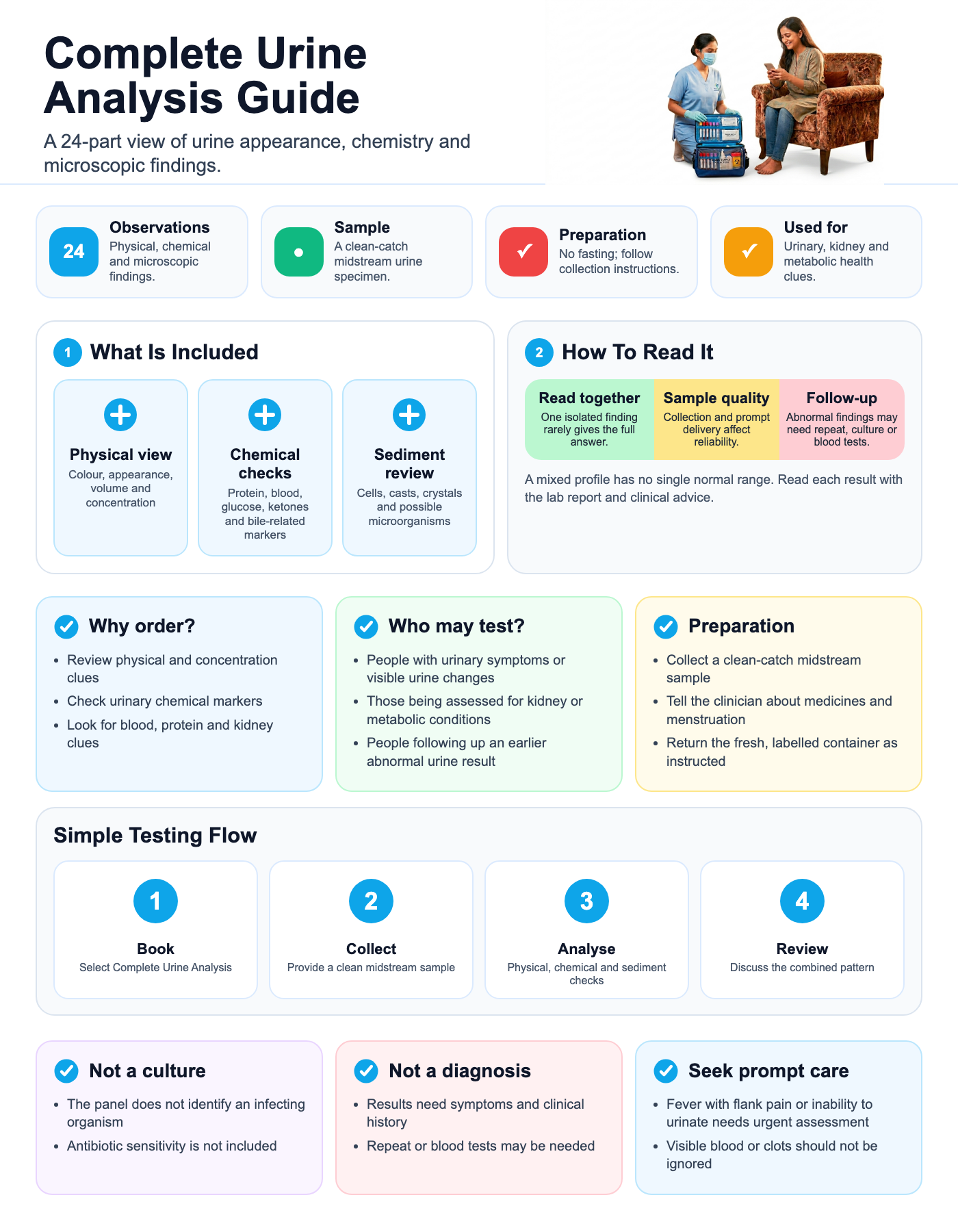
Complete Urine Analysis visual guide

Complete Urine Analysis Reference Guide in Kurnool

  • Complete Urine Analysis reports 24 physical, chemical and microscopic urine observations.
  • The profile covers appearance, concentration, cells, protein, glucose, ketones and bile-related markers.
  • It also checks infection clues such as leucocytes, nitrite and bacteria.
  • Each finding is a clue rather than a separate diagnosis.
  • Symptoms, collection quality, medicines and related tests shape the final interpretation.
  • Medical guidance stays consistent; use this page for Kurnool pricing and collection details.

Why This Test Is Ordered

See urine’s physical character and concentration
  • Colour records the visible shade of the submitted urine specimen.
  • Appearance describes whether the sample looks clear, hazy or cloudy.
  • Specific gravity estimates how concentrated or dilute the urine is.
  • Recent fluid intake can change colour and specific gravity considerably.
  • Foods, supplements and medicines may alter urine colour without causing disease.
  • Cells, crystals, mucus or microorganisms may contribute to a cloudy appearance.
  • Appearance alone cannot identify infection, stones or impaired kidney function.
  • Submitted volume is not the same as a measured 24-hour urine output.
Survey chemical markers in one specimen
  • Urine pH describes acidity or alkalinity at the time of testing.
  • Glucose may appear in urine when blood glucose exceeds kidney handling capacity.
  • Urine glucose cannot replace blood glucose or HbA1c for diabetes assessment.
  • Ketones can rise during fasting, vomiting, low-carbohydrate intake or uncontrolled diabetes.
  • Urine ketones may require blood testing when acute diabetic illness is suspected.
  • Bilirubin and urobilinogen provide clues about liver function and bile flow.
  • Urine bile markers do not replace a clinically indicated liver blood panel.
  • Medicines, supplements and sample delay can affect some chemical reactions.
Look for blood and protein that may need follow-up
  • The profile reports urinary blood, red blood cells and urinary protein.
  • Blood may be visible or detected only during laboratory testing.
  • Menstruation, hard exercise, infection, stones and urinary conditions can affect blood findings.
  • Visible blood or clots deserve clinical assessment even when other results appear normal.
  • Temporary protein may follow fever, dehydration or strenuous physical activity.
  • Persistent protein can indicate kidney filter damage and needs targeted assessment.
  • Routine urinary protein is not a quantified albumin-to-creatinine ratio.
  • An unexpected result may need a carefully collected repeat specimen.
Find infection and inflammation clues without calling it a culture
  • Leucocyte esterase can indicate white blood cells within the urine sample.
  • Microscopy separately reports urinary leucocytes, often labelled pus cells.
  • Nitrite may become positive when certain bacteria convert nitrate in urine.
  • Microscopy can show bacteria, although contamination may create a misleading finding.
  • Symptoms help interpret leucocytes, nitrite, bacteria and urinary blood together.
  • A negative nitrite result does not rule out every urinary infection.
  • This profile does not identify an organism or test antibiotic sensitivity.
  • Urine culture may be needed for pregnancy, recurrence, fever or treatment failure.
Use the sediment examination to add context
  • Microscopy reviews cells, casts, crystals, mucus and possible microorganisms.
  • A few epithelial cells may reflect ordinary lining-cell shedding.
  • Many squamous epithelial cells can suggest contamination from nearby skin or genital tissue.
  • Cast type and quantity matter more than the word casts alone.
  • Crystals can form because of urine chemistry, temperature or storage conditions.
  • Finding crystals does not automatically confirm a kidney stone.
  • Yeast or parasite findings require clinical correlation and sometimes confirmation.
  • Sediment findings become useful when read with chemistry, symptoms and collection quality.

Symptoms And Who Should Test

People with burning, urgency or frequent urination
  • Burning during urination can justify a clinician-led urinary assessment.
  • Frequent or urgent urination may occur with infection and other conditions.
  • Lower abdominal discomfort can add useful context to urine findings.
  • Cloudy, bloody or unusually strong-smelling urine should be reported accurately.
  • Leucocytes, nitrite, bacteria and blood help guide the next investigation.
  • Negative nitrite cannot exclude infection when symptoms remain convincing.
  • Fever, chills, vomiting or flank pain require prompt medical assessment.
  • Severe or worsening symptoms should not wait for a routine report.
People with visible blood, foam or changed urine appearance
  • Pink, red or brown urine can be a reason for urinalysis.
  • Persistent foam, cloudiness or an unexplained colour change also deserves discussion.
  • Foods, dehydration and medicines may alter colour without urinary disease.
  • Visible blood should never be assumed harmless from appearance alone.
  • This profile can detect blood and red cells but cannot locate bleeding.
  • Menstrual blood or vaginal discharge can enter the collection container.
  • Normal-looking urine does not exclude microscopic blood or protein.
  • Blood, clots, severe pain or difficulty urinating need prompt assessment.
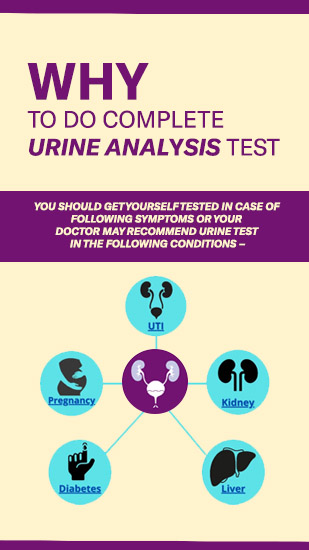
People with kidney, blood-pressure or diabetes risk
  • Clinicians may pair urinalysis with blood tests during kidney-risk assessment.
  • Protein, blood, cells and casts can provide clues about kidney involvement.
  • Glucose and ketones add metabolic clues but cannot diagnose diabetes alone.
  • This package does not measure serum creatinine, eGFR or blood glucose.
  • It also does not quantify urine albumin-to-creatinine ratio.
  • Those targeted tests may remain necessary after an unremarkable urinalysis.
  • One unusual urine result cannot establish chronic kidney disease.
  • Known kidney disease should follow its personalised monitoring schedule.
People being assessed for liver or metabolic clues
  • Urinary bilirubin can add information when jaundice or dark urine is present.
  • Urobilinogen contributes a separate clue about bilirubin processing and bile flow.
  • Neither marker provides a complete assessment of liver health.
  • Abnormal bile-related findings may lead to liver blood testing.
  • Urinary glucose can support investigation of thirst, weight loss or frequent urination.
  • Urinary ketones may accompany fasting, vomiting or altered glucose metabolism.
  • Diabetes concerns require blood glucose and sometimes HbA1c assessment.
  • Vomiting, deep breathing or drowsiness with diabetes needs urgent care.
People repeating or monitoring an earlier finding
  • A repeat test may clarify an unexpected or previously treated finding.
  • Consistent collection improves comparison between current and earlier reports.
  • Clean technique helps distinguish persistence from contamination or menstrual blood.
  • Recent exercise, dehydration, fever and medicines can alter selected results.
  • After antibiotics, culture may be more useful than another broad urinalysis.
  • Persistent blood or protein may require a more targeted investigation.
  • Bring previous reports and record treatment dates before clinical review.
  • Repeat timing should match the original finding and clinical question.

Preparation And Interpretation Notes

Collect a clean-catch midstream specimen
  • Wash and dry your hands before opening the sterile container.
  • Avoid touching the inside of the cup or its lid.
  • Clean the genital area exactly as the collection instructions describe.
  • Pass the first urine into the toilet before collecting the middle stream.
  • Keep the container away from skin while collecting the specimen.
  • Close the lid securely as soon as collection is complete.
  • Use the supplied sterile container rather than a household jar.
  • Ask for specific guidance when midstream collection is not practical.
No fasting, but coordinate other booked tests
  • Fasting is not required for this urine-only profile.
  • Follow stricter preparation when another booked test requires fasting.
  • Maintain ordinary fluid intake unless a clinician advises otherwise.
  • Forcing excessive water can produce an unusually dilute specimen.
  • Do not stop medicines, antibiotics or supplements without medical advice.
  • List medicines and supplements that may affect colour or chemistry.
  • Tell the laboratory if antibiotics have already been started.
  • Antibiotic timing may influence infection findings and decisions about culture.
Prevent menstrual and genital contamination
  • Tell the collection team if you are currently menstruating.
  • Also mention vaginal bleeding, discharge or recently used vaginal medicine.
  • Bleeding haemorrhoids can introduce outside blood into the specimen.
  • External cells or organisms may create findings unrelated to the bladder.
  • A clinician may postpone non-urgent testing or recommend careful collection.
  • The laboratory cannot always determine where detected blood originated.
  • Unexpected blood, bacteria or epithelial cells may justify recollection.
  • Use a fresh sterile container whenever a repeat sample is requested.
Keep the sample fresh and follow transport instructions
  • Return the sealed specimen within the laboratory’s stated time.
  • Follow the provided storage instructions when immediate handover is impossible.
  • Cells can break down when urine remains unprocessed for too long.
  • Microorganisms may multiply and chemistry may change after collection.
  • Heat and direct sunlight can reduce specimen reliability.
  • Check that the lid is secure and identification details are correct.
  • Home collection still requires careful coordination of collection and transport.
  • Request a new container after a spill or labelling mistake.
Review the combined report and know the limits
  • Use the units and reference information printed on the current report.
  • Absent, trace, graded and counted findings are not interchangeable descriptions.
  • Review leucocytes, nitrite, bacteria and symptoms as a combined infection pattern.
  • Ask whether an unexpected finding needs a fresh clean-catch repeat.
  • Urine culture identifies organisms and may guide antibiotic selection.
  • Blood tests or imaging may answer questions outside this profile.
  • This profile cannot diagnose diabetes, prove stones or stage kidney disease.
  • Inability to urinate, visible clots or fever with flank pain needs prompt care.

Frequently Asked Questions

What does Complete Urine Analysis include?

It reports 24 physical, chemical and microscopic urine observations.

Is fasting required for this urine profile?

No; fasting is not required unless another test in the same booking needs it.

How should I collect the sample?

Use the sterile container and provide a clean-catch midstream specimen as instructed.

Is Complete Urine Analysis the same as urine culture?

No; it does not identify the infecting organism or antibiotic sensitivity.

Can a negative nitrite result rule out a UTI?

No; symptoms and other findings may still justify clinical review or culture.

What should I do if I am menstruating?

Tell the collection team because outside blood can affect the result.

Can I book urine sample collection at home in Kurnool?

Home urine sample collection in Kurnool is available where the address is serviceable.

How quickly should the urine sample reach the lab?

Return it within the laboratory’s stated time and follow any storage instructions.

Can this profile diagnose kidney disease?

No; persistent abnormalities need clinical review and often targeted urine or blood tests.

When should I repeat Complete Urine Analysis in Kurnool?

Repeat testing in Kurnool should follow the clinician’s finding- and symptom-based plan.

Who can review my Complete Urine Analysis report in Kurnool?

A qualified clinician in Kurnool can review the pattern with your symptoms and history.

Ratings & Reviews
4.8 ★★★★★

Based on verified bookings

Good service

Sample collection was smooth and reports were delivered on time.

Health Insights & Resources
View All Blogs →
Blog Title

August 20, 2025

The Role of AI in Medical Healthcare
Read More
Blog Title

August 19, 2025

Insulin Fasting Test: Why It’s Important
Read More
Blog Title

August 18, 2025

Why Every Indian Child Should Take a Full Body Test?
Read More
Blog Title

August 17, 2025

Food Poisoning in Hindi - फूड पॉइज़निंग क्या है? कारण, लक्षण, बचाव के
Read More
Test Conducted By
Urine Test Price in Kurnool : Rs. 718
Rs. 449 37% Off
Home Sample Collection Available No Extra Charges
You will Save Rs. 269 on this Test
CAP Accredited NABL Accredited UKAS Management Systems ANAB Accredited
Lab Logo
Urine Test Price in Kurnool : Rs. 718
Rs. 449