Apolipoprotein - B (apo-b) in Ratlam
Apolipoprotein - B (apo-b) Test Visual Guide
Measures Apo B, a marker of atherogenic cholesterol particles linked with heart risk.

Download Apolipoprotein - B (apo-b) Test Visual Guide infographic (PNG)
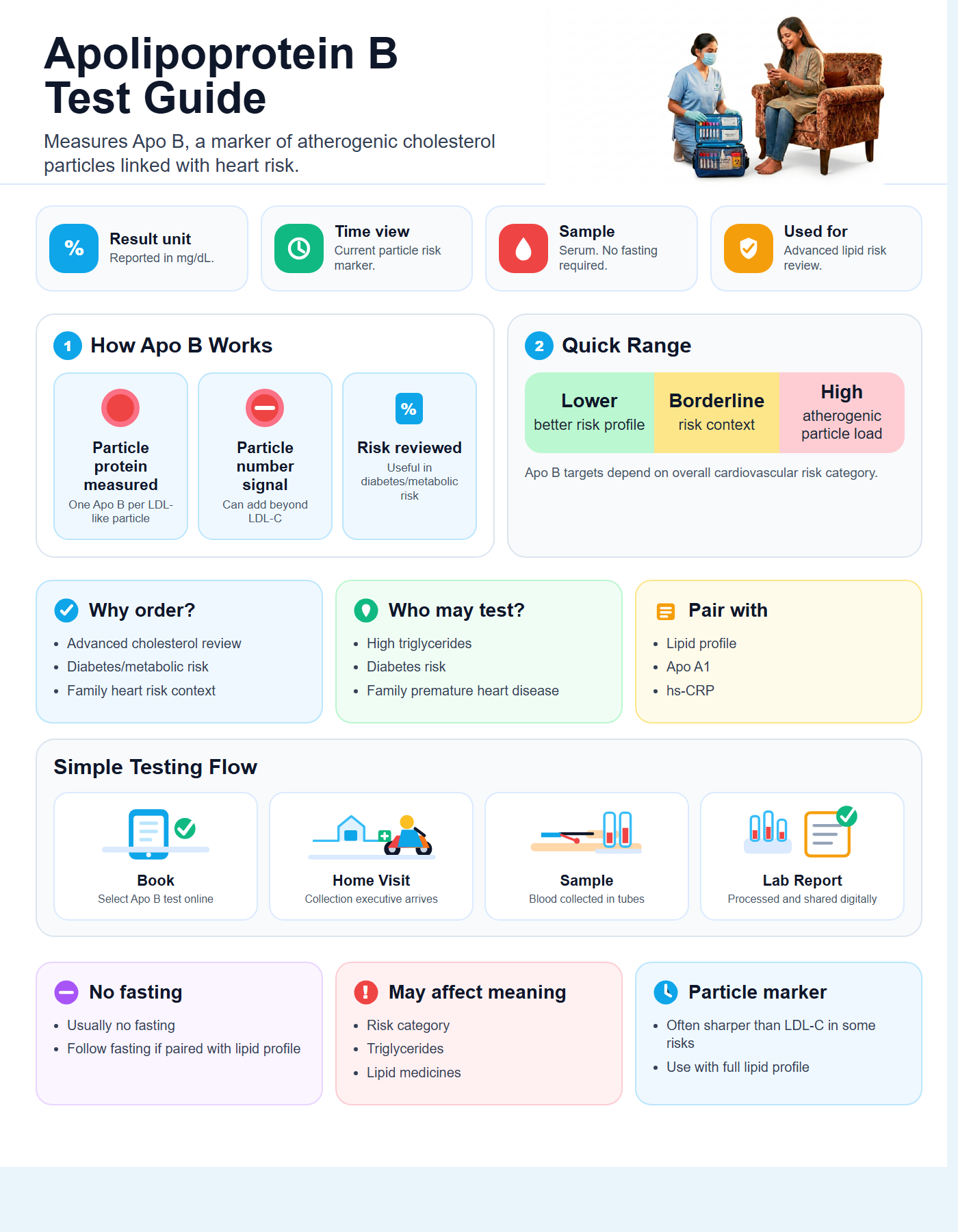
How Apo B Works
- Particle protein measuredOne Apo B per LDL-like particle
- Particle number signalCan add beyond LDL-C
- Risk reviewedUseful in diabetes/metabolic risk
Typical result context
| Result context | Guide |
|---|---|
| Lower | better risk profile |
| Borderline | risk context |
| High | atherogenic particle load |
Apo B targets depend on overall cardiovascular risk category.
Why it may be advised
- Advanced cholesterol review
- Diabetes/metabolic risk
- Family heart risk context
When to discuss it
- High triglycerides
- Diabetes risk
- Family premature heart disease
Often reviewed with
- Lipid profile
- Apo A1
- hs-CRP
Simple Testing Flow
- BookSelect Apo B test online
- Home VisitCollection executive arrives
- SampleSample collected as instructed
- Lab ReportProcessed and shared digitally
Preparation
- No fasting is required for this test alone. If another test in the same order requires fasting, follow its preparation instructions.
- Do not stop prescribed medicines without your clinician’s advice.
May affect meaning
- Risk category
- Triglycerides
- Lipid medicines
Particle marker
- Often sharper than LDL-C in some risks
- Use with full lipid profile
About the Apolipoprotein - B (apo-b) Test
Apolipoprotein - B (apo-b) is a laboratory test. Apo B helps assess the number of cholesterol-carrying particles that can contribute to plaque in arteries. It complements a standard lipid profile.
Your clinician can advise whether this test is appropriate for you. The result should be read with the laboratory range, symptoms, medical history and other relevant results. The listed sample type is Blood (Serum).
Apolipoprotein - B (apo-b) Sample Report Format & Ranges
Relevant details from a Thyrocare sample report are shown below. A standalone PDF preview for Apolipoprotein - B (apo-b) is not available here. Reference intervals may vary by method and patient factors. Use the interval printed on your own final report.
| Conducted at | Thyrocare Labs |
|---|---|
| Lab Accreditation | CAP, NABL, UKAS, ANAB |
Apolipoprotein - B (apo-b) Thyrocare Sample-Report Range Table
| Parameter | Unit | Reference Range |
|---|---|---|
| APOLIPOPROTEIN - B (APO-B) | mg/dL | 53 - 138 |
Apolipoprotein B (Apo B) Reference Guide in Ratlam
Educational guide only. The Thyrocare sample-report range is shown in the Reports & Ranges section. For your own result, use the range on your final report and discuss it with your clinician.
Why This Test Is Ordered
| Reason | Description |
|---|---|
| Particle burden | Apo B helps assess the number of cholesterol-carrying particles that can contribute to plaque in arteries. It complements a standard lipid profile. |
| When results differ | LDL cholesterol and Apo B do not always tell the same story. Apo B can help clarify risk when LDL cholesterol appears satisfactory but particle burden remains high. |
| Treatment review | Your clinician may use Apo B alongside LDL cholesterol, non-HDL cholesterol and your overall cardiovascular risk when reviewing treatment. |
Symptoms And Who Should Test
| Situation | Description |
|---|---|
| People with raised triglycerides, diabetes or metabolic risk | Apo B may add useful information when cholesterol measurements alone underestimate particle burden. |
| People with established cardiovascular disease | Testing may help a clinician assess residual lipid-related risk. It is not a test for an acute heart attack. |
| People without symptoms | High Apo B usually has no specific symptoms. Testing is guided by risk factors and clinical assessment, not symptoms alone. |
Preparation And Interpretation Notes
| Topic | Guidance |
|---|---|
| Fasting | No fasting is required for this test alone. If another test in the same order requires fasting, follow its preparation instructions. |
| Medicines | Tell your clinician about lipid-lowering treatment and other medicines. Do not stop prescribed treatment just to take this test. |
| Interpreting the report | The sample-report interval is not a personal treatment target. Your clinician sets a target according to your cardiovascular risk. |
Apolipoprotein - B (apo-b) Test FAQs in Ratlam
LDL cholesterol measures how much cholesterol is carried in LDL particles. Apo B reflects the number of atherogenic particles, including LDL and triglyceride-rich remnants. Two people with the same LDL cholesterol can have different Apo B levels.
There is no single target for everyone. The 2019 ESC/EAS guidelines give secondary Apo B treatment goals below 100 mg/dL for moderate risk, below 80 mg/dL for high risk and below 65 mg/dL for very high risk. These are risk-based treatment goals, not the laboratory reference interval. Ask your clinician which goal applies to you.
A clinician may recommend Apo B if you have high triglycerides, diabetes, obesity or metabolic syndrome, known cardiovascular disease, or a mismatch between your lipid results and overall risk. It is not automatically necessary for everyone.
A high result suggests more particles capable of contributing to artery plaque. It does not by itself diagnose a blockage or a heart attack. Your clinician will review the lipid profile, blood pressure, diabetes status, smoking, family history and current treatment before recommending next steps.
No fasting is required for this test alone. If another test in the same order requires fasting, follow its preparation instructions.
Thyrocare states that most test reports are available within 24–48 hours after the sample reaches the laboratory, depending on the test. This is a general estimate, not a guaranteed turnaround for this test; sample transport time is additional. Completed reports are shared digitally.
Payment is made after sample collection. Review the final booking amount before confirming your order; the collection team can confirm the available payment methods.
Apolipoprotein - B (apo-b) Test Price in Ratlam

.png) Free Home Sample Collection in Ratlam
Free Home Sample Collection in RatlamSubject to pincode confirmation at booking.