Choose your City

View more

The fever profile test including 32 Tests which examines blood for various infections, including viral and bacterial causes, helping to identify the source of a fever.

Fever Profile Test in Salem

The fever profile test including 32 Tests which examines blood for various infections, including viral and bacterial causes, helping to identify the source of a fever.


Group Name TYPHOID
Fasting Fasting not required
Sample Type SEBL
Sample Collection Expert collect samples at Home
Reports Delivered Online within 24-48 Hrs*
Report type Email & Hardcopy ( On request )

Parameters Included in Fever Profile

What tests are included in the Fever Profile?


Complete Hemogram (24 Tests)

  • Basophils
  • Basophils - absolute count
  • Eosinophils
  • Eosinophils - absolute count
  • Hematocrit(pcv)
  • Hemoglobin
  • Immature granulocyte percentage(ig%)
  • Immature granulocytes(ig)
  • Lymphocyte
  • Lymphocytes - absolute count
  • Mean corp.hemo.conc(mchc)
  • Mean corpuscular hemoglobin(mch)
  • Mean corpuscular volume(mcv)
  • Monocytes
  • Monocytes - absolute count
  • Neutrophils
  • Neutrophils - absolute count
  • Nucleated red blood cells
  • Nucleated red blood cells %
  • Platelet count
  • Red cell distribution width (rdw-cv)
  • Red cell distribution width - sd(rdw-sd)
  • Total leucocytes count (wbc)
  • Total rbc

Fever (4 Tests)

  • Plasmodium falciparum
  • Plasmodium vivax
  • Typhoid-igg
  • Typhoid-igm

Fever Profile Overview

What is a Fever Profile Test?

A Fever Profile Test is a simple blood test that is done to examine the cause of a recurrent or prolonged fever. Fever is not a serious medical condition, but only suggests a sign of infection in the body. The immune system of the body starts fighting that infection and causes fever as a result. Fever could occur due to seasonal changes, infections and medical conditions such as typhoid, dengue, and malaria.

The need for a Fever Profile Test occurs when the fever doesn’t subside even after taking all the measures. If the fever is prolonged and recurrent, it could be a sign that some serious medical condition is causing it and it should be diagnosed at the earliest. The timely test helps the doctor to provide the right course of treatment.

fever profile test

Why should I take a Fever Profile Test?

You should take the Fever Profile Test in the following situations:

  • Recurrent & prolonged fever – If you are experiencing fever for a couple of days without any reason or improvement, and it keeps happening again and again, you should take a Fever Profile Test to get the appropriate treatment. The test can help in identifying the actual cause and will help you to get better.
  • Unexplained symptoms – If you are facing various symptoms other than just fever like excessive sweating, sudden weight changes, chills, etc., it might be happening due to a serious health condition and can only be checked by taking a Fever Profile Test.
  • Underlying causes or medical condition – The recurrent and prolonged fever might also be due to a medical condition or an underlying cause which is undiagnosed. In this case, you should go for testing as soon as it possible for you to avoid consequences.
 

What is the cost of Fever Profile Test in Salem?

We make sure to provide affordable service to our customers and therefore the Fever Profile Test price in Salem is Rs- 780, which is a discounted price and includes taxes. The affordability of the test prices enables people to choose our services repeatedly.


Purpose of Doing a Fever Profile Test

The Fever Profile Test is done for the following reasons:

  • To diagnose and examine the underlying reasons of fever in time to prevent serious consequences.
  • To provide a focused and targeted evaluation to the patient regarding the causes and starting a treatment.
  • To identify the infection that is causing the fever.
  • To formulate the right course of treatment.
  • To decide the need of additional tests for proper assessment.
 

How should I prepare for a Fever Profile Test?

The preparation before a Fever Profile Test includes the following:

  • Overnight fasting – It is important to fast for at least 8-12 hours before a Fever Profile Test which means refraining from eating or drinking anything except water. Staying hydrated is necessary to maintain health and achieving accuracy in the test reports.
  • Medication – If you are taking any medication, do consult your doctor before the test. There are some medications that could have a negative impact on the test reports. Do not take any medication before the test without consulting the doctor.
  • Sleep & rest – Getting enough sleep and rest before the test is essential and it leaves a positive impact on the test reports. So, make sure to follow these guidelines to make sure the results are accurate.
 

Why should I choose Mediyaar for a Fever Profile Test in Salem?

Mediyaar is capable of providing a state-of-the-art health service to its customers. The services available includes online booking, home sample collection by a trained phlebotomist who ensures safety of the customer, testing in the advanced labs using latest technologies, and timely delivery of the test reports.
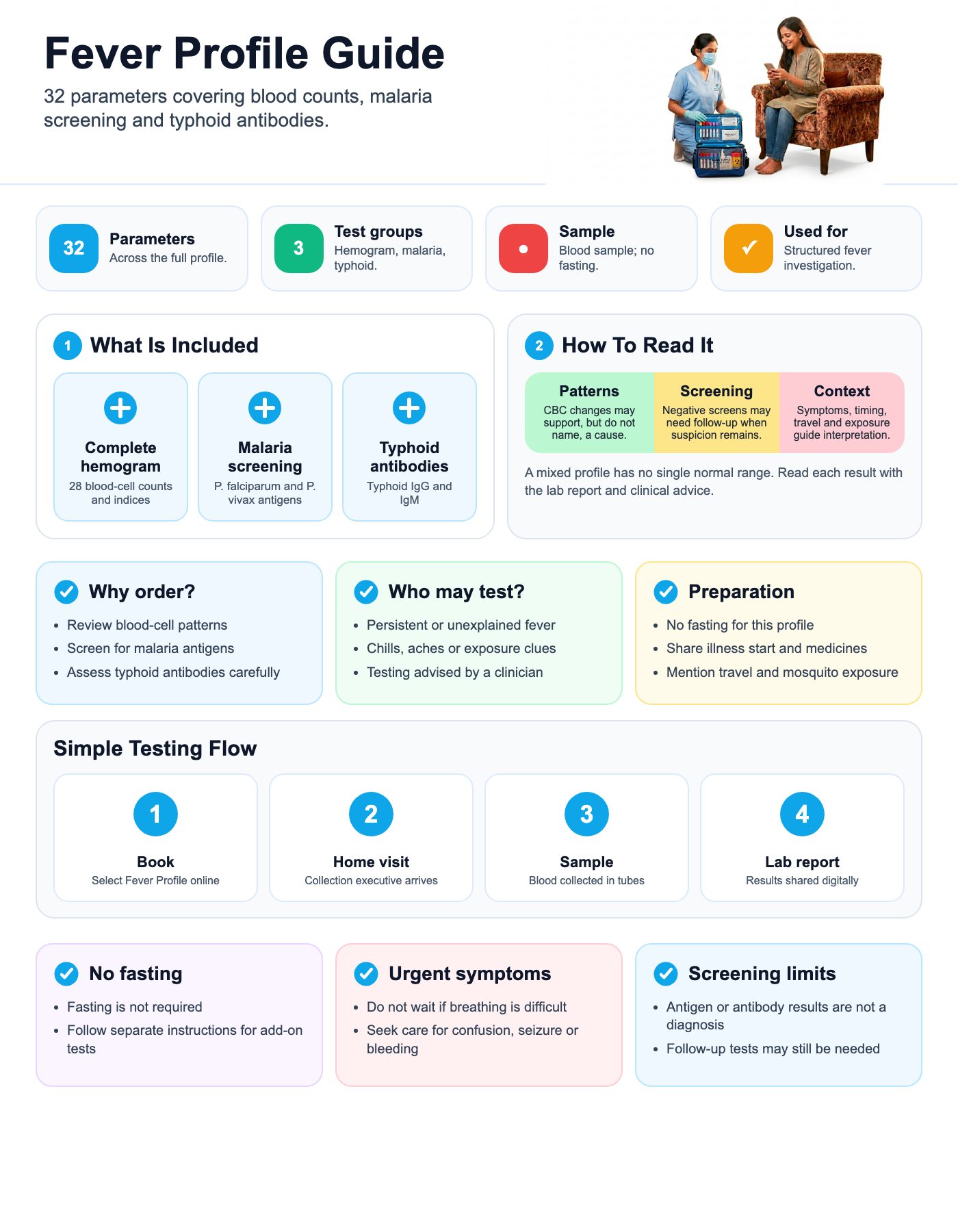
Fever Profile visual guide

Fever Profile Reference Guide in Salem

  • This profile combines a 28-parameter hemogram with four infection-screening results.
  • Two antigen results look for P. falciparum and P. vivax malaria markers.
  • Two antibody results report typhoid IgM and IgG responses.
  • Results need illness timing, symptoms, travel, exposures, medicines and clinical examination.
  • The package cannot investigate every infectious or non-infectious cause of fever.
  • Medical guidance stays consistent; use this page for Salem pricing and collection details.

Why This Test Is Ordered

Understand the complete hemogram
  • The hemogram measures red cells, white cells, platelets, haemoglobin and related indices.
  • These measurements describe blood-cell patterns rather than naming the fever cause.
  • Infection, inflammation, medicines and underlying illness can change several cell lines.
  • Dehydration may concentrate some values, while fluid shifts can alter comparisons.
  • A normal hemogram does not rule out malaria, typhoid or another infection.
  • An abnormal hemogram does not prove that fever is caused by infection.
  • Clinicians interpret the pattern with symptoms, examination and targeted infection tests.
Read white-cell patterns carefully
  • Total white-cell count shows the combined number of circulating white blood cells.
  • The differential separates neutrophils, lymphocytes, monocytes, eosinophils and basophils.
  • Absolute counts show cell numbers, while percentages show their relative distribution.
  • A percentage can look unusual because another white-cell type changed.
  • High white cells may accompany infection, inflammation, stress or medicine effects.
  • Low white cells can occur with some infections, medicines or marrow conditions.
  • Immature granulocytes may rise when marrow releases developing cells into circulation.
  • No single white-cell result can identify the responsible organism.
Review red cells and haemoglobin
  • Red-cell count, haemoglobin and haematocrit describe the oxygen-carrying part of blood.
  • Low haemoglobin may indicate anaemia but does not identify its cause.
  • MCV describes average red-cell size and helps organise anaemia patterns.
  • MCH and MCHC describe haemoglobin content within circulating red cells.
  • RDW reflects variation in red-cell size and needs interpretation beside MCV.
  • Dehydration, bleeding, nutrition and chronic disease can influence red-cell results.
  • Fever symptoms such as fatigue may overlap with anaemia-related symptoms.
  • A clinician may request iron, vitamin or other tests when indicated.
Review platelet results as one pattern
  • Platelets help blood clot after vessel injury.
  • The profile reports platelet count with size and distribution-related indices.
  • Some infections can lower platelets, but the finding is not disease-specific.
  • Inflammation, medicines, marrow conditions and laboratory factors may affect platelet results.
  • MPV, PDW, plateletcrit and large-cell ratio do not represent separate diagnoses.
  • A flagged platelet count may require confirmation or smear review.
  • Bleeding, widespread bruising or pinpoint red spots need timely clinical assessment.
  • Treatment decisions should not rely on one platelet index alone.
Understand the malaria antigen screen
  • The package lists antigen results for P. falciparum and P. vivax.
  • Malaria antigen tests look for parasite proteins in a blood sample.
  • A positive result needs prompt clinical assessment and appropriate malaria management.
  • Test performance depends on parasite level, species target and product characteristics.
  • A negative antigen result may not settle strong clinical suspicion.
  • WHO recommends parasite-based testing by rapid test or microscopy for suspected malaria.
  • Microscopy can identify species and estimate parasite density when available.
  • Fever after travel to a malaria area deserves urgent medical attention.
Interpret typhoid antibodies with caution
  • The profile reports separate typhoid IgM and IgG antibody results.
  • Antibodies reflect an immune response rather than direct detection of bacteria.
  • IgM or IgG patterns cannot independently confirm current enteric fever.
  • Past exposure, illness timing and test performance can affect antibody interpretation.
  • CDC guidance identifies blood culture as the mainstay of typhoid diagnosis.
  • Serologic tests can produce false-positive or otherwise unreliable results.
  • Antibiotics taken before testing may influence culture planning and clinical interpretation.
  • Persistent compatible illness needs clinical review even when antibody results are negative.

Symptoms And Who Should Test

People with persistent or unexplained fever
  • A clinician may consider this profile when fever persists, returns or lacks a clear source.
  • The package adds blood-cell context plus selected malaria and typhoid screening.
  • It does not test for dengue, respiratory viruses, urinary infection or every fever cause.
  • Fever may also arise from inflammatory, medicine-related or other non-infectious conditions.
  • Symptoms and examination determine whether this package matches the clinical question.
  • Very early testing can miss changes that develop later in illness.
  • Previous reports help distinguish a new blood-count change from a personal baseline.
  • Ongoing fever needs follow-up even when initial screening is reassuring.
People with malaria exposure clues
  • Travel or residence in a malaria area raises the importance of prompt assessment.
  • Mosquito exposure, chills, headache and body aches can support clinical suspicion.
  • Malaria symptoms overlap with many other infections and cannot confirm the diagnosis.
  • P. falciparum malaria can progress rapidly and requires urgent treatment when confirmed.
  • Pregnancy, young age and reduced immunity can increase concern about severe illness.
  • Tell the clinician where and when travel occurred and whether prevention tablets were used.
  • A previous malaria episode does not guarantee protection from another infection.
  • Do not self-treat solely from travel history or fever pattern.
People with enteric-fever exposure clues
  • Prolonged fever with headache, bowel symptoms or malaise may prompt enteric-fever assessment.
  • Unsafe food or water exposure can increase concern after compatible illness.
  • Recent travel and local outbreak information help guide testing choices.
  • Typhoid and paratyphoid symptoms overlap with many other febrile illnesses.
  • The included antibodies do not replace blood culture when acute typhoid is suspected.
  • Previous vaccination or exposure may complicate interpretation of antibody results.
  • Share any antibiotics taken before sample collection with the clinician.
  • Severe abdominal pain or gastrointestinal bleeding needs urgent assessment.
People needing blood-count monitoring during illness
  • A clinician may repeat counts when fever is accompanied by falling platelets or haemoglobin.
  • Repeat testing can show whether a cell-line change is improving or worsening.
  • The comparison works best when timing and treatment changes are recorded.
  • Small differences may reflect biological or laboratory variation rather than deterioration.
  • Trends should use actual counts, units and reference intervals from each report.
  • A repeat hemogram does not replace reassessment when symptoms are worsening.
  • Additional smear, culture, chemistry or imaging tests may be needed.
  • The monitoring interval should follow a clinician-defined reason rather than a fixed schedule.
People with urgent warning signs
  • Difficulty breathing, confusion, seizure or fainting requires urgent medical care.
  • A stiff neck, severe headache or new weakness should not await home collection.
  • Persistent vomiting can cause dehydration and may prevent safe oral intake.
  • Severe abdominal pain or gastrointestinal bleeding needs prompt assessment.
  • Reduced urine output, extreme drowsiness or rapidly worsening illness are warning signs.
  • Widespread bruising, bleeding or pinpoint red spots require timely evaluation.
  • A very unwell child, older adult or pregnant person needs lower-threshold assessment.
  • Laboratory booking should never delay emergency evaluation or treatment.

Preparation And Interpretation Notes

Follow the correct collection instructions
  • Fasting is not required for the listed Fever Profile results.
  • Follow stricter preparation if another booked test requires fasting.
  • The catalog lists serum and EDTA blood collection for different profile groups.
  • A trained professional collects venous blood into the required tubes.
  • Minor discomfort or bruising can follow a routine blood draw.
  • Tell the collector about fainting, difficult draws or blood-thinning medicines.
  • Normal hydration may make collection easier unless medical advice restricts fluids.
  • Do not delay urgent care merely to arrange a fasting or home sample.
Record timing, temperature and symptoms
  • Write down when fever began and whether it has been continuous or intermittent.
  • Record measured temperatures rather than relying only on feeling feverish.
  • Note chills, rash, headache, cough, bowel symptoms, pain and urinary changes.
  • Mention recent travel, mosquito exposure, unsafe food or unsafe water.
  • Share known contact with illness and any local outbreak information.
  • Illness timing can affect antigen, antibody, culture and blood-count findings.
  • A clear timeline helps clinicians choose any necessary follow-up tests.
  • Bring earlier reports when counts or infection tests have already been performed.
Report medicines before interpretation
  • List antibiotics, antimalarials, fever medicines and other recent treatments.
  • Record when each medicine started relative to fever and sample collection.
  • Antibiotics can affect culture planning and may change the clinical picture.
  • Some medicines can influence white cells, platelets or other blood counts.
  • Do not stop prescribed treatment merely to obtain this profile.
  • Avoid starting antibiotics or antimalarials without appropriate medical advice.
  • Share allergies, pregnancy and important medical conditions with the treating clinician.
  • Report supplements or traditional remedies that were taken during the illness.
Interpret malaria results safely
  • Read P. falciparum and P. vivax results as targeted antigen screens.
  • A positive screen requires prompt clinical review rather than self-treatment.
  • A negative screen does not investigate every malaria species or every fever cause.
  • Low parasite levels and test limitations can affect rapid-test sensitivity.
  • Strong suspicion may require repeat testing or microscopy according to clinical advice.
  • Microscopy can provide species and parasite-density information not shown by this profile.
  • Treatment choice depends on species, severity, pregnancy, location and resistance patterns.
  • Worsening symptoms need reassessment regardless of the initial antigen result.
Interpret typhoid results safely
  • Read IgM and IgG as antibody findings rather than direct bacterial detection.
  • Neither antibody result confirms acute typhoid without compatible clinical evidence.
  • A positive antibody may reflect past exposure or a non-specific reaction.
  • An early negative antibody result may not settle ongoing clinical suspicion.
  • Blood culture remains the preferred diagnostic method in CDC guidance.
  • Multiple cultures may sometimes be needed when enteric fever remains suspected.
  • Antimicrobial susceptibility testing helps clinicians choose treatment for cultured bacteria.
  • Do not start or change antibiotics solely from these two antibody results.
Review the whole profile, not isolated flags
  • Use the units and reference intervals printed on the current laboratory report.
  • Interpret absolute white-cell counts beside percentages to avoid misleading conclusions.
  • Read red-cell indices together when considering an anaemia pattern.
  • Review platelet count before focusing on size or distribution indices.
  • Connect malaria and typhoid results with illness timing and exposure history.
  • One abnormal value may need confirmation rather than an immediate diagnosis.
  • One normal value cannot exclude every cause of persistent fever.
  • A clinician should decide whether cultures, smears, imaging or other tests are required.

Frequently Asked Questions

What does the Fever Profile include?

It includes a 28-parameter hemogram, two malaria antigens and two typhoid antibodies.

Is fasting required for the Fever Profile?

No; fasting is not required unless another booked test has stricter instructions.

Can this profile identify every fever cause?

No; many infectious and non-infectious fever causes require different tests.

Can a normal hemogram rule out infection?

No; blood counts provide patterns but cannot exclude infection by themselves.

Which malaria species are listed?

The package lists P. falciparum and P. vivax antigen results.

Can a negative malaria antigen exclude malaria?

Not always; persistent clinical suspicion may require microscopy or repeat testing.

Can typhoid IgM or IgG confirm acute typhoid?

No; antibody results need clinical correlation, and blood culture is preferred.

Should I share antibiotics taken before testing?

Yes; record the medicine, dose and timing for the clinician.

Can I book Fever Profile home collection in Salem?

Fever Profile home collection in Salem is available where the address is serviceable.

Who can review my Fever Profile report in Salem?

A qualified clinician in Salem can review the report with your illness history.

When should I seek urgent care for fever?

Seek urgent care for breathing difficulty, confusion, seizure, severe bleeding or rapid worsening.

Ratings & Reviews
4.8 ★★★★★

Based on verified bookings

Good service

Sample collection was smooth and reports were delivered on time.

Health Insights & Resources
View All Blogs →
Blog Title

August 20, 2025

The Role of AI in Medical Healthcare
Read More
Blog Title

August 19, 2025

Insulin Fasting Test: Why It’s Important
Read More
Blog Title

August 18, 2025

Why Every Indian Child Should Take a Full Body Test?
Read More
Blog Title

August 17, 2025

Food Poisoning in Hindi - फूड पॉइज़निंग क्या है? कारण, लक्षण, बचाव के
Read More
Test Conducted By
Fever Profile Test Price in Salem : Rs. 1248
Rs. 780 38% Off
Home Sample Collection Available No Extra Charges
You will Save Rs. 468 on this Test
CAP Accredited NABL Accredited UKAS Management Systems ANAB Accredited
Lab Logo
Fever Profile Test Price in Salem : Rs. 1248
Rs. 780