Choose your City


Cardiac Risk Markers Test is used to analyze if a person has the chance of getting cardiovascular disorder such as heart attack or heart stroke.

Cardiac Risk Markers Test - Advanced in West Godavari

Cardiac Risk Markers Test is used to analyze if a person has the chance of getting cardiovascular disorder such as heart attack or heart stroke.

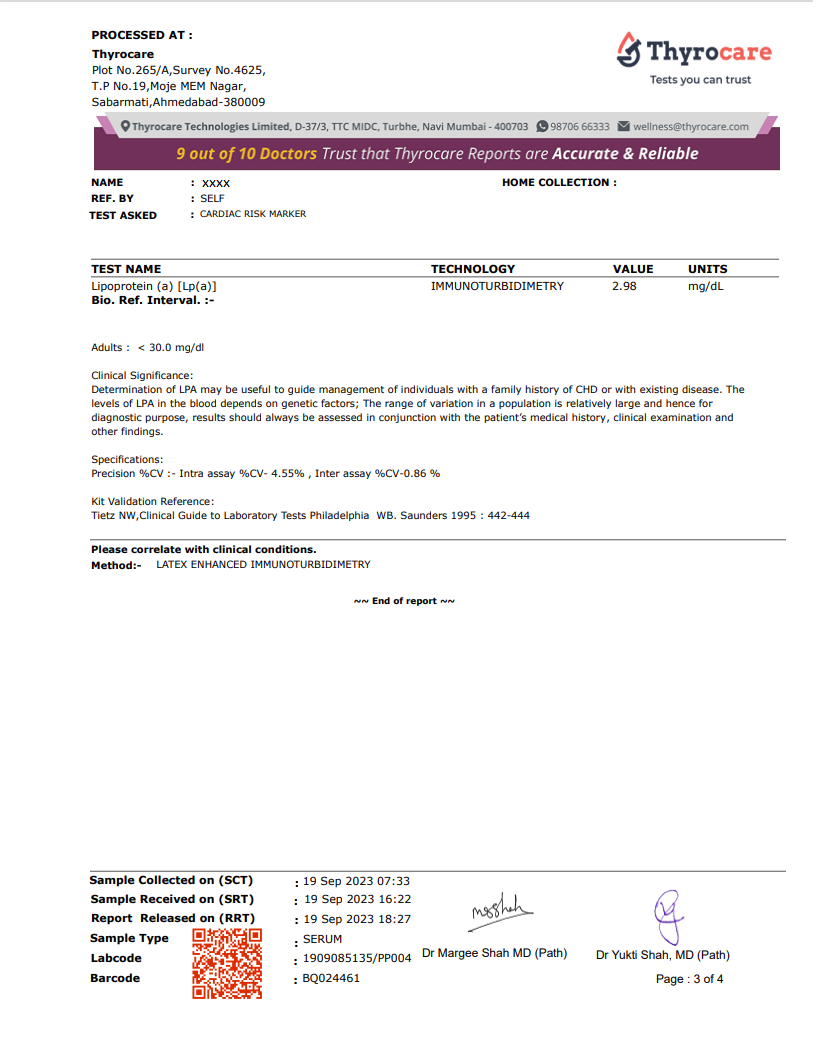
Cardiac Risk Marker Test Sample Report

Group Name Cardiac Panel
Fasting Overnight Fasting required
Sample Type SERUM
Sample Collection Expert collect samples at Home
Reports Delivered Online within 24-48 Hrs*
Report type Email & Hardcopy ( On request )

Parameters Included in Jaanch - Cardiac Risk Markers Advanced (heart) Test

What tests are included in the Jaanch - Cardiac Risk Markers Advanced (heart) Test?


Cardiac Risk Markers (6 Tests)

  • Apo b / apo a1 ratio (apo b/a1)
  • Apolipoprotein - a1 (apo-a1)
  • Apolipoprotein - b (apo-b)
  • High sensitivity c-reactive protein (hs-crp)
  • Homocysteine
  • Lipoprotein (a) [lp(a)]
Cardiac Risk Marker Test Sample Report
  • Previous        
  • Next
Jaanch - Cardiac Risk Markers Advanced (heart) Sample report & Ranges
Conducted at Thyrocare Labs
Lab Accreditation CAP, NABL, ICMR, NGSP, ISO
Method LATEX ENHANCED IMMUNOTURBIDIMETRY
Technology IMMUNOTURBIDIMETRY
Supervision Dr Margee Shah MD (Path)
Results Highly Specific

Our labs work 365 days / 24 x 7 to ensure your  Jaanch - Cardiac Risk Markers Advanced (heart) samples reach us the same night, before midnight. We are equipped with  (MUT) -  India's first preanalytical barcoded vial sorter, Sample Sorter  &  Aptio (Siemens).

Our IT-enabled barcoded bi-directional operating systems & world-class air logistics process your blood samples within the specified time with the utmost accuracy. Once your specimen for Jaanch - Cardiac Risk Markers Advanced (heart) is collected by our phlebotomist, Your reports will be sent to your email id within 24 to 48 hours. For hard copy requests, the reports would be delivered in 3 to 5 days.  You will be informed via SMS & email once we process your report.
 

Jaanch - Cardiac Risk Markers Advanced (heart) Sample Report & Ranges

Conducted at Thyrocare Labs
Lab Accreditation CAP, NABL, ICMR, NGSP, ISO
Method LATEX ENHANCED IMMUNOTURBIDIMETRY
Technology IMMUNOTURBIDIMETRY
Supervision Dr Margee Shah MD (Path)
Results Highly Specific

Our labs work 365 days / 24 x 7 to ensure your  Jaanch - Cardiac Risk Markers Advanced (heart) samples reach us the same night, before midnight. We are equipped with  (MUT) -  India's first preanalytical barcoded vial sorter, Sample Sorter  &  Aptio (Siemens).

Our IT-enabled barcoded bi-directional operating systems & world-class air logistics process your blood samples within the specified time with the utmost accuracy. Once your specimen for Jaanch - Cardiac Risk Markers Advanced (heart) is collected by our phlebotomist, Your reports will be sent to your email id within 24 to 48 hours. For hard copy requests, the reports would be delivered in 3 to 5 days.  You will be informed via SMS & email once we process your report.


Jaanch - Cardiac Risk Markers Advanced (heart) Sample Report

Jaanch - Cardiac Risk Markers Advanced (heart) Overview

Cardiac risk marker test

What to expect during a Jaanch - Cardiac Risk Markers Advanced (heart) Blood Test?

During a Jaanch - Cardiac Risk Markers Advanced (heart) blood test, a healthcare professional takes a blood sample from your arm, which is also known as venipuncture. A lab expert known as a phlebotomist conducts this process using a needle. He locates a vein on your arm and inserts the needle to draw blood. The blood sample will be transferred into a test tube and will be taken safely to the labs for the test.

The lab technicians will test the sample by following established standards, to ensure correct reports. Thyrocare Labs has a team of professionals who are skilled and experienced. After the testing is done, your reports are sent to your email within 1-2 days. On the other hand, if you need a hard copy of the report, expect the delivery of the same within 3-5 business days.

Preparations before a Jaanch - Cardiac Risk Markers Advanced (heart) Blood Test?

For Jaanch - Cardiac Risk Markers Advanced (heart) blood tests, special preparations are not needed. However, some important steps must be taken to ensure accuracy in the test reports.

  • Jaanch - Cardiac Risk Markers Advanced (heart) test requires Overnight Fasting, the same must be done for at least 8-10 hours. Only water can be consumed during this time. Being hydrated helps the blood draw easier and also ensures accurate results.
  • Eating junk food and consuming sweetened beverages or alcohol can alter your test results. So, it is advisable to be careful about what to consume or take the advice of a professional.
  • Consumption of certain medications is also prohibited before blood tests. You can discuss the details about the same with your doctor to be sure.
  • Avoid strenuous exercise as it can alter the readings of a blood test.

Are there any side effects of the test?

There are no side effects or risks attached to Jaanch - Cardiac Risk Markers Advanced (heart) blood tests. The test involves the collection of a blood sample from your home. A phlebotomist draws blood from your arm using a needle, which only takes a few minutes. During this process, you might feel a sting on your arm, which is not painful. The blood sample will then be sent to the labs. Our medical experts take all precautions and safety measures during sample collection and testing.
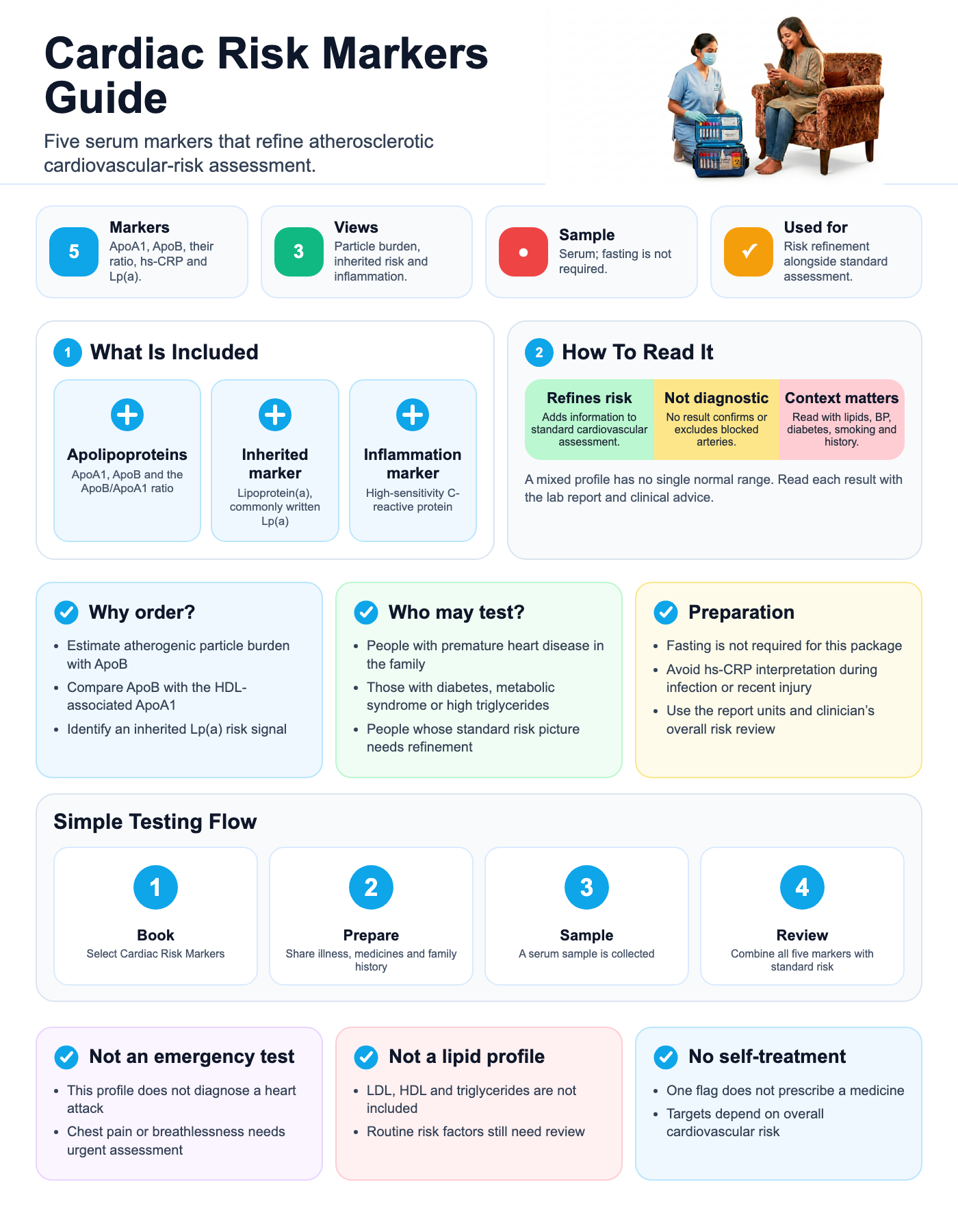
Cardiac Risk Markers visual guide

Cardiac Risk Markers Reference Guide in West Godavari

  • Cardiac Risk Markers combines five serum measurements for cardiovascular risk refinement.
  • ApoB estimates atherogenic particle burden, while ApoA1 adds HDL-associated context.
  • Lp(a) contributes a largely inherited risk signal.
  • Hs-CRP adds non-specific inflammation context during clinically stable periods.
  • The profile supplements standard lipids, blood pressure, diabetes and smoking assessment.
  • Medical guidance stays consistent; use this page for West Godavari pricing and collection details.

Why This Test Is Ordered

Estimate atherogenic particle burden with ApoB
  • ApoB is present on LDL and other particles that can enter artery walls.
  • Each major atherogenic particle carries one ApoB molecule.
  • ApoB therefore estimates particle number rather than cholesterol mass.
  • Particle number and LDL cholesterol may not always align closely.
  • Discordance can matter with diabetes, metabolic syndrome or high triglycerides.
  • Higher ApoB can strengthen concern about plaque-forming particle burden.
  • ApoB cannot show whether an artery is narrowed or blocked.
  • Standard LDL, non-HDL cholesterol and triglycerides remain important.
  • Treatment decisions also depend on age, history and overall risk.
Compare ApoB with the HDL-associated ApoA1
  • ApoA1 is the main protein component of high-density lipoprotein particles.
  • It contributes to cholesterol transport within the broader lipid system.
  • The ratio compares ApoB with the HDL-associated ApoA1 measurement.
  • Either component can change the calculated ApoB-to-ApoA1 ratio.
  • A less favourable balance may add information about cardiovascular risk.
  • The ratio is not an independent substance or a diagnosis.
  • Use the laboratory method and current report units for interpretation.
  • Standard cholesterol results remain necessary for prevention decisions.
Identify a largely inherited Lp(a) risk signal
  • Lp(a) is a cholesterol-carrying particle containing ApoB and apolipoprotein(a).
  • The Lp(a) level is determined mainly by inherited genetic variation.
  • Levels often remain fairly stable through adult life.
  • Higher Lp(a) can add risk for heart disease and stroke.
  • Risk may remain relevant even when LDL cholesterol is well controlled.
  • Current guidance supports at least one adult Lp(a) measurement.
  • Family history of premature disease makes inherited risk especially relevant.
  • Reports may use mg/dL or nmol/L, which are not interchangeable.
  • Read the result in its stated unit without fixed-factor conversion.
Add inflammation context with hs-CRP
  • Hs-CRP measures small concentrations of C-reactive protein in blood.
  • The liver produces CRP in response to inflammation within the body.
  • Hs-CRP can act as a risk-enhancing marker during cardiovascular prevention.
  • The marker is not specific to inflammation inside artery walls.
  • Colds, fever, dental infection, injury or surgery can raise it.
  • Inflammatory conditions may also produce a temporarily higher result.
  • An unexpected elevation may need reassessment after recovery.
  • Hs-CRP cannot locate inflammation or diagnose coronary disease.
Use the panel to refine, not replace, standard risk assessment
  • Cardiovascular risk includes age, blood pressure, diabetes and smoking history.
  • Standard cholesterol, kidney health and family history also remain important.
  • This package adds selected risk markers without calculating risk percentage.
  • Total cholesterol, LDL, HDL and triglycerides are not included.
  • Glucose and HbA1c results are also outside this package.
  • The profile cannot show plaque, coronary calcium or blood flow.
  • A clinician may add lipids, diabetes testing or blood-pressure review.
  • Five normal markers cannot cancel hypertension, smoking or diabetes risk.
  • One abnormal marker cannot predict that a heart attack will occur.

Symptoms And Who Should Test

People with premature cardiovascular disease in the family
  • An early heart attack or stroke in a close relative can prompt review.
  • Record the relative’s age, diagnosis and known cholesterol disorder.
  • Lp(a) is relevant because its concentration is largely inherited.
  • ApoB may reveal particle burden not fully described by LDL cholesterol.
  • This profile does not test genes for familial hypercholesterolaemia.
  • It also does not replace a standard LDL cholesterol measurement.
  • Higher Lp(a) may justify discussing testing with close relatives.
  • Modifiable risk factors still need attention when inherited risk is present.
People with diabetes, high triglycerides or metabolic syndrome
  • Insulin resistance can alter the cholesterol carried inside atherogenic particles.
  • ApoB may add information when LDL cholesterol appears acceptable.
  • Type 2 diabetes and high triglycerides can create particle discordance.
  • Blood pressure and glucose control remain central to prevention.
  • HbA1c, kidney function and standard lipids are not included here.
  • Hs-CRP may rise with obesity or another inflammatory condition.
  • Hs-CRP is not a direct measurement of arterial plaque.
  • Testing should refine a defined prevention or treatment decision.
People with established heart or arterial disease
  • Previous heart attack or ischaemic stroke already indicates high clinical risk.
  • Peripheral arterial disease or coronary procedures also establish important history.
  • ApoB may help assess residual particle burden during lipid-lowering treatment.
  • Lp(a) can add information about inherited residual risk.
  • These markers do not replace treatment targets chosen by the cardiologist.
  • Do not independently change statins or other medicines from this report.
  • A lower hs-CRP does not mean established plaque has disappeared.
  • Share medicine adherence and recent lipid reports with the reviewer.
  • New chest pressure or stroke symptoms require emergency care.
People whose standard risk estimate remains uncertain
  • Standard assessment starts with age, blood pressure, cholesterol and diabetes.
  • Smoking and family history add further information to the risk estimate.
  • ApoB, Lp(a) and hs-CRP can refine selected prevention decisions.
  • The panel is not automatically necessary at every routine check.
  • No single result dictates one treatment without clinical discussion.
  • Expected benefit, possible harms and patient preferences still matter.
  • Coronary calcium imaging may answer a different question in some adults.
  • Testing should focus on the uncertainty that remains after standard assessment.
People planning a broader preventive review
  • High cholesterol and high blood pressure often cause no symptoms.
  • A person who feels well may still have cardiovascular risk.
  • This profile can support a clinician-led preventive review.
  • It should accompany measured blood pressure and a standard lipid profile.
  • Smoking, activity, diet, weight and diabetes require separate review.
  • Kidney health and chronic inflammation may also alter risk.
  • Age, reproductive history and family history add personal context.
  • The goal is reducing overall heart attack and stroke risk.

Preparation And Interpretation Notes

Fasting and serum collection
  • Fasting is not required for these five serum markers.
  • Follow stricter preparation when another booked test requires fasting.
  • A trained professional collects blood from a vein and prepares serum.
  • Maintain ordinary hydration unless a clinician advises otherwise.
  • Do not prolong fasting or change food intake to influence results.
  • Minor pain or bruising can follow routine blood collection.
  • Tell the collector about fainting or difficult previous collections.
  • Mention blood-thinning medicine before the sample is collected.
  • These instructions do not apply automatically to every cardiac blood test.
Choose a clinically stable time for hs-CRP
  • Hs-CRP responds to inflammation arising from many different causes.
  • Report fever, respiratory infection or a current dental infection.
  • Also mention vaccination, injury, surgery or an autoimmune flare.
  • A temporary elevation may not reflect the usual cardiovascular-risk signal.
  • The clinician may defer testing or repeat it after recovery.
  • Do not delay treatment of infection to obtain a lower result.
  • A low hs-CRP result should not dismiss active symptoms.
  • Hs-CRP cannot diagnose infection or an acute heart problem.
Report medicines, supplements and health changes
  • List lipid-lowering medicines, anti-inflammatory drugs and hormone therapy.
  • Include all other prescriptions, supplements and recent dose changes.
  • Do not stop statins or aspirin without prescriber advice.
  • Treatment can influence ApoB and inflammation-related measurements.
  • Pregnancy, kidney disease and chronic inflammation affect interpretation context.
  • Substantial weight change or recent hospitalisation should also be reported.
  • Bring earlier lipid and biomarker reports when available.
  • State whether testing is baseline, follow-up or inherited-risk assessment.
Keep Lp(a) units and repeat testing in perspective
  • Lp(a) may be reported in mg/dL or nmol/L.
  • The units describe different properties and are not interchangeable.
  • Do not convert Lp(a) using one fixed universal multiplier.
  • Use the current laboratory’s unit and decision threshold.
  • Lp(a) is largely genetic and often needs measurement only once.
  • A clinician may repeat it after a relevant clinical or treatment change.
  • ApoB and hs-CRP may be repeated for different reasons.
  • Keep dated reports to identify method, unit and inflammation differences.
Interpret results through an overall prevention plan
  • Use the reference information and units on the current report.
  • Reference ranges and clinical decision thresholds are not always identical.
  • Review ApoB, ApoA1 and their calculated ratio together.
  • Then combine Lp(a) and hs-CRP with standard risk factors.
  • Ask whether results change lifestyle or lipid-lowering priorities.
  • Do not start aspirin, statins or supplements from this report alone.
  • Troponin, ECG and cardiac imaging are not included.
  • This prevention profile cannot diagnose an acute heart attack.
  • Chest pressure, breathlessness or stroke symptoms need emergency assessment.

Frequently Asked Questions

What does Cardiac Risk Markers include?

It includes ApoA1, ApoB, their ratio, hs-CRP and lipoprotein(a).

Is fasting required for this package?

No; fasting is not required unless another test in the booking needs it.

Is this package the same as a lipid profile?

No; LDL, HDL, total cholesterol and triglycerides are not included.

What does ApoB add to heart-risk assessment?

ApoB estimates the number of atherogenic lipoprotein particles in blood.

Is lipoprotein(a) inherited?

Yes; Lp(a) is largely genetically determined and often remains fairly stable.

Can infection affect hs-CRP?

Yes; infection, injury or inflammation can temporarily raise hs-CRP.

Can this panel diagnose blocked arteries?

No; it refines risk and cannot show plaque or arterial narrowing.

Should I stop statins before testing?

No; do not stop prescribed medicine unless your clinician instructs you.

Can I book Cardiac Risk Markers at home in West Godavari?

Home collection for Cardiac Risk Markers in West Godavari is available where the address is serviceable.

When should I repeat Cardiac Risk Markers in West Godavari?

Repeat timing in West Godavari should follow the clinician’s marker- and treatment-based plan.

Who can review my cardiac-risk report in West Godavari?

A qualified clinician in West Godavari can combine it with standard risk factors.

Ratings & Reviews
4.8 ★★★★★

Based on verified bookings

Good service

Sample collection was smooth and reports were delivered on time.

Health Insights & Resources
View All Blogs →
Blog Title

August 20, 2025

The Role of AI in Medical Healthcare
Read More
Blog Title

August 19, 2025

Insulin Fasting Test: Why It’s Important
Read More
Blog Title

August 18, 2025

Why Every Indian Child Should Take a Full Body Test?
Read More
Blog Title

August 17, 2025

Food Poisoning in Hindi - फूड पॉइज़निंग क्या है? कारण, लक्षण, बचाव के
Read More
Test Conducted By
Cardiac Risk Markers Test Cost in West Godavari : Rs. 2398
Rs. 1499 37% Off
This profile is currently not available for booking from Thyrocare. You can review the information here and choose a similar active test or package below.