Choose your City

Blood Grouping And Rh Typing

Blood Grouping And Rh Typing is available for online booking with home sample collection.

Blood Grouping And Rh Typing

Blood Grouping And Rh Typing : Info - Procedure

Test Price
Rs. 230 (Tax included)

List of test included in Blood Grouping And Rh Typing


  • Blood grouping
  • Rh typing
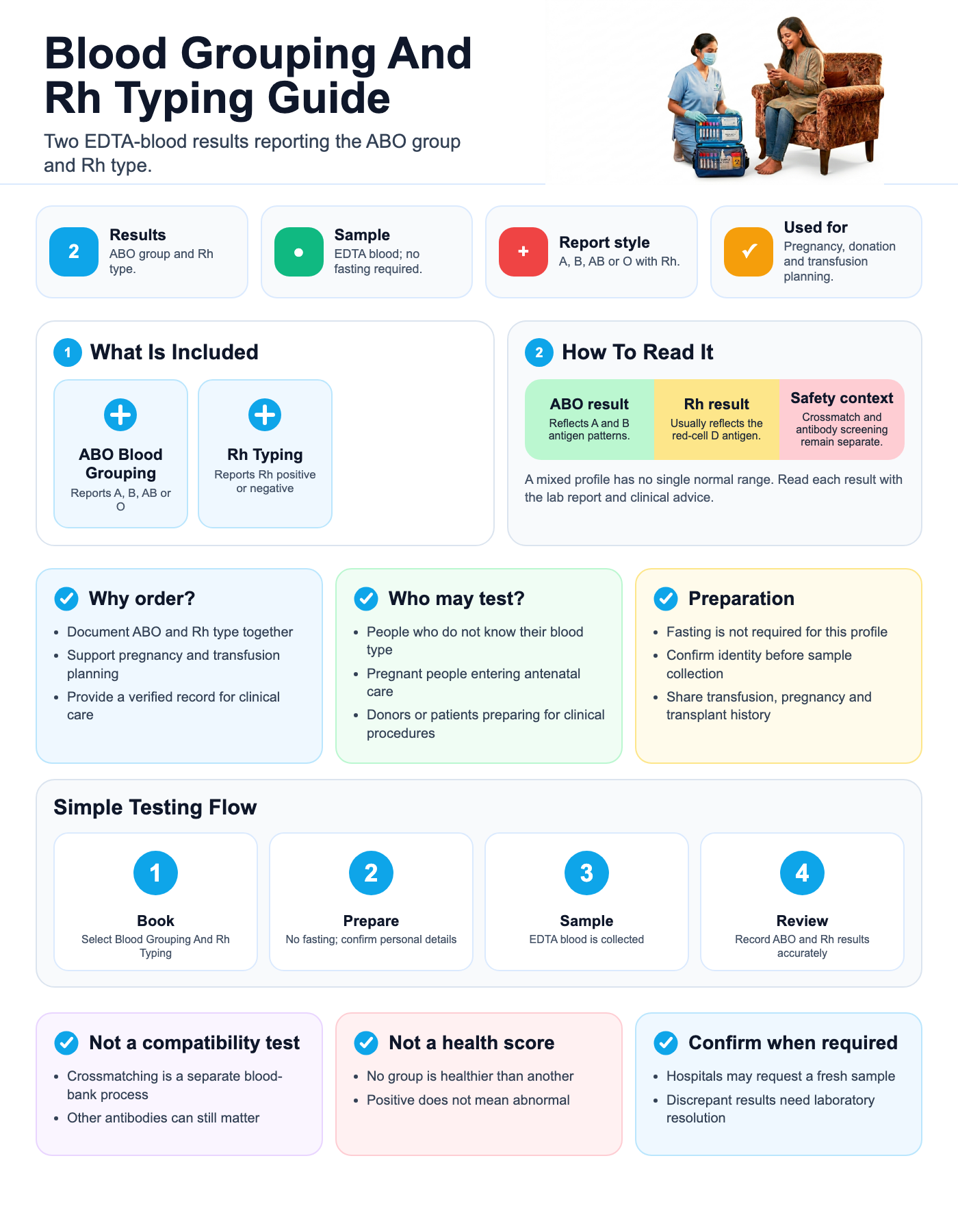
Blood Grouping And Rh Typing visual guide

Blood Grouping And Rh Typing Reference Guide

  • Blood Grouping And Rh Typing reports an ABO group and an Rh type from one EDTA-blood sample.
  • The ABO result is A, B, AB or O, while the Rh result is commonly positive or negative.
  • These inherited red-cell features matter in pregnancy, blood donation and transfusion planning.
  • A blood group is not a health score, and Rh positive does not mean an abnormal result.
  • This profile does not include an antibody screen, crossmatch, infection screen, CBC or genetic typing.

Why This Test Is Ordered

Understand the two-result profile
  • The profile combines ABO blood grouping with Rh typing in one report.
  • ABO grouping classifies blood as A, B, AB or O.
  • Rh typing commonly reports whether the red-cell D antigen is detected.
  • The familiar positive or negative label refers to this Rh result.
  • ABO and Rh are inherited features carried on red blood cells.
  • Neither result measures haemoglobin, infection, clotting or general wellness.
  • The two results should be recorded together to avoid incomplete identification.
  • Clinical services may confirm the type again when patient safety requires it.
Read the ABO group correctly
  • Type A red cells carry A antigen within the ABO system.
  • Type B red cells carry B antigen within the ABO system.
  • Type AB red cells carry both A and B antigens.
  • Type O red cells carry neither A nor B antigen.
  • Laboratory grouping uses specific reactions to identify these antigen patterns.
  • Professional blood banks may also check expected plasma antibody reactions.
  • Forward and reverse grouping should agree before a transfusion group is accepted.
  • Infants and unusual clinical situations can require modified confirmation procedures.
Read the Rh result correctly
  • Routine Rh typing usually focuses on the clinically important D antigen.
  • A detected D antigen is generally reported as Rh positive.
  • An undetected D antigen is generally reported as Rh negative.
  • Positive and negative describe antigen status rather than health or disease.
  • The wider Rh blood-group system contains antigens beyond the D antigen.
  • This profile does not list extended Rh phenotyping or RHD genetic testing.
  • Weak or inconclusive reactions may require specialist laboratory investigation.
  • Use the final verified report instead of interpreting a raw reaction yourself.
Support safe transfusion planning
  • ABO and RhD typing are core parts of pre-transfusion laboratory testing.
  • An incorrect blood group can contribute to a serious transfusion reaction.
  • Blood banks verify patient identity, sample labels and previous group records.
  • They also perform an antibody screen for clinically important non-ABO antibodies.
  • A crossmatch assesses compatibility between selected donor cells and patient plasma.
  • ABO and Rh results alone do not authorise a particular blood component.
  • Compatibility rules differ among red cells, plasma and other blood components.
  • Emergency transfusion decisions belong to the treating team and transfusion service.
Support pregnancy and newborn care
  • ABO and Rh typing are commonly included early in antenatal blood testing.
  • Rh-negative pregnancy can require assessment of the fetus’s possible Rh status.
  • Exposure to Rh-positive fetal cells can lead to maternal anti-D antibodies.
  • Those antibodies may affect fetal red cells during a current or later pregnancy.
  • An antibody screen is separate and checks whether relevant antibodies are present.
  • Rh immunoglobulin can prevent sensitisation in eligible Rh-negative pregnancies.
  • The obstetric team decides whether and when preventive treatment is appropriate.
  • Typing alone cannot show whether sensitisation or fetal anaemia has occurred.

Symptoms And Who Should Test

People with an unknown blood type
  • Testing can provide a documented ABO and Rh result when no record exists.
  • A remembered family statement or identity card may contain an error.
  • Blood type cannot be predicted reliably from appearance, symptoms or diet.
  • Relatives can have different groups because inheritance combines parental genes.
  • A verified laboratory report is more useful than an unconfirmed personal note.
  • Keep the report accessible without treating it as permanent transfusion clearance.
  • Hospitals may repeat testing to meet identification and safety policies.
  • An unexpected result should be confirmed before changing important medical records.
People entering antenatal care
  • Early pregnancy testing commonly includes ABO group, Rh status and antibody screening.
  • Rh-negative results need obstetric interpretation rather than alarm or self-treatment.
  • The partner’s Rh status may not establish the fetus’s result with certainty.
  • Pregnancy bleeding, miscarriage, procedures or abdominal trauma can affect prevention planning.
  • Previous pregnancy or transfusion exposure may have produced red-cell antibodies.
  • This two-result profile does not detect anti-D or other maternal antibodies.
  • Share earlier antibody reports and Rh immunoglobulin dates with the obstetric team.
  • Urgent pregnancy bleeding requires clinical care, not only a blood-group booking.
People preparing for transfusion or surgery
  • A planned procedure may prompt current ABO and Rh documentation before admission.
  • The hospital may require its own labelled sample despite an outside report.
  • Pre-transfusion work also includes an antibody screen and compatibility procedures.
  • Previous transfusions can create antibodies not identified by ABO and Rh typing.
  • Pregnancy history can also matter because fetal-cell exposure may cause antibodies.
  • Share earlier transfusion reactions and known antibody records before treatment.
  • Do not delay urgent hospital care while arranging an independent typing test.
  • The transfusion service selects components according to the full clinical situation.
People considering blood donation
  • Donation services determine ABO and Rh type as part of donor processing.
  • A previous personal result does not replace testing performed on donated blood.
  • Donated blood also requires mandatory screening for transfusion-transmitted infections.
  • This profile does not assess eligibility, haemoglobin or infection-screening criteria.
  • Donation eligibility depends on health, history and service-specific safety checks.
  • Component compatibility is more detailed than a simple donor-recipient slogan.
  • Plasma compatibility follows different principles from red-cell compatibility.
  • Ask the donation service about eligibility rather than relying on blood type alone.
People with conflicting earlier records
  • Two different recorded blood groups require formal laboratory resolution before clinical use.
  • Incorrect identification or labelling can create an apparent discrepancy.
  • Recent transfusion can produce mixed red-cell populations in the tested sample.
  • Stem-cell transplantation can also complicate comparison with an older blood group.
  • Some ABO subgroups produce weak or unusual serological reactions.
  • Weak RhD reactions may require additional serology or genetic testing.
  • Do not choose the result that appears most familiar or convenient.
  • A transfusion medicine laboratory should resolve important or persistent discrepancies.

Preparation And Interpretation Notes

Follow the collection instructions
  • Fasting is not required for this ABO and Rh typing profile.
  • Eat and drink normally unless another booked test requires different preparation.
  • A trained professional collects venous blood into the specified EDTA tube.
  • Tell the collector about fainting, difficult draws or blood-thinning medicines.
  • Minor discomfort or bruising can follow routine venous blood collection.
  • Do not book this outpatient test instead of seeking emergency treatment.
  • Follow the hospital’s instructions when typing is needed for surgery or transfusion.
  • Preparation requirements may differ when other tests are collected simultaneously.
Protect patient and sample identity
  • Use the same full name and identifiers shown on your clinical records.
  • Confirm spelling, date of birth and other requested details before collection.
  • Tell staff immediately if the label or displayed details appear incorrect.
  • Transfusion safety depends on matching the request, patient and sample accurately.
  • Do not submit another person’s sample to learn or confirm their group.
  • Keep the final report linked to the correct person and collection date.
  • A photograph of an old report may not meet hospital verification requirements.
  • Identity checks are safety steps, not unnecessary administrative repetition.
Share relevant clinical history
  • Report recent transfusions because donor cells can affect current serological reactions.
  • Mention bone-marrow or stem-cell transplantation and its approximate date.
  • Share pregnancy history, miscarriages and known red-cell antibodies when relevant.
  • Provide previous ABO and Rh reports if results have ever differed.
  • Mention any earlier weak-D, subgroup or blood-bank investigation.
  • Do not assume Rh immunoglobulin changes your inherited ABO group.
  • A detailed history helps the laboratory investigate unexpected reaction patterns.
  • Urgent transfusion teams need this information even when an old type is known.
Understand what the profile excludes
  • This profile does not include a red-cell antibody screen.
  • It does not identify anti-D or other unexpected blood-group antibodies.
  • It does not crossmatch your sample against a selected donor unit.
  • It does not screen donated blood for HIV, hepatitis, syphilis or malaria.
  • It does not include haemoglobin, a CBC or blood-donation eligibility checks.
  • It does not provide extended antigen phenotyping or molecular blood-group genotyping.
  • Pregnancy and transfusion decisions may therefore require additional laboratory work.
  • Read the package composition before assuming every blood-bank test is included.
Use and confirm the final report
  • Record the ABO letter and Rh sign exactly as displayed on the report.
  • A positive Rh result is not a positive disease or infection test.
  • A negative Rh result is not evidence of illness or low immunity.
  • There is no healthy, superior or preferred ABO blood group.
  • Laboratory technique and reaction strength can affect handling of unusual results.
  • A discrepant or inconclusive result may need a newly collected sample.
  • Hospitals can require independent confirmation before issuing blood components.
  • Ask a clinician or transfusion specialist about implications for pregnancy or transfusion.

Frequently Asked Questions

What does this profile include?

It includes ABO blood grouping and Rh typing.

Is fasting required for blood grouping?

No; fasting is not required for this profile.

What are the ABO blood groups?

The four main ABO groups are A, B, AB and O.

What does Rh positive mean?

It generally means the red-cell D antigen was detected.

Is Rh negative a disease?

No; Rh negative is an inherited blood-type result.

Does this profile include antibody screening?

No; a red-cell antibody screen is a separate test.

Is this result enough before transfusion?

No; blood banks also perform identity, antibody and compatibility checks.

Why is Rh typing important in pregnancy?

Rh status helps guide antibody screening and preventive care.

Can a hospital repeat my blood group?

Yes; hospitals may require a fresh independently labelled sample.

Can I book home collection?

Home collection is available where the entered address is serviceable.

Who should review an Rh-negative result?

An obstetric or treating clinician should review its clinical relevance.

What if my old report differs?

A transfusion laboratory should resolve conflicting blood-group records.

Test Conducted By

Rs. 368
Rs. 230 38% Off
Home Sample Collection Available No Extra Charges
You will Save Rs. 138 on this Test
CAP Accredited NABL Accredited UKAS Management Systems ANAB Accredited

Why Choose Thyrocare for Blood Grouping And Rh Typing

Get tested for Blood Grouping And Rh Typing at fully automated diagnostic laboratory Thyrocare which has Centralized Processing Lab (CPL)
for esoteric tests and Regional Processing Labs in major cities of India.

Home Based Diagnostics

Home Based & Quality Diagnostics
at an Unbeatable Price


Carefully designed Panels to provide you with the most vital information for your health.

Convenient Home Based

Affordable — Book Online

Certified Labs — NABL, CAP, ISO

Graphical Reports Online

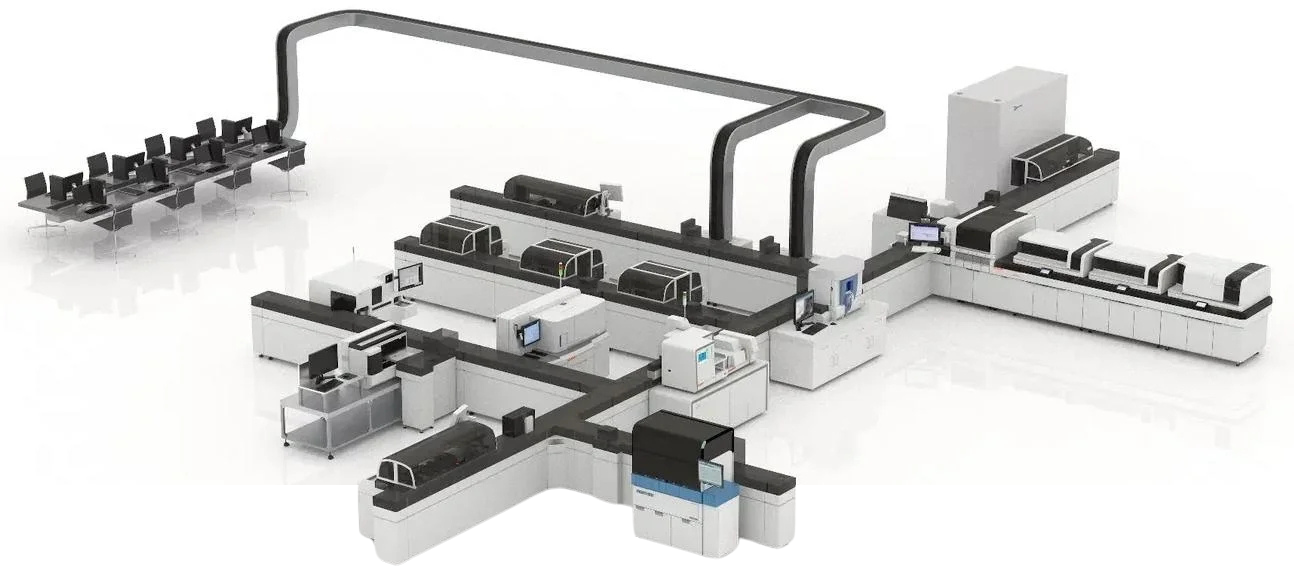
World's largest laboratory track automation

Thyrocare Technologies Limited has huge set up covering over 2 Lakh sq. ft. floor area ensures zero error processing if approx 50 thousand
specimens and over 3 lakh Clinical investigations per day is the right choice for your Blood Grouping And Rh Typing testing.

Aptio Automation

Aptio Automation

Similar Test & Packages WELLNESS
Aarogyam A Pro - Package Aarogyam B Pro - Package Aarogyam C Pro Package Aarogyam C Pro With Heart Attack Risk Package Aarogyam D Pro Package Aarogyam E Pro Package Aarogyam F Pro Package Aarogyam Female Panel Aarogyam Lite Package Aarogyam Male Package Aarogyam Mini Aarogyam Stree - Package

Ratings & Reviews

4.8 ★★★★★

Based on verified bookings

Good service

Sample collection was smooth and reports were delivered on time.