Choose your City

Routine Urine Analysis

Routine Urine Analysis is available for online booking with home sample collection.

Routine Urine Analysis

Routine Urine Analysis : Info - Procedure

Test Price
Rs. 180 (Tax included)

List of test included in Routine Urine Analysis


  • Appearance
  • Colour
  • Leucocyte esterase

View More

  • Nitrite
  • Ph
  • Specific gravity

View More

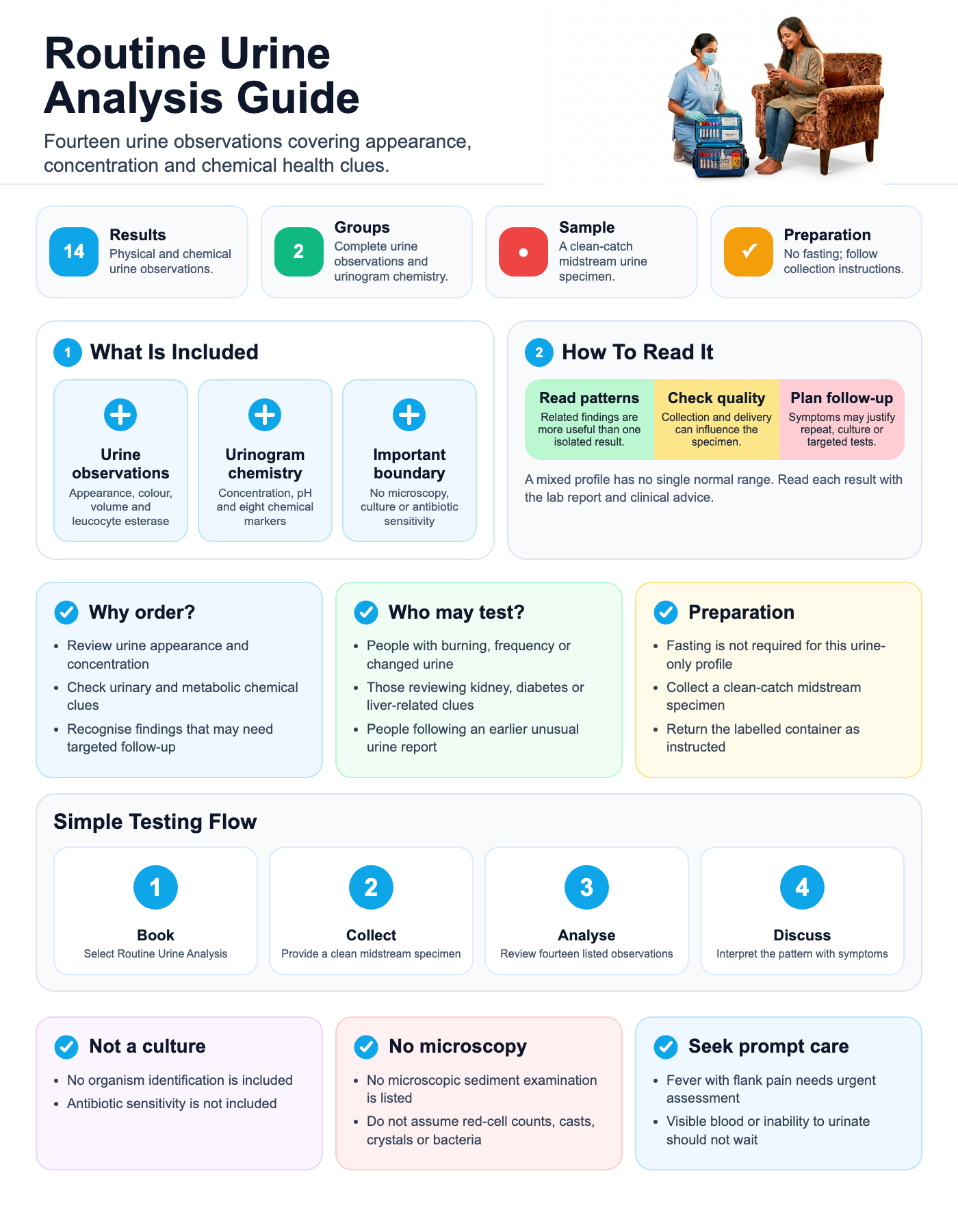
Routine Urine Analysis visual guide

Routine Urine Analysis Reference Guide

  • Routine Urine Analysis reports fourteen observations from one urine specimen.
  • The profile combines appearance, colour, volume, concentration and chemical markers.
  • It includes infection clues but does not identify organisms or antibiotic sensitivity.
  • No documented microscopic sediment examination, red-cell count, casts, crystals or bacteria are listed.
  • Read the combined pattern with symptoms, collection quality and any targeted follow-up tests.

Why This Test Is Ordered

Know exactly what this profile contains
  • The profile lists fourteen observations from a single urine specimen.
  • Four results cover appearance, colour, volume and leucocyte esterase.
  • Ten urinogram results cover concentration, acidity and selected chemical markers.
  • The listed markers include blood, protein, glucose, ketones, bilirubin and urobilinogen.
  • Nitrite, urinary leucocytes and leucocyte esterase add related infection clues.
  • No red-cell count, epithelial cells, casts, crystals or bacteria are listed.
  • Urine culture and antibiotic sensitivity are also outside this profile.
  • Knowing these boundaries prevents routine screening from being mistaken for diagnosis.
Review appearance, colour and concentration
  • Appearance records whether the submitted urine looks clear, hazy or cloudy.
  • Colour describes the visible shade present when the sample is examined.
  • Hydration can make urine lighter or darker without identifying a disease.
  • Foods, supplements and medicines may also change urine colour temporarily.
  • Specific gravity estimates whether the specimen is relatively concentrated or dilute.
  • Recent fluid intake can influence specific gravity and visible colour together.
  • The reported volume describes the submitted sample, not daily urine production.
  • Physical observations become useful only when interpreted beside symptoms and chemistry.
Look for related urinary infection clues
  • Leucocyte esterase is a chemical clue associated with white cells in urine.
  • The report separately lists urinary leucocytes, also called pus cells.
  • Nitrite can become detectable when certain urinary bacteria convert nitrate.
  • Some infection-causing organisms do not produce a positive nitrite result.
  • A negative nitrite therefore cannot exclude every urinary tract infection.
  • Urinary blood can accompany infection, stones, inflammation or other conditions.
  • Burning, urgency, fever and flank pain change how these markers are interpreted.
  • Urine culture may be needed when symptoms, recurrence or treatment response warrant it.
Use blood and protein as follow-up clues
  • The urinary blood result can detect a clue not visible to the eye.
  • Menstruation, strenuous exercise and recent procedures can influence urinary blood findings.
  • Persistent blood needs evaluation because urinary and kidney causes vary widely.
  • Urinary protein can suggest kidney filter leakage when the finding persists.
  • Dehydration, fever, exercise and stress may raise urine protein temporarily.
  • This profile does not quantify albumin or calculate an albumin-creatinine ratio.
  • It also does not measure blood creatinine or estimated filtration rate.
  • Repeat urine testing or targeted kidney tests may clarify an unexpected pattern.
Read metabolic and bile-related markers carefully
  • Urinary glucose may rise when blood glucose exceeds normal kidney handling.
  • A normal urine glucose result cannot rule out diabetes or high blood sugar.
  • Blood glucose or HbA1c testing is more appropriate for diabetes diagnosis.
  • Ketones appear when the body uses more fat as an energy source.
  • Large ketones with diabetes symptoms can signal an urgent metabolic problem.
  • Urinary bilirubin can provide an early clue to liver or bile-duct problems.
  • Urobilinogen adds related context but cannot diagnose a liver condition alone.
  • Urine pH records acidity at collection and has many non-specific influences.

Symptoms And Who Should Test

People with burning, frequency or urgency
  • Burning during urination can prompt assessment for infection or irritation.
  • Frequent urges may occur with infection, bladder conditions or increased urine production.
  • Passing only small amounts can add useful context to urinary symptoms.
  • Lower abdominal discomfort may accompany a bladder problem but remains non-specific.
  • Cloudy or strong-smelling urine can be reported alongside laboratory findings.
  • Leucocytes, esterase, nitrite and blood should be reviewed as a pattern.
  • A routine analysis cannot identify which organism may be causing symptoms.
  • Persistent symptoms may justify culture, examination or other targeted testing.
People noticing blood, foam or colour change
  • Pink, red or brown urine should be reported even when discomfort is absent.
  • Microscopic blood may be detected despite urine looking completely normal.
  • Foods and medicines can change colour, but visible blood still needs assessment.
  • Foamy urine can have harmless causes or accompany increased urinary protein.
  • Persistent protein or blood usually needs confirmation and cause-focused evaluation.
  • Menstrual or genital bleeding can contaminate the specimen and alter interpretation.
  • Blood clots, severe pain or difficulty passing urine need prompt medical attention.
  • The urine report cannot locate stones, obstruction or structural urinary problems.
People with kidney or blood-pressure risk
  • Diabetes and high blood pressure increase the importance of kidney assessment.
  • Urine protein is one clue, but a routine result has important limits.
  • Early kidney assessment commonly also uses urine albumin and estimated filtration rate.
  • This profile does not contain a urine albumin-creatinine ratio result.
  • It also does not include serum creatinine or an estimated filtration value.
  • Swelling, foamy urine or changed output should be shared with the reviewer.
  • One normal routine urinalysis cannot exclude every form of kidney disease.
  • Previous urine and blood reports help distinguish a persistent trend from variation.
People reviewing diabetes or liver clues
  • Thirst, frequent urination or unexplained weight loss may prompt diabetes testing.
  • Urinary glucose provides a clue but is less accurate than blood testing.
  • Ketones deserve careful review during diabetes, vomiting, fasting or acute illness.
  • Nausea, abdominal pain, confusion or deep breathing with ketones needs urgent care.
  • Jaundice, dark urine or pale stools may prompt liver and bile assessment.
  • Urinary bilirubin is only one measure and may require a liver blood panel.
  • Urobilinogen should be interpreted with bilirubin, symptoms and related laboratory results.
  • Routine urine chemistry cannot diagnose diabetes, ketoacidosis or liver disease alone.
People having routine or follow-up testing
  • Urinalysis may be included during checkups, pregnancy care or hospital assessment.
  • A clinician may repeat testing after an earlier unexpected urine result.
  • Repeat collection can help determine whether a finding was temporary or persistent.
  • Collection quality should be reviewed before comparing two urine reports.
  • Treatment monitoring may require tests tailored to the diagnosed condition.
  • Recurrent urinary symptoms may need culture or imaging rather than repeated screening alone.
  • Fever with back pain can suggest a more serious urinary infection.
  • Inability to urinate, severe weakness or confusion needs urgent clinical assessment.

Preparation And Interpretation Notes

Follow the verified preparation instruction
  • Fasting is not required for the current Routine Urine Analysis profile.
  • Follow stricter preparation when another booked blood test requires fasting.
  • The required specimen is urine rather than serum or whole blood.
  • Use the laboratory container supplied for this specific collection.
  • Do not transfer urine from a household jar or another unapproved container.
  • Ordinary hydration is reasonable unless a clinician gives different instructions.
  • Excessive water immediately before collection may produce a very dilute specimen.
  • Confirm instructions again if the booked package composition changes.
Collect a clean-catch midstream specimen
  • Wash and dry your hands before opening the collection container.
  • Keep fingers away from the container’s inner surface and lid interior.
  • Clean the genital area using the supplied instructions and materials.
  • Begin urinating into the toilet before moving the container into position.
  • Collect the middle part of the urine stream without touching your body.
  • Finish urinating into the toilet after collecting the required amount.
  • Close the lid firmly and keep the outside of the container clean.
  • Clean-catch technique reduces germs and cells introduced from surrounding skin.
Label and return the sample promptly
  • Check that the container carries the correct patient identification details.
  • Record collection time when the laboratory instructions ask for it.
  • Return the specimen within the laboratory’s stated delivery interval.
  • Follow the laboratory’s storage advice when immediate handover is impossible.
  • Delay can change cells, bacteria and some chemical characteristics within urine.
  • Keep the sealed container away from heat, sunlight and accidental contamination.
  • Tell the collection team if any urine spilled before the lid was secured.
  • Ask for a fresh container when sample integrity is uncertain.
Report factors that may alter findings
  • Tell the reviewer if collection occurred during a menstrual period.
  • Mention genital bleeding, discharge or bleeding haemorrhoids before interpretation.
  • List prescribed medicines, supplements and recent over-the-counter products.
  • Do not stop a prescribed medicine unless your clinician advises it.
  • Report strenuous exercise performed shortly before the urine collection.
  • Share recent fever, vomiting, diarrhoea or reduced fluid intake.
  • Mention pregnancy because symptoms, risks and follow-up choices may differ.
  • Record recent antibiotics because they can affect infection follow-up decisions.
Interpret the combined result and limits
  • Use the laboratory’s own reference labels for every reported urine marker.
  • Do not compare colour blocks or ranges from a different laboratory method.
  • Review related markers together instead of treating each as a diagnosis.
  • Match the report with symptoms, medicines, hydration and collection quality.
  • A possible infection may require culture to identify organisms and treatment options.
  • Persistent protein may require albumin measurement and kidney blood tests.
  • Persistent blood may require repeat urinalysis, imaging or specialist assessment.
  • Seek urgent care for severe symptoms rather than waiting for routine follow-up.

Frequently Asked Questions

What does Routine Urine Analysis include?

It reports fourteen physical and chemical urine observations.

Is fasting required for this profile?

No; fasting is unnecessary unless another booked test requires it.

Does this profile include urine microscopy?

No; a microscopic sediment examination is not listed.

Is Routine Urine Analysis the same as culture?

No; it does not identify organisms or antibiotic sensitivity.

Can negative nitrite rule out a UTI?

No; symptoms and other findings may still justify culture.

Can urine glucose diagnose diabetes?

No; diagnosis usually requires appropriate blood glucose testing.

Does normal urine protein exclude kidney disease?

No; urine albumin and filtration tests may still be needed.

Can menstruation affect the result?

Yes; outside blood may contaminate the urine specimen.

Can I book home urine collection?

Home collection is available where the entered address is serviceable.

How soon should I return the sample?

Follow the laboratory’s stated delivery and storage instructions.

Who should review an abnormal report?

A qualified clinician should interpret the pattern with your symptoms.

Test Conducted By

Rs. 288
Rs. 180 38% Off
Home Sample Collection Available No Extra Charges
You will Save Rs. 108 on this Test
CAP Accredited NABL Accredited UKAS Management Systems ANAB Accredited

Why Choose Thyrocare for Routine Urine Analysis

Get tested for Routine Urine Analysis at fully automated diagnostic laboratory Thyrocare which has Centralized Processing Lab (CPL)
for esoteric tests and Regional Processing Labs in major cities of India.

Home Based Diagnostics

Home Based & Quality Diagnostics
at an Unbeatable Price


Carefully designed Panels to provide you with the most vital information for your health.

Convenient Home Based

Affordable — Book Online

Certified Labs — NABL, CAP, ISO

Graphical Reports Online

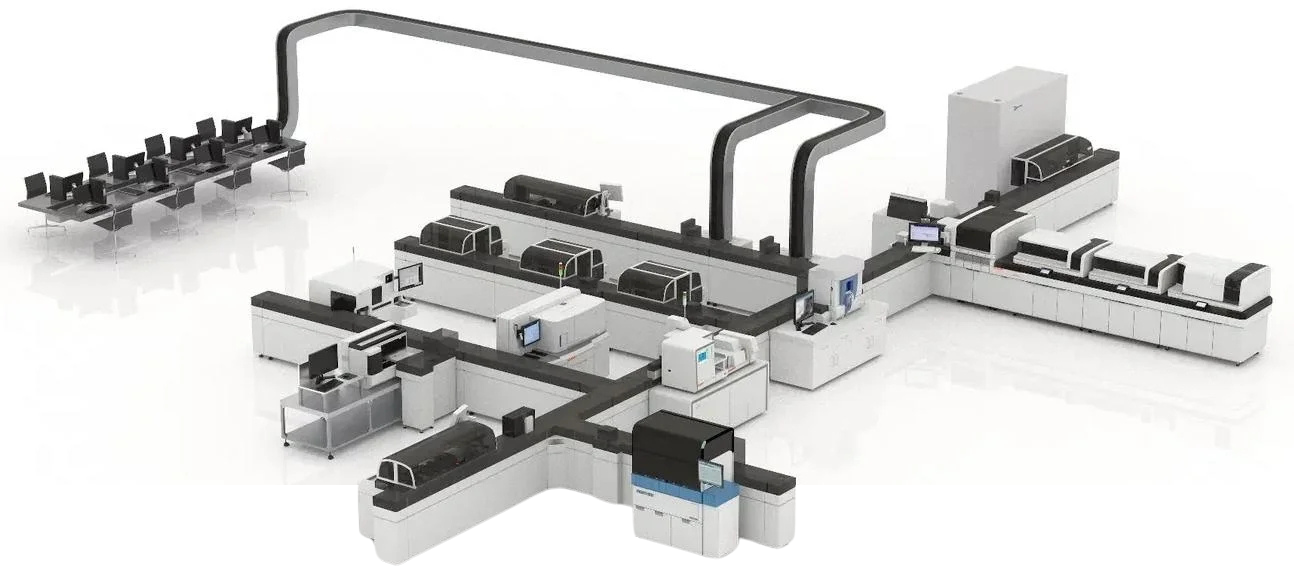
World's largest laboratory track automation

Thyrocare Technologies Limited has huge set up covering over 2 Lakh sq. ft. floor area ensures zero error processing if approx 50 thousand
specimens and over 3 lakh Clinical investigations per day is the right choice for your Routine Urine Analysis testing.

Aptio Automation

Aptio Automation

Similar Test & Packages RENAL,WELLNESS,UTI
Urinogram

Ratings & Reviews

4.8 ★★★★★

Based on verified bookings

Good service

Sample collection was smooth and reports were delivered on time.