Choose your City


The Beta Thalassemia Screening Test identifies genetic traits linked to beta thalassemia, helping assess the risk of inherited blood disorders.

Beta Thalassemia Screening Test in Jodhpur

The Beta Thalassemia Screening Test identifies genetic traits linked to beta thalassemia, helping assess the risk of inherited blood disorders.

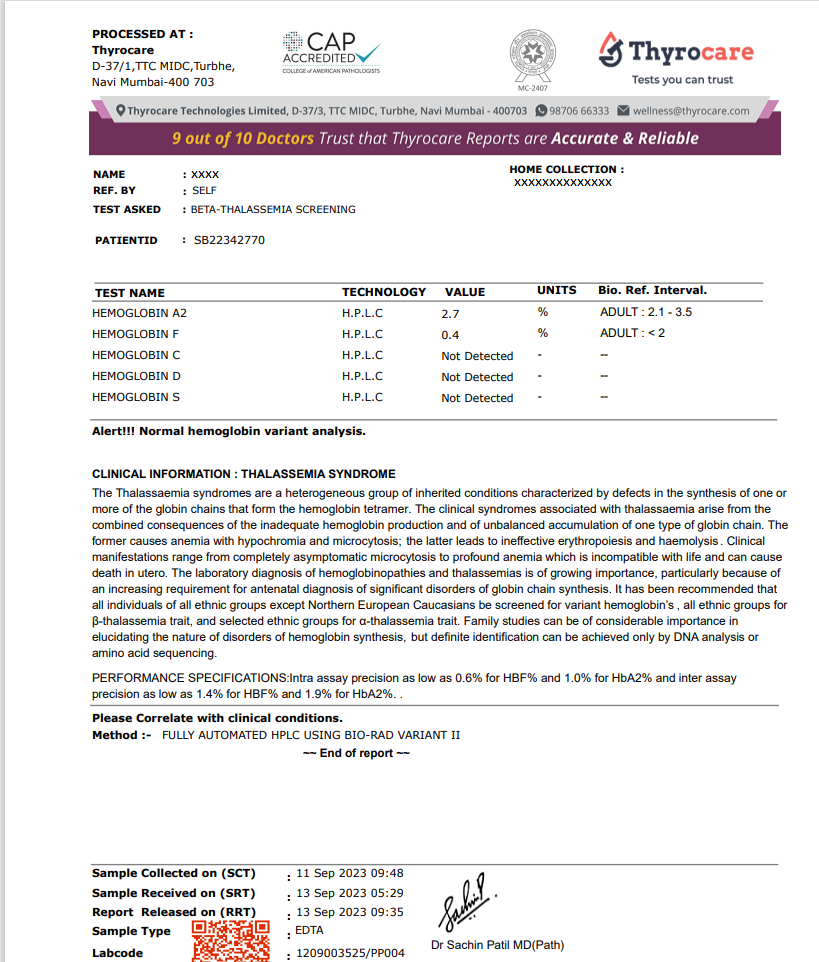
Beta Thalassemia Test Sample Report

Group Name THALASSEMIA
Fasting Fasting not required
Sample Type EDTA
Sample Collection Expert collect samples at Home
Reports Delivered Online within 24-48 Hrs*
Report type Email & Hardcopy ( On request )

Parameters Included in Beta-thalassemia Screening Test

What tests are included in the Beta-thalassemia Screening Test?


Thalassemia (5 Tests)

  • Hemoglobin a2
  • Hemoglobin c
  • Hemoglobin d
  • Hemoglobin f
  • Hemoglobin s
Beta Thalassemia Test Sample Report
Beta-thalassemia Screening Sample report & Ranges
Conducted at Thyrocare Labs
Lab Accreditation CAP, NABL, ICMR, NGSP, ISO
Method FULLY AUTOMATED HPLC USING BIO-RAD VARIANT II
TECHNOLOGY H.P.L.C
Supervision Dr Sachin Patil MD(Path)
Results Highly Specific

Our labs work 365 days / 24 x 7 to ensure your  Beta-thalassemia Screening samples reach us the same night, before midnight. We are equipped with  (MUT) -  India's first preanalytical barcoded vial sorter, Sample Sorter  &  Aptio (Siemens).

Our IT-enabled barcoded bi-directional operating systems & world-class air logistics process your blood samples within the specified time with the utmost accuracy. Once your specimen for Beta-thalassemia Screening  is collected by our phlebotomist, Your reports will be sent to your email id within 24 to 48 hours. For hard copy requests, the reports would be delivered in 3 to 5 days.  You will be informed via SMS & email once we process your report.


Beta-thalassemia Screening Sample Report & Ranges

Conducted at Thyrocare Labs
Lab Accreditation CAP, NABL, ICMR, NGSP, ISO
Method FULLY AUTOMATED HPLC USING BIO-RAD VARIANT II
TECHNOLOGY H.P.L.C
Supervision Dr Sachin Patil MD(Path)
Results Highly Specific

Our labs work 365 days / 24 x 7 to ensure your  Beta-thalassemia Screening samples reach us the same night, before midnight. We are equipped with  (MUT) -  India's first preanalytical barcoded vial sorter, Sample Sorter  &  Aptio (Siemens).

Our IT-enabled barcoded bi-directional operating systems & world-class air logistics process your blood samples within the specified time with the utmost accuracy. Once your specimen for Beta-thalassemia Screening  is collected by our phlebotomist, Your reports will be sent to your email id within 24 to 48 hours. For hard copy requests, the reports would be delivered in 3 to 5 days.  You will be informed via SMS & email once we process your report.


Beta-thalassemia Screening Sample Report

Beta-thalassemia Screening Overview

What to expect during a Beta-thalassemia Screening Blood Test?

During a Beta-thalassemia Screening blood test, a healthcare professional takes a blood sample from your arm, which is also known as venipuncture. A lab expert known as a phlebotomist conducts this process using a needle. He locates a vein on your arm and inserts the needle to draw blood. The blood sample will be transferred into a test tube and will be taken safely to the labs for the test.

The lab technicians will test the sample by following established standards, to ensure correct reports. Thyrocare Labs has a team of professionals who are skilled and experienced. After the testing is done, your reports are sent to your email within 1-2 days. On the other hand, if you need a hard copy of the report, expect the delivery of the same within 3-5 business days.

Preparations before a Beta-thalassemia Screening Blood Test?

For Beta-thalassemia Screening blood tests, special preparations are not needed. However, some important steps must be taken to ensure accuracy in the test reports.

  • Beta-thalassemia Screening test requires Fasting not, the same must be done for at least 8-10 hours. Only water can be consumed during this time. Being hydrated helps the blood draw easier and also ensures accurate results.
  • Eating junk food and consuming sweetened beverages or alcohol can alter your test results. So, it is advisable to be careful about what to consume or take the advice of a professional.
  • Consumption of certain medications is also prohibited before blood tests. You can discuss the details about the same with your doctor to be sure.
  • Avoid strenuous exercise as it can alter the readings of a blood test.

Are there any side effects of the test?

There are no side effects or risks attached to Beta-thalassemia Screening blood tests. The test involves the collection of a blood sample from your home. A phlebotomist draws blood from your arm using a needle, which only takes a few minutes. During this process, you might feel a sting on your arm, which is not painful. The blood sample will then be sent to the labs. Our medical experts take all precautions and safety measures during sample collection and testing.
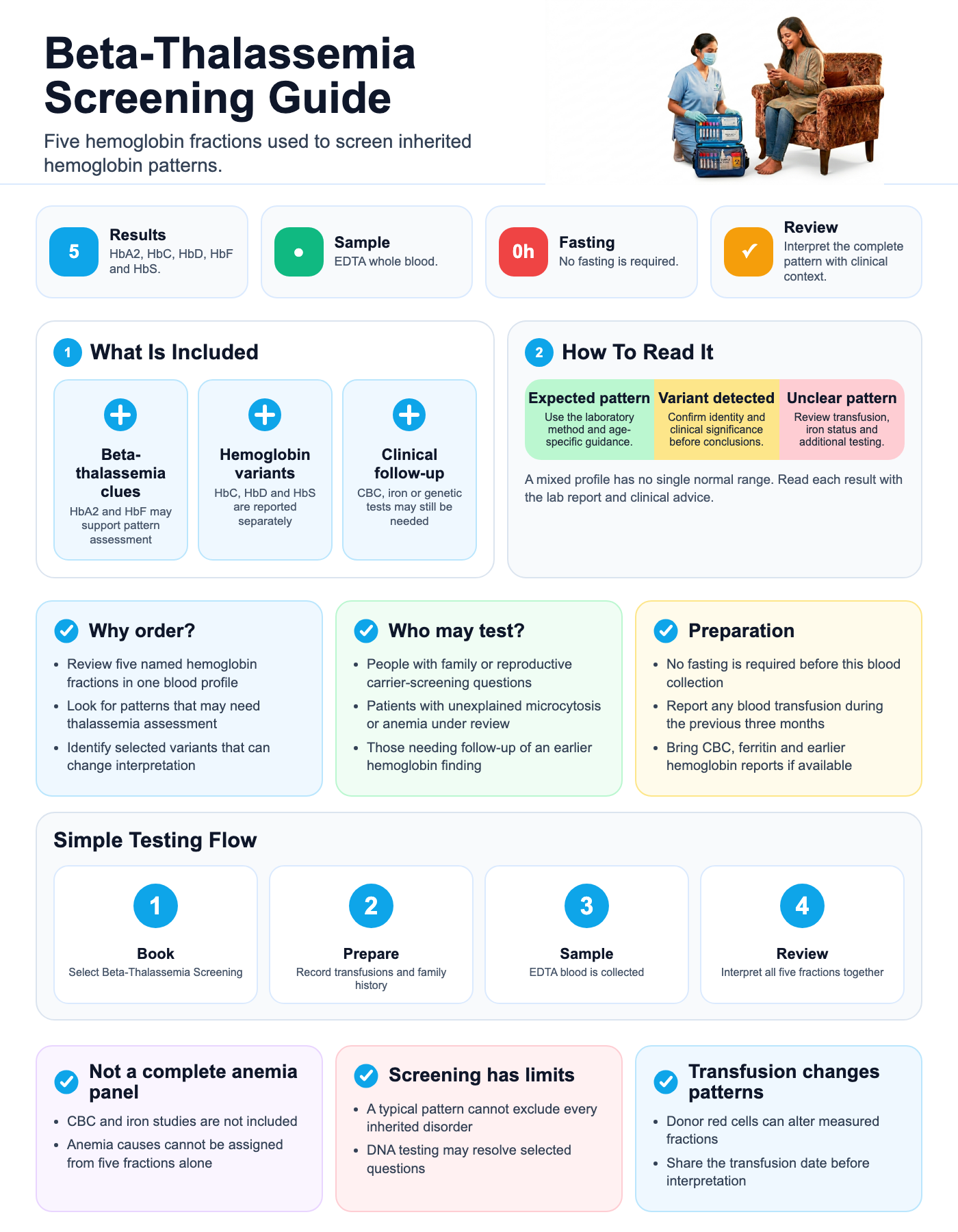
Beta Thalassemia Screening visual guide

Beta-Thalassemia Screening Reference Guide in Jodhpur

  • This profile reports five hemoglobin fractions: HbA2, HbC, HbD, HbF and HbS.
  • HbA2 and HbF can contribute to beta-thalassemia assessment, while HbC, HbD and HbS represent selected variants.
  • The package does not include a complete blood count, ferritin, iron studies, blood film or genetic testing.
  • A screening pattern must be interpreted with age, anemia findings, family history, pregnancy plans and recent transfusion history.
  • No fasting is required, but accurate clinical details are important before the report is interpreted.
  • Medical guidance stays consistent; use this page for Jodhpur pricing and collection details.

Why This Test Is Ordered

Understand the five reported fractions
  • HbA2 is a minor adult hemoglobin fraction containing delta globin chains.
  • HbF is fetal hemoglobin and normally predominates before birth.
  • HbC, HbD and HbS are selected structural hemoglobin variants.
  • The laboratory reports each named fraction as a separate result.
  • The five values form a pattern rather than five unrelated diagnoses.
  • HbA and HbE are not listed as separate results in this package.
  • CBC, ferritin, iron and molecular genetics are also not included.
  • Read the exact laboratory comments before assigning clinical meaning.
Use HbA2 as a screening clue
  • Raised HbA2 commonly supports consideration of beta-thalassemia carrier status.
  • The report-specific method and interval determine whether HbA2 is flagged.
  • HbA2 alone cannot establish the precise inherited beta-globin change.
  • Borderline values need red-cell indices, iron status and clinical context.
  • Iron deficiency can complicate interpretation of a possible carrier pattern.
  • Some hemoglobin variants can interfere with method-specific HbA2 measurement.
  • A normal-looking HbA2 does not exclude every thalassemia genotype.
  • Genetic testing may be appropriate when the clinical question remains unresolved.
Place HbF in age context
  • HbF carries oxygen during fetal life and falls after birth.
  • Infants naturally have more HbF than older children and adults.
  • Raised HbF in an adult can occur in several inherited conditions.
  • Beta-thalassemia patterns may include increased HbF alongside other findings.
  • HbF elevation is not specific enough to diagnose beta-thalassemia alone.
  • Pregnancy, treatment and selected blood disorders can alter HbF interpretation.
  • Age-specific laboratory guidance is essential for children and young infants.
  • Unexpected HbF should be reviewed with the complete hemoglobin pattern.
Recognise selected hemoglobin variants
  • HbS is associated with sickle-cell traits and diseases in different combinations.
  • HbC and HbD can also appear in carrier or compound patterns.
  • A detected fraction does not automatically distinguish trait from disease.
  • Relative proportions and companion fractions help define a likely pattern.
  • Some analytical methods cannot separate every variant with complete certainty.
  • An unexpected peak may need a second method or molecular confirmation.
  • Clinical severity cannot be predicted from one fraction percentage alone.
  • Specialist review is important when more than one variant is suspected.
Know what screening cannot prove
  • This profile is a screen for selected hemoglobin fractions, not complete genotyping.
  • Alpha-thalassemia can remain possible despite an unremarkable fraction pattern.
  • Silent or uncommon beta-globin changes may require molecular investigation.
  • The package cannot identify iron deficiency because ferritin is absent.
  • It cannot grade anemia because hemoglobin concentration and CBC are absent.
  • It cannot show red-cell size because MCV and MCH are not included.
  • A negative screen should not override a strong family or clinical history.
  • Further testing should answer the specific unresolved clinical question.

Symptoms And Who Should Test

People planning a pregnancy
  • Carrier screening may be considered before pregnancy or early in pregnancy.
  • Testing before conception allows more time for informed reproductive decisions.
  • Hemoglobin traits can be present without symptoms or obvious anemia.
  • A carrier result should prompt appropriate testing of the reproductive partner.
  • When both partners carry relevant variants, genetic counselling clarifies inheritance risk.
  • This five-result profile does not replace comprehensive molecular carrier screening.
  • Previous reports should be reviewed before repeating tests during pregnancy.
  • An obstetric clinician can select pregnancy-appropriate confirmatory testing.
People with family history
  • A known family hemoglobin disorder can justify targeted laboratory assessment.
  • Bring the affected relative’s diagnosis or genetic report when available.
  • Family labels such as anemia may not identify the actual inherited condition.
  • The relevant variant determines which relatives and partners need testing.
  • An ordinary blood count cannot identify every hemoglobin carrier state.
  • A fraction screen may narrow the question without proving the genotype.
  • Genetics professionals can explain inheritance across parents, siblings and children.
  • Testing choices should reflect the documented family condition whenever possible.
People with microcytosis or anemia
  • Small red cells can occur with iron deficiency or thalassemia traits.
  • CBC indices provide essential context that this profile does not contain.
  • Ferritin helps assess iron stores when iron deficiency is clinically possible.
  • Empirical iron should not be started solely from a thalassemia suspicion.
  • Coexisting iron deficiency and a hemoglobin trait can complicate the pattern.
  • A blood film may add morphological information in selected anemia assessments.
  • Symptoms such as fatigue are too nonspecific to identify the cause.
  • Persistent anemia requires clinician-led evaluation beyond this screening profile.
People with an earlier abnormal screen
  • An earlier variant flag may require confirmation using another analytical method.
  • Bring the complete old report rather than recalling only a fraction name.
  • Newborn screening patterns require age-specific paediatric follow-up pathways.
  • Adult reference expectations should not be applied directly to an infant.
  • Recent transfusion can produce a pattern partly reflecting donor red cells.
  • Results obtained during transfusion treatment need specialist interpretation.
  • Molecular testing may confirm an inherited change when fractions remain unclear.
  • Repeat testing should follow a defined diagnostic question and appropriate timing.
People from any ancestry
  • Hemoglobin variants occur worldwide and ancestry alone cannot exclude carrier status.
  • Beta-thalassemia is common across parts of India and several global regions.
  • Migration and mixed ancestry make appearance-based risk assumptions unreliable.
  • Family history and reproductive plans remain important across all communities.
  • Testing should be offered through informed choice rather than stigma.
  • Carrier status does not mean a person has thalassemia major.
  • Confidential handling protects people from avoidable social or employment harm.
  • Counselling should explain both health meaning and inheritance without blame.

Preparation And Interpretation Notes

Follow the collection instruction
  • Fasting is not required for the current Beta-Thalassemia Screening profile.
  • Normal meals and water may continue unless another booked test differs.
  • A trained professional collects venous blood into an EDTA tube.
  • EDTA prevents clotting so red-cell hemoglobin can be analysed.
  • Do not fast unnecessarily because fasting does not improve this fraction pattern.
  • Follow stricter instructions when the same booking includes another test.
  • Tell the collector about fainting, difficult draws or blood-thinning medicines.
  • Minor soreness or bruising can follow an ordinary venous blood draw.
Report recent transfusions
  • Tell the clinician about any red-cell transfusion during the previous twelve weeks.
  • Donor red cells can mask the patient’s own hemoglobin pattern.
  • A donor variant can also appear temporarily in the recipient’s result.
  • Record the transfusion date and number of units when known.
  • Do not hide a transfusion because the report may otherwise be misclassified.
  • The clinician may delay testing or choose a different confirmation strategy.
  • Regularly transfused patients need interpretation by their treating hematology team.
  • Earlier pre-transfusion reports can provide especially valuable comparison evidence.
Bring supporting blood reports
  • Bring recent CBC results showing hemoglobin, MCV, MCH and red-cell count.
  • Ferritin or iron studies help distinguish an overlapping iron deficiency concern.
  • Bring earlier electrophoresis, fractionation, HPLC or genetic reports if available.
  • Include newborn screening records when the question began in infancy.
  • Share any established sickle-cell, thalassemia or variant diagnosis accurately.
  • List ongoing transfusion, chelation or hemoglobin-directed treatment.
  • Pregnancy records may contain previous carrier screening worth reviewing.
  • Comparable historical results can prevent unnecessary repeat investigation.
Read the pattern carefully
  • Review HbA2, HbC, HbD, HbF and HbS together on one report.
  • Use the laboratory’s stated units, intervals and interpretive comments.
  • Do not apply an internet cutoff without checking the analytical method.
  • A small detected fraction may need confirmation before it is named.
  • Absence of a listed variant does not exclude every hemoglobin disorder.
  • Ask whether CBC and iron findings support or challenge the suspected pattern.
  • Age and transfusion history can materially change the expected fractions.
  • A hematologist can resolve discordant or compound hemoglobin patterns.
Plan safe next steps
  • Discuss an abnormal result with the clinician who requested the screen.
  • Do not start iron unless iron deficiency has been appropriately assessed.
  • Do not label a child or partner from an unconfirmed screening result.
  • Partner testing is relevant when a reproductive carrier state is confirmed.
  • Genetic counselling explains possible child outcomes without directing personal choices.
  • Molecular testing may be selected when fraction analysis remains inconclusive.
  • Urgent breathlessness, severe weakness or chest pain needs prompt medical care.
  • Routine screening must not delay assessment of significant anemia symptoms.

Frequently Asked Questions

Which results are included?

The profile reports HbA2, HbC, HbD, HbF and HbS.

Is fasting required?

No; fasting is not required for this EDTA blood test.

Does this profile include a CBC?

No; hemoglobin concentration and red-cell indices require a separate CBC.

Can it confirm beta-thalassemia trait?

It can support screening, but full interpretation may require CBC, iron or genetic testing.

Can a normal result exclude all thalassemia?

No; some thalassemia states need additional hematology or molecular assessment.

Why does recent transfusion matter?

Donor red cells can mask or alter the measured hemoglobin fractions.

Should my partner be tested?

Partner testing is appropriate when a relevant carrier state is confirmed.

Is the pattern different in babies?

Yes; infants naturally have more HbF and need age-specific interpretation.

Can I book beta-thalassemia screening in Jodhpur?

Beta-thalassemia screening in Jodhpur is available where home collection is serviceable.

Who can review this result in Jodhpur?

A qualified clinician in Jodhpur can review the complete hemoglobin pattern.

Is genetic follow-up available after testing in Jodhpur?

A clinician in Jodhpur can advise whether molecular confirmation is appropriate.

Ratings & Reviews
4.8 ★★★★★

Based on verified bookings

Good service

Sample collection was smooth and reports were delivered on time.

Health Insights & Resources
View All Blogs →
Blog Title

August 20, 2025

The Role of AI in Medical Healthcare
Read More
Blog Title

August 19, 2025

Insulin Fasting Test: Why It’s Important
Read More
Blog Title

August 18, 2025

Why Every Indian Child Should Take a Full Body Test?
Read More
Blog Title

August 17, 2025

Food Poisoning in Hindi - फूड पॉइज़निंग क्या है? कारण, लक्षण, बचाव के
Read More
Test Conducted By
Beta-thalassemia Screening Test price : Rs. 915
Rs. 572 37% Off
Home Sample Collection Available No Extra Charges
You will Save Rs. 343 on this Test
CAP Accredited NABL Accredited UKAS Management Systems ANAB Accredited
Lab Logo
Beta-thalassemia Screening Test price : Rs. 915
Rs. 572